Facebook
 Google
 GitHub
 Linkedin
Research Shorts: 6 Studies Target Semiconductors, Clean Water, and More
Whether it’s streaming speech directly from the brain or turning sunlight into clean water, these new studies aim to solve problems across healthcare, clean energy, materials science, and beyond.
The wheels of research never stop turning, with scientists from around the world reporting countless new innovations to make our world better. Today we’ll focus on six recently released studies that cover a wide range of topics, from materials science to AI-enabled brain interfaces.
AI-Enabled Speech for Paralyzed Patients
Engineers from UC Berkeley and UC San Francisco have leveraged AI models in conjunction with brain-sensing devices to stream speech directly from the brain, facilitating natural speech for people affected by paralysis. By sensing activity in the motor cortex, the AI model translates the received electrical signals into speech that, with the help of more AI and old patient voice data, can restore speech ability.

By connecting a sensor on the skull to a trained AI model, UC researchers have been able to synthesize speech in real time for paralyzed patients. Image used courtesy of UC Berkeley
While UC researchers have been developing this technology for years, this most recent breakthrough offers speech in near real-time—a significant upgrade when compared to the long latency in their previous designs. This streaming mechanism more closely mimics the natural conversation patterns of humans, enabling a better speaking experience. The researchers have also tested their algorithm using multiple datasets with different sensors, showing that different sensors can be used with the same algorithm to produce comparable results.
Nanomats Produce Clean Drinking Water and Energy
Researchers at Ohio State University have recently developed a blanket that, leveraging nanotechnology, can effectively rid water of pollutants. With the goal of turning solar energy into clean water, the blanket uses titanium dioxide, often used in solar cells, along with copper, to translate solar energy into free electrons.
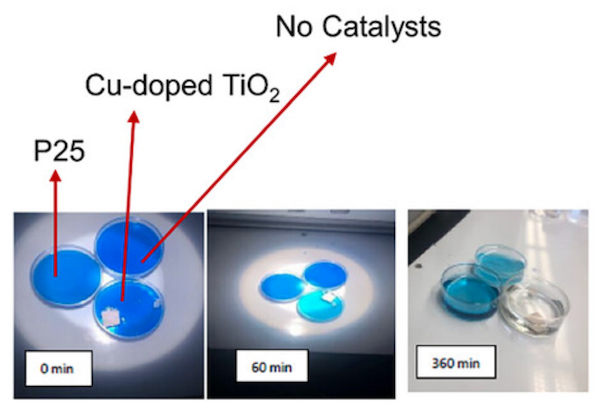
The Cu-doped nanomats offer better cleaning performance than their commercial counterparts, paving the way for environmental remediation using nanotechnology. Image used courtesy of Wiley Advanced Science
These free electrons can serve two purposes: on the one hand, they can provide clean energy, and on the other, they can be used to purify water. If, for example, the nanotech blanket is placed on a body of water, the free electrons oxidize the water molecules and attack pollutants. The researchers also found that the blanket can be used as a power generator under natural sunlight, rivaling traditional solar cell technologies.
Atom-Thick Photodetectors for Smaller Devices
Researchers from Carnegie Mellon University have recently announced the successful development of two-dimensional photodetectors. Their new devices leverage physical vapor deposition to deposit extremely thin layers of tellurium, a p-type material that exhibits high mobility and good resilience for fast semiconductors that don’t degrade in air.
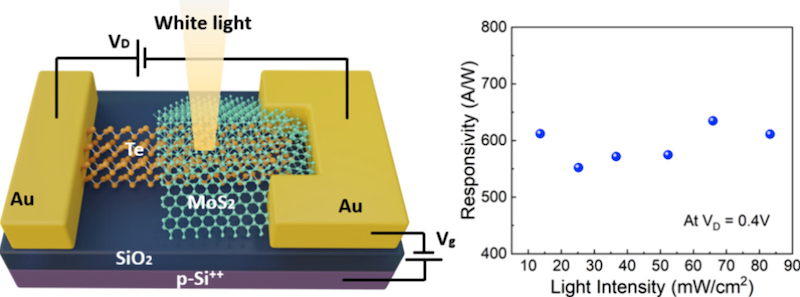
Tellurium, coupled with the ultra-thin layer sizes, makes for a fast and efficient photodetector that can have applications in a wide range of industries. Image used courtesy of ACS Applied Materials and Interfaces
While ultra-thin semiconductors may not seem like much by themselves, the ability to deposit slim layers of p-type material is a huge step forward for many industries outside photonics. Modern CMOS processes can make great use of the material to shrink feature sizes and allow for higher-performing RF and high-speed devices. Plus, thanks to the extremely small amount of material, chips can get lighter and smaller.
A New Understanding of Solid-State Batteries
Florida State University researchers have recently discovered a potential cause of solid-state battery breakdown. Solid-state batteries, as the name suggests, use a solid electrolyte instead of the traditional liquid or gel in other batteries, such as lithium-ion batteries. While this structure allows better energy density and fewer catastrophic failures, researchers have identified key gaps in our current knowledge that must be addressed.
A key failure mechanism for solid-state batteries is dendrite formation, where solid lithium needles can create short circuits within a battery. While many have theorized how and why these dendrites form, FSU’s latest research sheds more light on this complex interaction.

A volume view of a solid-state battery electrolyte highlights how dendrites (shown in blue) form and can short the terminals of the battery. Image used courtesy of Florida State University
Using a 21 Tesla MRI magnet coupled with a nuclear magnetic resonance (NMR) probe, researchers have found that dendrite formation occurs at both the electrodes (the terminals) and in the middle of the electrolyte in solid-state batteries. With their custom probes, FSU’s researchers provide all-new insight into the dynamics of solid-state batteries and bring the field one step closer to making them practical for use.
The "World’s First Kilowatt-Scale Elastocaloric Cooling Device"
Researchers from the Hong Kong University of Science and Technology (HKUST) have recently made significant steps in solid-state cooling technology using the elastocaloric effect. As climate change becomes a greater concern, many researchers have dedicated countless hours to finding greener and more efficient solutions to cooling, making HKUST’s breakthrough quite significant.
The elastocaloric effect is a complex phenomenon that describes how mechanical stress can cause changes in temperature, thereby enabling solid-state cooling. HKUST’s system uses this effect, along with a graphene nanofluid that can efficiently transfer heat from the environment to the elastocaloric material. The system then allows heat to sink away from the room.
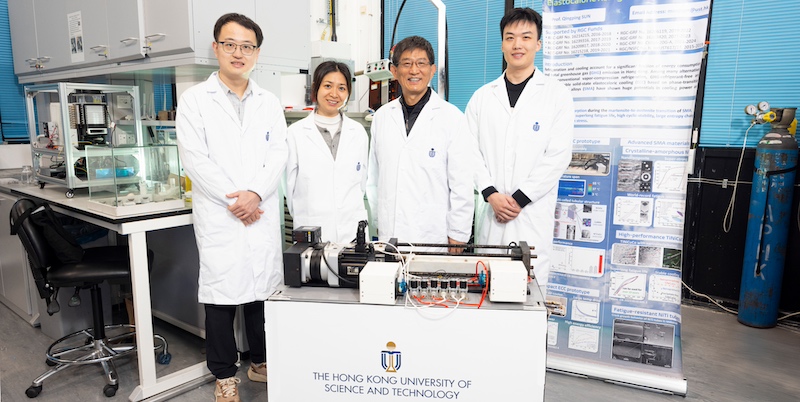
The HKUST researchers claim they have developed the "world’s first kilowatt-scale elastocaloric cooling device." Image used courtesy of Hong Kong University of Science and Technology
HKUST’s cooling device achieved a total cooling power of 1,284 W, making it practical for use in homes or offices. In addition, the specific cooling power of 12.3 W/g makes it very attractive as a green, lightweight, and efficient alternative to traditional cooling technologies.
Using Nanodrums to Understand Materials
Together with researchers from the University of Valencia and the National University of Singapore, TU Delft researchers have recently discovered how nanomaterials interact during phase transitions. As these ultra-thin structures, only a few atoms thick, undergo phase transitions, their properties can change considerably. To gain a better understanding of this change, TU Delft researchers turned to nanodrums.
Nanodrums essentially act as membranes that, when vibrated with a laser, reveal some properties of the material. By sweeping the temperature and watching for phase transitions, the TU Delft researchers gained much more insight into the material’s nonlinear properties.
“Hitting” the nanomaterial with a laser works similar to striking a drum. As the properties change, the researchers can measure the vibrations to gain more insight into the dynamics of the material.
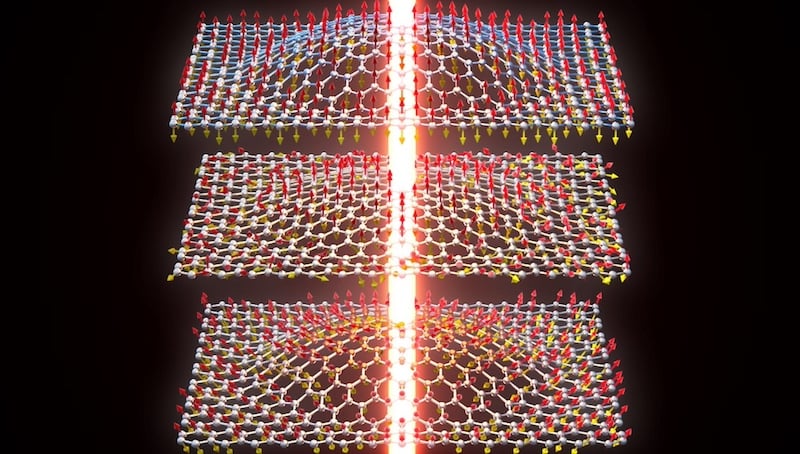
Rendering of nanodrums vibrating in response to laser light. Image used courtesy of TU Delft
This new understanding of nanomaterials makes them more useful because they are inherently highly sensitive to external forces in their environment. Knowing more about their interactions could prove to be highly useful for future sensing technology.