Facebook
 Google
 GitHub
 Linkedin
Vannevar Bush and the Engineering of American Innovation
Vannevar Bush shaped how the United States builds, funds, and thinks about technology. As both inventor and institutional architect, his work laid the foundations for digital logic, wartime research coordination, and the entire modern R&D landscape.
Before DARPA, before the National Science Foundation, before digital logic as we know it, there was Vannevar Bush. An engineer with a knack for building systems and institutions, Bush helped guide America’s technological rise in the twentieth century, shaping everything from wartime research to postwar science funding. He also helped plant the seeds of modern computing.
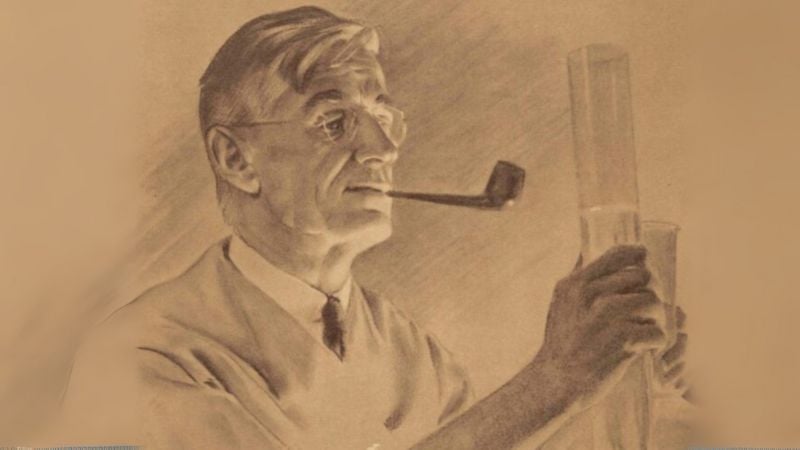
Eugene Montgomery’s portrait of engineer Vannevar Bush. Image (modified) used courtesy of the Science History Institute
From Analog Machines to the Architecture of Ideas
Born in 1890 in Everett, Massachusetts, Bush earned his undergraduate degree at Tufts before going on to complete a joint doctorate in electrical engineering at MIT and Harvard. That training would lead to an academic and industrial career spanning machine design, circuit theory, and systems-level thinking.
At MIT, Bush made early contributions to analog computing through the differential analyzer, a mechanical computer that used rotating shafts and gears to solve differential equations. While bulky and pre-digital, the analyzer allowed engineers to simulate everything from electric circuits to ballistics. The design would go on to influence military computing and inspire future work in automation.
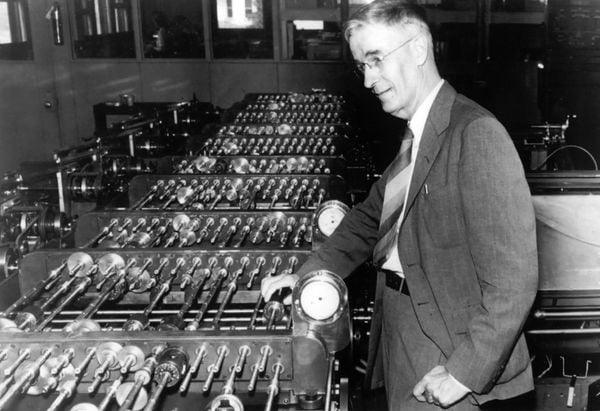
Bush’s differential analyzer, a mechanical computer that used gears and shafts to solve differential equations. Image used courtesy of the Computer History Museum
Bush’s interest in computation extended to teaching. He co-authored foundational texts on electrical engineering that standardized early circuit theory and analysis. His mentorship of Claude Shannon, who extended Bush’s analog computing work into binary logic systems, helped set the groundwork for digital design.
Bush also applied his engineering mindset to entrepreneurship. In 1922, he co-founded the American Appliance Company, which would become instrumental in microwave radar development. His ability to bridge research and real-world application made him a trusted figure in both academic and government circles by the time the U.S. entered World War II.
Coordinating the Machinery of War
As war loomed in 1940, Bush approached President Roosevelt with a proposal: Mobilize American scientists into a coordinated civilian body that could accelerate research for national defense. The result was the National Defense Research Committee (NDRC), followed by the Office of Scientific Research and Development (OSRD), which Bush directed throughout the war.
The OSRD oversaw more than 6,000 research contracts and helped develop radar, sonar, proximity fuzes, antibiotics, and other battlefield technologies. It also quietly managed the Manhattan Project, where Bush played a central administrative role, ensuring the project remained on track and adequately funded while maintaining scientific oversight.
_receives_the Atomic_Pioneers_Award.jpg)
Vannevar Bush (middle) receives the Atomic Pioneers Award with James B. Conant and Gen. Leslie Groves from President Richard Nixon in November 1969. Image used courtesy of DOE Oakridge via Wikimedia Commons (Public domain)
He also knew when to step aside. As the atomic project matured, Bush handed off direct control to military leadership, believing his role was to coordinate innovation, not weaponize it.
The Memex, and a Model for Scientific America
Bush’s influence didn’t end with the war. In 1945, he published "As We May Think", an essay imagining a device he called the memex, a desk-sized, microfilm-based knowledge system that would let users store, retrieve, and link information in nonlinear “trails of association.”
The concept anticipated features of modern computing like hypertext, contextual search, and linked data. Though analog in description, the memex marked a pivotal shift in how engineers and scientists thought about knowledge systems, less as static archives and more as interactive, associative tools.
That same year, Bush issued the report “Science, the Endless Frontier,” which argued that federally funded, university-based research was essential to American security and economic growth. This document became the blueprint for the National Science Foundation and for how the U.S. would organize and fund research in the postwar era. Nearly every major federal research program today, including NASA, NIH, and DARPA, reflects the structure Bush envisioned.
Bush died in 1974, but his influence endures wherever research meets application.
Related Content