
 Facebook
 Google
 GitHub
 Linkedin
Discrete Semiconductor Devices and Circuits
Active Loads in Amplifier Circuits
7 questions By Tony R. Kuphaldt
-
Question 1 of 7
We know that the current in a series circuit may be calculated with this formula:
$$I=\frac{E_{total}}{R_{total}}$$
We also know that the voltage dropped across any single resistor in a series circuit may be calculated with this formula:
$$E_R=IR$$
Combine these two formulae into one, in such a way that the I variable is eliminated, leaving only ER expressed in terms of Etotal, Rtotal, and R.
Reveal answer$$E_R=E_{total}(\frac{R}{R_{total}})$$
Follow-up question: algebraically manipulate this equation to solve for Etotal in terms of all the other variables. In other words, show how you could calculate for the amount of total voltage necessary to produce a specified voltage drop (ER) across a specified resistor (R), given the total circuit resistance (Rtotal).
Notes:Though this “voltage divider formula” may be found in any number of electronics reference books, your students need to understand how to algebraically manipulate the given formula to arrive at this one.
-
Question 2 of 7
Determine what will happen to the output voltage (Vout) and resistor R1‘s current (IR1) in this circuit as the resistance of R2 is increased:
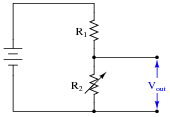
Reveal answerAs R2 increases in resistance, Vout increases and IR1 decreases.
Notes:Nothing special here - just a qualitative analysis of a very simple voltage divider circuit.
-
Question 3 of 7
Suppose we were to compare the performance of two voltage divider circuits side-by-side. The circuit on the left has one variable resistor (R2), while the circuit on the right has two variable resistors (R1 and R2). The right-hand circuit’s resistors are ganged together in such a way that as one resistance increases, the other will decrease by the same amount, keeping the circuit’s total resistance constant:
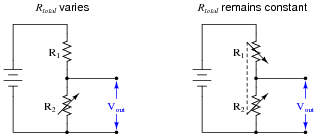
Knowing that the voltage output by a voltage divider is described by the following formula, determine which voltage divider circuit yields the greatest change in output voltage for a given change in R2‘s resistance.
$$V_{out}=V_{battery}(\frac{R_2}{R_1+R_2})$$
Reveal answerThe voltage divider with the ganged rheostats will yield the greatest change in output voltage for a given change in R2‘s resistance, because only the numerator of the fraction in the voltage divider formula changes with R2, not the denominator as well.
Follow-up question #1: what happens to the amount of current in each circuit for a given change in R2 resistance? Explain why.
Follow-up question #2: explain how a potentiometer performs the exact function as the second circuit with the two (complementarily) ganged rheostats.
Notes:Understanding the mathematical basis for the answer may be a significant leap for some students. If they experience trouble understanding how the voltage divider formula proves the answer, have them try a “thought experiment” with really simple numbers:
- •
- Initial conditions:
- R1 = 1 Ω
- R2 = 1 Ω
- Vbattery = 1 volt
Now, increase R2 from 1 Ω to 2 Ω and see which voltage divider circuit has experienced the greatest change in output voltage. Once these example quantities are placed into the respective formulae, it should become easy to see how the voltage divider formula explains the larger voltage swing of the second divider circuit.
Point out to your students that this is an example of practical problem-solving: performing a “thought experiment” with really simple quantities to numerically explore how two different systems react to change. Although there is nothing particularly difficult about this technique, many students avoid it because they think there must be some easier way (a ready-made explanation, as opposed to a thought experiment of their own) to understand the concept. Getting students over this attitude barrier is a difficult yet crucial step in them developing self-teaching ability.




