Facebook
 Google
 GitHub
 Linkedin
DC Electric Circuits
DC Generator Theory
14 questions By Tony R. Kuphaldt
-
Question 1 of 14
Generators used in battery-charging systems must be regulated so as to not overcharge the battery(ies) they are connected to. Here is a crude, relay-based voltage regulator for a DC generator:
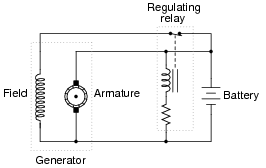
Simple electromechanical relay circuits such as this one were very common in automotive electrical systems during the 1950’s, 1960’s, and 1970’s. The fundamental principle upon which their operation is based is called negative feedback: where a system takes action to oppose any change in a certain variable. In this case, the variable is generator output voltage. Explain how the relay works to prevent the generator from overcharging the battery with excessive voltage.
Reveal answerIf the battery voltage becomes excessive, the relay opens and de-energizes the field winding. When the voltages sags back down to an acceptable level, the relay re-closes and re-energizes the field winding so that the generator can begin generating voltage again.
Challenge question: what would we have to change in this circuit to alter the generator’s voltage regulation set-point (the “target” voltage at which the generator’s output is supposed to be regulated)?
Notes:The circuit drawn here is very similar to real generator regulator circuits used in American automobiles before the advent of inexpensive, reliable semiconductor circuits. I show it here not just for historical background, but also to demonstrate how relatively crude circuits are still able to perform certain tasks reasonably well.
“Negative feedback” is one of the fundamental principles of electronics and electrical engineering. A simple system like this provides a good way to gently introduce students to this vital concept.
-
Question 2 of 14
A mechanic has an idea for upgrading the electrical system in an automobile originally designed for 6 volt operation. He wants to upgrade the 6 volt headlights, starter motor, battery, etc, to 12 volts, but wishes to retain the original 6-volt generator and regulator. Shown here is the original 6-volt electrical system:

The mechanic’s plan is to replace all the 6-volt loads with 12-volt loads, and use two 6-volt batteries connected in series, with the original (6-volt) regulator sensing voltage across only one of those batteries:

Explain how this system is supposed to work. Do you think the mechanic’s plan is practical, or are there any problems with it?
Reveal answerSo long as the generator is capable of outputting 12 volts, this system will work!
Challenge question: identify factors that may prevent the generator from outputting enough voltage with the regulator connected as shown in the last diagram.
Notes:In this question, we see a foreshadowing of op-amp theory, with the regulator’s negative feedback applied to what is essentially a voltage divider (two equal-voltage batteries being charged by the generator). The regulator circuit senses only 6 volts, but the generator outputs 12 volts.
Fundamentally, the focus of this question is negative feedback and one of its many practical applications in electrical engineering. The depth to which you discuss this concept will vary according to the students’ readiness, but it is something you should at least mention during discussion on this question.
This idea actually came from one of the readers of my textbook series
Lessons In Electric Circuits. He was trying to upgrade a vehicle from 12 volts to 24 volts, but the principle is the same. An important difference in his plan was that he was still planning on having some 12-volt loads in the vehicle (dashboard gauges, starter solenoid, etc.), with the full 24 volts supplying only the high-power loads (such as the starter motor itself):

As a challenge for your students, ask them how well they think this system would work. It is a bit more complex than the system shown in the question, due to the two different load banks.
-
Question 3 of 14
If an electric current is passed through this wire, which direction will the wire be pushed (by the interaction of the magnetic fields)?
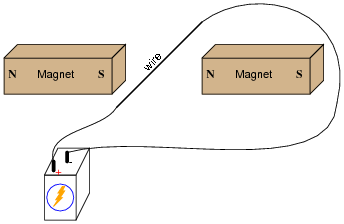
Is this an example of an electric motor or an electric generator?
Reveal answerThe wire will be pushed up in this motor example.
Notes:A visual aid to understanding the interaction of the two magnetic fields is a diagram showing the lines of flux emanating from the permanent magnets, against the circular lines of flux around the wire. Ask those students who came across similar illustrations in their research to draw a picture of this on the board in front of the class, for those who have not seen it.