Facebook
 Google
 GitHub
 Linkedin
Discrete Semiconductor Devices and Circuits
Electron Versus Conventional Flow
10 questions By Tony R. Kuphaldt
-
Question 1 of 10
In this electrical circuit, trace the direction of current through the wires:
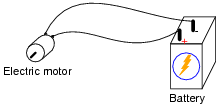
Reveal answerThis is a “trick” question, as there are two accepted ways of denoting the direction of electric current: conventional flow (sometimes called hole flow), and electron flow.
Notes:This question breaches one of the more contentious subjects in electricity/electronics: which way do we denote the direction of current? While there is no debate as to which direction electrons move through a metal conductor carrying current, there are two different conventions for denoting current travel, one of which goes in the direction of electrons and the other which goes against the direction of electrons. The reason for having these two disparate conventions is embedded in the history of electrical science, and what your students find in their research will likely fuel an interesting conversation.
-
Question 2 of 10
Show which directions these free-floating ions would move, if exposed to an electric field of the polarity shown:

Note: the “H ” ion is a positively charged hydrogen atom, while the ÖH−” ion is a negatively charged hydroxyl ion.
Reveal answer
Follow-up question: which of these metal plates would we call the cathode, and which would we call the anode?
Notes:The scenario shown is not academic - it is what happens when an electric field is applied to water. The dissociated ions move in opposite directions, liberating hydrogen gas at the negative electrode and oxygen gas at the positive.
-
Question 3 of 10
Label the directions of both electron flow and conventional flow in this simple circuit:

Reveal answer
Notes:In case anyone asks, the little circles with the letter “e” inside are supposed to represent electrons. Kind of silly, I know, but I was looking for some way of clearly distinguishing one direction from the other without just relying on the text labels.