Facebook
 Google
 GitHub
 Linkedin
Discrete Semiconductor Devices and Circuits
Signal Modulation
31 questions By Tony R. Kuphaldt
-
Question 1 of 31
A modern method of electrical power control involves inserting a fast-operating switch in-line with an electrical load, to switch power on and off to it very rapidly over time. Usually, a solid-state device such as a transistor is used:
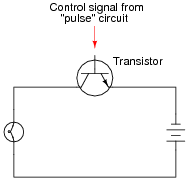
This circuit has been greatly simplified from that of a real, pulse-control power circuit. Just the transistor is shown (and not the “pulse” circuit which is needed to command it to turn on and off) for simplicity. All you need to be aware of is the fact that the transistor operates like a simple, single-pole single-throw (SPST) switch, except that it is controlled by an electrical current rather than by a mechanical force, and that it is able to switch on and off millions of times per second without wear or fatigue.
If the transistor is pulsed on and off fast enough, power to the light bulb may be varied as smoothly as if controlled by a variable resistor. However, there is very little energy wasted when using a fast-switching transistor to control electrical power, unlike when a variable resistance is used for the same task. This mode of electrical power control is commonly referred to as Pulse-Width Modulation, or PWM.
Explain why PWM power control is much more efficient than controlling load power by using a series resistance.
Reveal answerWhen the transistor is on, is acts like a closed switch: passing full load current, but dropping little voltage. Thus, its “ON” power (P = I E) dissipation is minimal. Conversely, when the transistor is off, it acts like an open switch: passing no current at all. Thus, its “OFF” power dissipation (P = I E) is zero. The power dissipated by the load (the light bulb) is the time-averaged power dissipated between “ON” and OFF” transistor cycles. Thus, load power is controlled without “wasting” power across the control device.
Notes:Students may have a hard time grasping how a light bulb may be dimmed by turning it on and off really fast. The key to understanding this concept is to realize that the transistor’s switching time must be much faster than the time it takes for the light bulb’s filament to fully heat or fully cool. The situation is analogous to throttling the speed of an automobile by rapidly “pumping” the accelerator pedal. If done slowly, the result is a varying car speed. If done rapidly enough, though, the car’s mass averages the “ON”/“OFF” cycling of the pedal and results in a nearly steady speed.
This technique is very popular in industrial power control, and is gaining popularity as an audio amplification technique (known as Class D). The benefits of minimal wasted power by the control device are many.
-
Question 2 of 31
Explain the difference between AM (Amplitude Modulation) and FM (Frequency Modulation).
Reveal answerThis is an easy question to find the answer to. I’ll leave the job to you!
Notes:Ask your students to explain which type of modulation their transmitter circuit will use, and what advantages one modulation type may have over the other.
-
Question 3 of 31
A very important concept in electronics is modulation. Explain what “modulation” means, and give one or two examples of it.
Reveal answerModulation is the act of impressing information onto an otherwise featureless stream of matter or energy, usually for the sake of communicating that information over a long distance. Radio is a very common example of modulation, but I’ll let you research a few more on your own!
Notes:There are many examples of modulation that students can find for presentation, and not all of them are electronic. Challenge them to think of scenarios other than modern electronic and/or optical communication schemes where modulation of some kind is employed.