Facebook
 Google
 GitHub
 Linkedin
Digital Circuits
Programmable Logic Technology
10 questions By Tony R. Kuphaldt
-
Question 1 of 10
Define the following acronyms as they apply to digital logic circuits:
- ASIC
- PAL
- PLA
- PLD
- CPLD
- FPGA
Reveal answer- ASIC: Application-Specific Integrated Circuit
- PAL: Programmable Array Logic
- PLA: Programmable Logic Array
- PLD: Programmable Logic Device
- CPLD: Complex Programmable Logic Device
- FPGA: Field-Programmable Gate Array
Follow-up question: now, comment on what each of these acronyms actually means, going beyond a mere recitation of the definition.
Notes:There is a veritable “alphabet soup” of acronyms in the world of programmable digital logic, and these are just a few. Going into the precise meaning of each acronym may not be the best use of time in answering this question, as there is little context in which to understand the meanings. Please do not attempt to do what so many technical courses do, and that is stuff students’ heads with acronym definitions to the neglect of actually understanding the various technologies. This question is intended only as an opening to an in-depth discussion of programmable logic, and not an end in itself!
-
Question 2 of 10
Why would anyone use programmable logic devices (PLD, PAL, PLA, CPLD, FPGA, etc.) in place of traditional “hard-wired” logic such as NAND, NOR, AND, and OR gates? Are there any applications where hard-wired logic would do a better job than a programmable device?
Reveal answerI’ll let you do the research on this one!
Notes:Ask your students to share where they found their information on programmable devices, and how they determined the advantages and disadvantages of this technology compared to hard-wired logic.
-
Question 3 of 10
Perhaps the simplest form of programmable logic is a PROM integrated circuit, programmed with a specific truth table. Take for instance this example of a 256 × 1 PROM:

Suppose we wished to program this memory IC to act as a digital comparator, outputting a logical “high” state only when two four-bit binary numbers are equal:
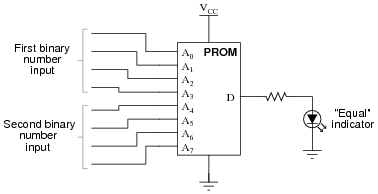
Describe what the truth table would look like for the data we must program into this memory chip. How many rows would the truth table have? Could you briefly describe the content pattern of the data without having to complete the entire truth table?
Reveal answerHere’s a clue: the truth table would only have sixteen rows with a “1” output. All other rows will be programmed with “0” outputs!
Notes:This is an example of a look-up table, whereby arbitrary data programmed into a memory circuit fulfills a logic function. If time permits, discuss with your students what other sorts of useful logic functions might be programmed into a PROM chip such as this.