
 Facebook
 Google
 GitHub
 Linkedin


2026 Design Contest using Phytec’s phyBOARD®-RT1170 Development Kit
Project submissions have ended
Design Beyond Boundaries: 2026 Embedded Design Contest with PHYTEC’s phyBOARD®-RT1170 powered by NXP
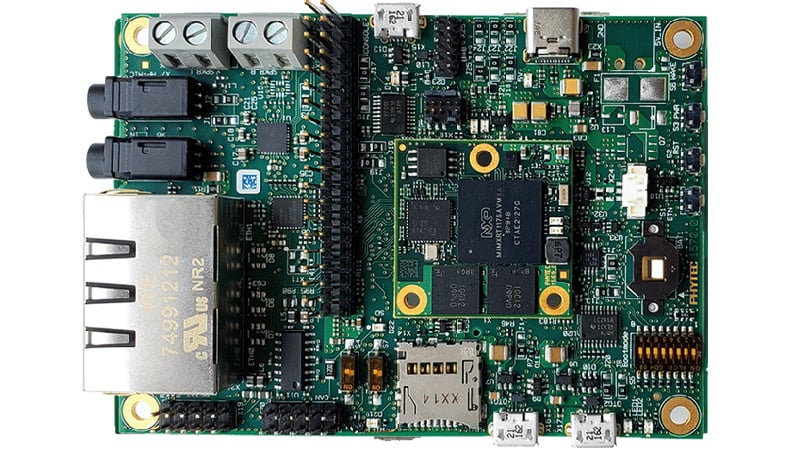
Introduction: We’re excited to launch the 2026 Embedded Design Contest—inviting developers, engineers, and innovators from around the world to unleash their creativity using the phyBOARD®-RT1170 Development Kit featuring the phyCORE®-RT1170 System on Module.
This contest is your chance to push boundaries, explore new possibilities, and showcase how high-performance real-time processing and secure embedded development can transform next-generation industrial, consumer, and IoT applications.
What will you create with the phyBOARD®-RT1170 Development Kit?
Use the link below to sign up for the contest and submit your design idea!
Register Now
The Technology
The phyBOARD®-RT1170 Development Kit features the phyCORE®-RT1170 System on Module, powered by the NXP i.MX RT1176 crossover MCU. Designed for developers who need high performance without Linux complexity, the platform combines the efficiency and simplicity of a traditional microcontroller with the advanced capabilities of an applications processor.
Built around a dual-core Cortex®-M7 and Cortex®-M4 architecture, the phyCORE®-RT1170 delivers exceptional real-time performance, multimedia support, industrial connectivity, and energy efficiency for demanding embedded designs.
At just 30 mm x 30 mm, the phyCORE®-RT1170 is the smallest connectorized SoM based on the NXP i.MX RT1170, making it ideal for space-constrained applications across industrial automation, IoT, and consumer markets.
The kit includes Zephyr OS integration to accelerate application development. In addition, the SoC provides support for advanced security features including SecureBoot, Software Bill of Materials (SBoM), and encryption.
Extensive industrial interfaces including Dual Ethernet, CAN FD, 2x USB 2.0 OTG, UART, I2C, MIPI-DSI, MIPI-CSI, audio, and JTAG provide the connectivity needed for complex embedded systems. An onboard M.2 interface also makes it easy to quickly expand the kit with additional features and wireless connectivity options. Learn more about the phyCORE®-RT1170.
Learn more about the phyCORE®-RT1170.
How to Enter
Sign up and submit your idea
Deadline: July 15, 2026
Idea review and selection
Participants are reviewed and selected based on submitted ideas
Selected participants notified
By: July 22, 2026
Development kits shipped to approved participants
July 25 – August 20, 2026
Top 20 ideas receive one phyBOARD®-RT1170 Development Kit
Project development period
Build your solution using the phyBOARD®-RT1170
Submit final project designs
Deadline: September 30, 2026
Winners announced
October 15, 2026
Key Features of the phyBOARD®-RT1170 Development Kit
• NXP i.MX RT1170 Dual-Core Cortex®-M7 + Cortex®-M4 architecture
• Zephyr OS integration with advanced embedded security features
• Compact 30 mm x 30 mm phyCORE®-RT1170 System on Module
• High-performance real-time processing with energy efficiency
• Dual Gigabit Ethernet connectivity
• 3x CAN FD interfaces for industrial communication
• MIPI-DSI and MIPI-CSI multimedia support
• M.2 connector for wireless expansion
• Extensive UART, I2C, USB, and expansion interfaces
• Ideal for industrial automation, IoT, and embedded control applications
The RT1170 is built for ideas where real-time performance, graphics, and sensor intelligence come together. It gives you a flexible foundation to explore, experiment, and turn concepts into working embedded systems whether that is an interactive interface, a connected sensing device, or something entirely new.
It also runs on Zephyr, an open-source RTOS, which means your work does not just stay within your project. It contributes back to a broader ecosystem used by developers around the world.
For inspiration, we are currently seeing strong interest in efficiency and constraint-driven design, including projects shaped by limited memory environments. One compelling direction could be taking an existing embedded application and migrating or optimizing it for the RT1170, unlocking new performance, graphics, or real-time capabilities in the process.
We have seen the RT1170 SoC used in applications such as vehicle management units and EV charger station simulations, showing what is possible when real-time control and system-level thinking come together. This challenge is your opportunity to take that foundation and build something bold, useful, and entirely your own.
Open to residents of North, Central, and South America. By registering to the contest, you agree to the Terms and Conditions.
Idea Submission Prize
phyBOARD®-RT1170 Development Kit
phyBOARD®-RT1170 Development Kit




GridSense™ – Intelligent Energy Orchestration Platform
GridSense™ is an embedded controller designed to manage and coordinate multiple energy sources including utility power, solar PV, battery storage, generators, and controllable loads. The objective is to determine energy demand, evaluate available resources, and deploy energy where it is needed while prioritizing renewable generation whenever possible.
Using the PHYTEC phyBOARD®-RT1170, the system will communicate with meters, inverters, battery management systems, and generator controllers using industrial protocols such as Modbus and Ethernet. A custom decision engine, OptiFlow™, will continuously evaluate system conditions including load demand, battery state of charge, renewable production, and source availability to make real-time energy allocation decisions.
The prototype will demonstrate renewable-first energy management, battery optimization, load prioritization, automatic failover during outages, and a web-based dashboard showing real-time energy flows and system status.
The long-term goal is to develop a scalable platform that can be deployed in residential, commercial, and industrial applications to improve energy efficiency, resiliency, and utilization of renewable resources.
Thermal Imaging Diagnostic scanner (Wand)
A thin scanner with medical thermal cameras used to track inflammation, skin infections, or circulatory blood flow blocks without touching the patient.
The vision is to develop a diagnostic thermal imaging platform, an entire interconnected ecosystem that includes the scanner combined with advanced software, mobile apps, and data-management systems that allows to analyze, store, and report on the thermal data across multiple devices.
The scanner (called as wand) connects a digital thermal sensor grid, (the Melexis MLX90640) (a 32×24 thermal pixel array), via the I²C bus. This sensor internally converts thermal radiation to temperature values and streams the data digitally. The data matrix is small enough that the Cortex-M4 can fetch it rapidly.
The Cortex-M7 takes the raw temperature matrix, uses its 2D PXP Graphics Engine to smoothly interpolate the grid from a blocky 32×24 array into a high-resolution color heat map, and blends it on the screen over a normal camera preview from the MIPI-CSI camera port
The prototype for the thermal Imaging Diagnostic Wand will be developed using PHYTEC phyBOARD-RT1170.