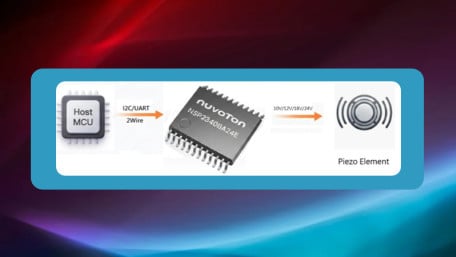
The new smart buzzer control chip enables voice, music, and sound effects via a piezo element with minimal external components.
The new smart buzzer control chip enables voice, music, and sound effects via a piezo element with minimal external components.

Learn how analog and digital circuits can implement these compression methods to improve SNR for low-amplitude voice signals.
Learn how analog and digital circuits can implement these compression methods to improve SNR for low-amplitude voice signals.

Uniform quantization adds the same noise power at every level, so SNR collapses for soft speech. See how compressing the…
Uniform quantization adds the same noise power at every level, so SNR collapses for soft speech. See how compressing the signal first makes noise track signal power and holds SNR steady.

Featuring 0.0004% THD+N and a 120 dB dynamic range, this design drives 600 Ω loads directly via a 3-wire serial…
Featuring 0.0004% THD+N and a 120 dB dynamic range, this design drives 600 Ω loads directly via a 3-wire serial interface. Zero-crossing detection ensures click-free level steps.

The aperture effect rolls off high message frequencies in flat-top PAM. Here’s how pulse duration limits that…
The aperture effect rolls off high message frequencies in flat-top PAM. Here’s how pulse duration limits that distortion to under 0.5% and when an equalizer helps.

Flat-top PAM holds each sample’s amplitude for the pulse duration, weighting the spectrum with a sinc function.…
Flat-top PAM holds each sample’s amplitude for the pulse duration, weighting the spectrum with a sinc function. Here’s how that weighting leads to the aperture effect.

Multiplying a message by a pulse train replicates its spectrum at every harmonic. See why a 1/3 duty cycle and 4x…
Multiplying a message by a pulse train replicates its spectrum at every harmonic. See why a 1/3 duty cycle and 4x oversampling stretch the bandwidth roughly 12-fold.

The Snapdragon 8 Elite Extreme Gen 6 and 8 Elite Gen 6 are the first mobile SoCs to break the 5 GHz barrier, while…
The Snapdragon 8 Elite Extreme Gen 6 and 8 Elite Gen 6 are the first mobile SoCs to break the 5 GHz barrier, while Snapdragon Sound Elite Gen 2 targets camera-equipped AI wearables.

Interference in FM grows stronger with frequency offset, until pre-emphasis flattens the curve. See why a signal just…
Interference in FM grows stronger with frequency offset, until pre-emphasis flattens the curve. See why a signal just twice as strong as a rival broadcast can completely capture the channel.

Pre-emphasis and de-emphasis boost noise performance in FM, but only up to a point—push the gain too far and you risk…
Pre-emphasis and de-emphasis boost noise performance in FM, but only up to a point—push the gain too far and you risk overmodulation.

Simple first-order pre-emphasis and de-emphasis filters can boost FM receiver SNR by more than 13 dB by exploiting the…
Simple first-order pre-emphasis and de-emphasis filters can boost FM receiver SNR by more than 13 dB by exploiting the spectral differences between signal and noise.

Worked examples quantify just how much the FMFB loop shrinks noise bandwidth. We also show how the PLL demodulator offers…
Worked examples quantify just how much the FMFB loop shrinks noise bandwidth. We also show how the PLL demodulator offers a simpler alternative for reducing threshold.

The new mic offers an 84-dBA signal-to-noise ratio and a 146-dB acoustic overload point—a 10-dB improvement over the…
The new mic offers an 84-dBA signal-to-noise ratio and a 146-dB acoustic overload point—a 10-dB improvement over the industry standard.

While feedback lowers the FM detection threshold, it offers no noise advantage over conventional receivers when the…
While feedback lowers the FM detection threshold, it offers no noise advantage over conventional receivers when the carrier power is strong. Discover why in this discussion and mathematical analysis.

This project brief describes how to build a compact, single-supply preamplifier module that converts the output of an…
This project brief describes how to build a compact, single-supply preamplifier module that converts the output of an electret microphone into a usable line-level audio signal.

By closing a feedback loop around the demodulator, the FMFB architecture narrows the noise bandwidth and lowers the FM…
By closing a feedback loop around the demodulator, the FMFB architecture narrows the noise bandwidth and lowers the FM threshold, without improving SNR at high CNR.

Working through examples shows how the threshold effect reshapes FM design choices. See how ignoring it can undershoot…
Working through examples shows how the threshold effect reshapes FM design choices. See how ignoring it can undershoot the required carrier power by over 5x for the same target SNR.

New chip weds advanced technology from Nuvoton and Klippel to create a high-performance audio solution for smart audio devices
New chip weds advanced technology from Nuvoton and Klippel to create a high-performance audio solution for smart audio devices

The ATS296X series from Actions Technology combines Ceva's High Data Throughput radio IP with Actions' own dual-RF…
The ATS296X series from Actions Technology combines Ceva's High Data Throughput radio IP with Actions' own dual-RF design, targeting links of roughly 7.5 Mbps.

The standard FM SNR equation breaks down once the carrier-to-noise ratio drops below a critical threshold, revealing a…
The standard FM SNR equation breaks down once the carrier-to-noise ratio drops below a critical threshold, revealing a hard limit on trading bandwidth for noise performance.


 Facebook
 Google
 GitHub
 Linkedin
