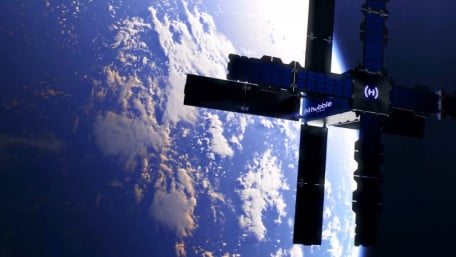
The Seattle startup has reached a $1.6 billion valuation by turning Bluetooth LE chips into globally trackable assets—all the way from space.
The Seattle startup has reached a $1.6 billion valuation by turning Bluetooth LE chips into globally trackable assets—all the way from space.

Interference in FM grows stronger with frequency offset, until pre-emphasis flattens the curve. See why a signal just…
Interference in FM grows stronger with frequency offset, until pre-emphasis flattens the curve. See why a signal just twice as strong as a rival broadcast can completely capture the channel.

Amphenol RF 2.92mm Cable Assemblies provide reliable, high-frequency connectivity for demanding RF and microwave…
Amphenol RF 2.92mm Cable Assemblies provide reliable, high-frequency connectivity for demanding RF and microwave applications, supporting operation up to 40 GHz with low VSWR and insertion loss. Watch and learn all about their features, specs, applications, and more!

The SY757xx family translates clock inputs from 1.2 to 3.3 V down to 1.2 V LVCMOS outputs at frequencies up to 250 MHz,
The SY757xx family translates clock inputs from 1.2 to 3.3 V down to 1.2 V LVCMOS outputs at frequencies up to 250 MHz,

Pre-emphasis and de-emphasis boost noise performance in FM, but only up to a point—push the gain too far and you risk…
Pre-emphasis and de-emphasis boost noise performance in FM, but only up to a point—push the gain too far and you risk overmodulation.

The DPO718AX extends the year-old 7 Series platform with eight synchronized high-bandwidth channels in a single 8U…
The DPO718AX extends the year-old 7 Series platform with eight synchronized high-bandwidth channels in a single 8U rack-mount instrument.

Simple first-order pre-emphasis and de-emphasis filters can boost FM receiver SNR by more than 13 dB by exploiting the…
Simple first-order pre-emphasis and de-emphasis filters can boost FM receiver SNR by more than 13 dB by exploiting the spectral differences between signal and noise.

Worked examples quantify just how much the FMFB loop shrinks noise bandwidth. We also show how the PLL demodulator offers…
Worked examples quantify just how much the FMFB loop shrinks noise bandwidth. We also show how the PLL demodulator offers a simpler alternative for reducing threshold.

Amphenol / SV Microwave U.FL-to-VITA Cable Assemblies, available from Mouser, provide compact, high-performance RF…
Amphenol / SV Microwave U.FL-to-VITA Cable Assemblies, available from Mouser, provide compact, high-performance RF connectivity for dense VPX plug-in cards, embedded computing systems, and precision test environments. Watch and learn all about their features, specs, applications, and more!

Scaling down RF circuit footprints requires balancing board space against critical trade-offs. Discover how loading…
Scaling down RF circuit footprints requires balancing board space against critical trade-offs. Discover how loading methods and high-dielectric substrates impact Q factor and insertion loss.

While feedback lowers the FM detection threshold, it offers no noise advantage over conventional receivers when the…
While feedback lowers the FM detection threshold, it offers no noise advantage over conventional receivers when the carrier power is strong. Discover why in this discussion and mathematical analysis.

The new devices provide compact C-band filtering options for 5G RF front-end designs from 3,300 MHz to 5,000 MHz.
The new devices provide compact C-band filtering options for 5G RF front-end designs from 3,300 MHz to 5,000 MHz.

By closing a feedback loop around the demodulator, the FMFB architecture narrows the noise bandwidth and lowers the FM…
By closing a feedback loop around the demodulator, the FMFB architecture narrows the noise bandwidth and lowers the FM threshold, without improving SNR at high CNR.

Accelerator-based computing brings faster load changes, higher current density, and tighter thermal constraints,…
Accelerator-based computing brings faster load changes, higher current density, and tighter thermal constraints, requiring updates to rectifiers, DC/DC conversion, and battery backup.

Working through examples shows how the threshold effect reshapes FM design choices. See how ignoring it can undershoot…
Working through examples shows how the threshold effect reshapes FM design choices. See how ignoring it can undershoot the required carrier power by over 5x for the same target SNR.

Joaquin Torrecilla, Keysight’s VP of Software Transformation, joins the show to discuss the evolution of wireless…
Joaquin Torrecilla, Keysight’s VP of Software Transformation, joins the show to discuss the evolution of wireless tech—from early Bluetooth to LEO satellite lasers, RedCap, and AI-native 6G.

The standard FM SNR equation breaks down once the carrier-to-noise ratio drops below a critical threshold, revealing a…
The standard FM SNR equation breaks down once the carrier-to-noise ratio drops below a critical threshold, revealing a hard limit on trading bandwidth for noise performance.

The FCE870X and FME170X share the same high-end feature set across two package formats, giving product teams a choice…
The FCE870X and FME170X share the same high-end feature set across two package formats, giving product teams a choice between embedded and modular designs.

Deriving a general signal-to-noise expression for frequency modulation with any message signal reveals a core trade-off:…
Deriving a general signal-to-noise expression for frequency modulation with any message signal reveals a core trade-off: more deviation buys better noise performance, but only by using more bandwidth.

This article explores how combining signal and noise power reveals how the FM system’s output SNR scales with carrier…
This article explores how combining signal and noise power reveals how the FM system’s output SNR scales with carrier amplitude and modulation index.


 Facebook
 Google
 GitHub
 Linkedin