Facebook
 Google
 GitHub
 Linkedin
Broadcom Unveils Integrated Wi-Fi 8- and 50G PON Gateway-ICs for the AI Era
Broadcom’s high-integration Wi-Fi 8 & NPU-accelerated 50G PON gateway SoCs aim to build a cohesive, 50 Gbps broadband access ecosystem for the AI-infused home.
Broadcom has expanded its network edge infrastructure ecosystem with a dual rollout of products designed to handle next-generation residential and service provider demands. Today, the company announced a new "5th Wave" trio of highly integrated Wi-Fi 8 systems-on-chip (SoCs)—the BCM6772, BCM6774, and BCM6776—tailored for high-performance home mesh networks and multi-gigabit Ethernet routers.
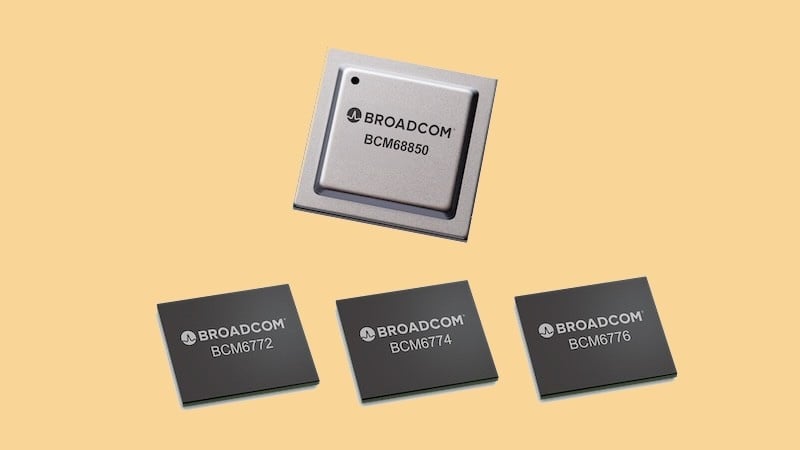
Broadcom’s new BCM68850 50G ITU-PON home gateway SoC (above), and its three new Wi-Fi 8 SoCs, the BCM6772, BCM6774, and BCM6776 (below).
Alongside those devices, yesterday Broadcom debuted the BCM68850, claiming it as the industry's first 50G ITU-PON home gateway SoC equipped with a dedicated neural processing unit (NPU) for local Edge AI workloads.
By launching these platforms concurrently, the chipmaker targets both sides of the residential broadband equation, ensuring that the local wireless link can keep up as service providers push backhaul connections up to 50 Gbps.
To learn more about these new products, I was pleased to interview Broadcom experts on both sets of devices. For the 50G PON SoC, I spoke with Jim Muth, a Senior Manager of Product Marketing for Broadcom's Wireless Broadband Communications Division, and Chris Szymanski, a Director of Product Marketing for Broadcom's Wireless Communications and Connectivity Division. And for the new Wi-Fi 8 SoCs, I talked with Kevin Narimatsu, Associate Director of Product Marketing for the Wireless Broadband Communications Division at Broadcom and Gabe Desjardins, a Director of Product Marketing at Broadcom.
BCM68850: Unlocking 50G PON and Edge AI
As homes evolve into edge-compute nodes running always-on autonomous AI agents, multi-stream ultra-HD telepresence, and intensive cloud-sync tasks, the backhaul gateway demands massive throughput headroom. Broadcom's BCM68850 answers this requirement by offering full 50G symmetric ITU-T PON performance.
“This is a key device that can become the hub for the AI-infused home," says Jim Muth.
The platform operates on a rapid "burst and release" data handling technique: it processes and transmits high-density payloads in fractions of a millisecond before instantly freeing the fiber channel for subsequent data packets. This mechanism protects the shared fiber strand from node congestion and guarantees the near zero-jitter performance needed for latency-critical applications.
Muth explains this node protection capability, "When you have multiple users sharing the same fiber link, you want to be able to have the node have the protection to be able to absorb data spikes without adversely affecting the other users that are actually taking advantage of that shared network," says Muth.
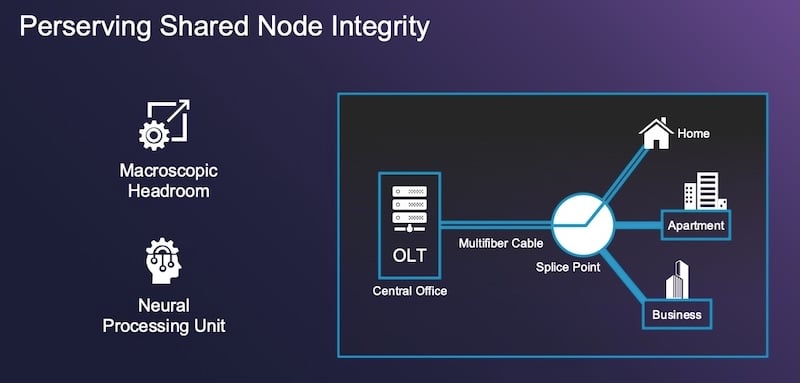
Node protection capability in the BCM68850 is all about preserving shared node integrity in a network.
Beyond backhaul bandwidth, the BCM68850 integrates an on-premises Neural Engine. This dedicated hardware NPU accelerates local Edge AI inference workloads. By shifting processing away from the cloud, the design enhances user data privacy by keeping sensitive information on-premises while cutting overall response latency. The neural core operates alongside a distinct High-Performance Application Engine tailored to host third-party operator applications utilizing standard open middleware.
The 50G PON gateway SoC also includes several structural optimizations:
- Native compatibility across current Wi-Fi 8 specifications.
- Intelligent self-healing engines that handle real-time anomaly detection and predictive bandwidth optimization to minimize operator OpEx.
- Advanced security primitives, including hardware-level Post-Quantum Cryptography (PQC) blocks, to protect aging infrastructure nodes from next-generation mathematical decryption tools.
The BCM68850 completes an end-to-end 50G pipe across the access layer, building a direct technical ecosystem that bridges Broadcom's BCM68660 OLT in the central office to the consumer premises via either the standalone BCM55050 ONT or the BCM68850 CPE gateway.
From Modular Complexity to Integrated Efficiency
Historically, deploying early iterations of advanced network protocols like Wi-Fi 8 has required complex, multi-chip architectures suited for enterprise access points or specialized broadband gateways. For wide-scale adoption in consumer markets, hardware design teams require streamlined alternatives that minimize manufacturing costs, board space, and thermal budgets.
To address this layout challenge, Broadcom’s BCM677x family consolidates critical discrete components into a unified system on a single die:
- An integrated high-performance quad-core CPU complex handles primary operations.
- A dedicated Network Processing Engine offloads packet-routing tasks to protect CPU headroom.
- Tightly coupled 2.4-GHz and 5-GHz Wi-Fi 8 radios run on-premises alongside a multi-gigabit Ethernet PHY layer.
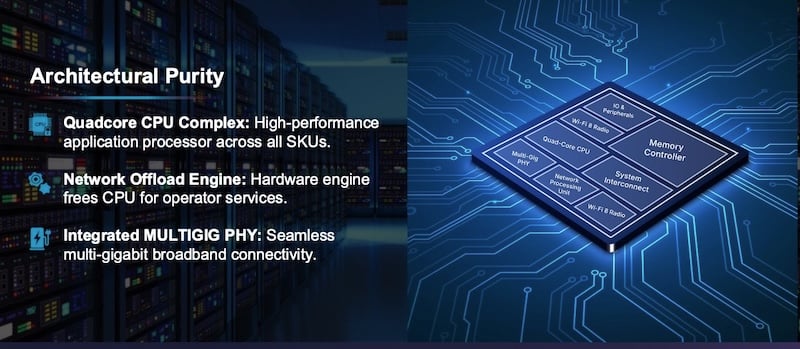
The high-level of integration of the BCM677x family SoCs are critical to serving the mass market.
Tighter hardware integration simplifies two primary system architectures:
- High-Performance Mesh Nodes: Minimizing the component count and overall heat signature allows original equipment manufacturers (OEMs) to fabricate compact, aesthetically minded mesh nodes. These can be distributed flexibly throughout a home without risking thermal throttling or dropping wireless coverage bounds.
- Multi-Gigabit Routing Engine: Native support for multi-gigabit WAN and LAN interfaces ensures that the local wireless network never bottlenecks expanding fiber-to-the-home (FTTH) connections.
The integration is a significant part of the story, "Because we want to serve the mass market and high-volume SKUs, the integration becomes critical,” says Narimatsu. “So here, in this BCM677x family, we integrate the CPU complex, and dual-band radios. We also have a network offload engine for packet acceleration, and then the multi-gig PHY."
Gabe Desjardins positions the family versus the competition. "The key thing here is that this is really a mass-market play,” he says. “We're coming in with higher specs than the other players and lower prices, so we're seeing a lot of interest in this."
Breakdown of the BCM677x Wi-Fi 8 Portfolio
The new product family is segmented to give system designers an optimized cost-performance tradeoff spanning mass-market extenders up to flagship retail platforms:
- BCM6772: Serving as the core foundation for mass-market Ethernet routers, extenders, and repeaters, the chip integrates a 2x2 2.4-GHz and 2x2 5-GHz radio layout. The silicon includes a versatile memory controller supporting DDR4 and DDR5 memory and resides in an ultra-compact 15x15 mm FCBGA package.
- BCM6774: Optimized for high-volume residential routers and extenders, this variant steps up the wireless subsystem to a 2x2 2.4-GHz and 4x4 5-GHz radio configuration. It shares the identical DDR4/DDR5 memory controller and tight 15x15 mm FCBGA footprint as the base model.
- BCM6776: Designed for premium tri-band router implementations when paired with an external BCM6718 radio, this chip integrates a 2x2 2.4-GHz and 4x4 5-GHz radio architecture. It incorporates dual PCIe Gen3 controllers and expands its versatile memory controller to support DDR4, DDR5, LPDDR4, and LPDDR5 within a 19 mm x19 mm FCBGA package.
To reduce external component demands, all three chips utilize on-chip 2.4-GHz power amplifiers (iPAs). Furthermore, Broadcom has implemented its third-generation digital pre-distortion (DPD) tech across the family, a move that drastically scales back power consumption inside the highly demanding 5-GHz band.
As Kevin Narimatsu explains, it’s the quick and low latency access to AI that’s the important aspect. It's not just about peak bandwidth, it’s about being able to service the data very quickly,” says Narimatsu. “That enables AI/ML applications to be utilized in a way that is good for the user. We think about AI applications that are like Marvel’s Jarvis AI, where you want to be able to interact live with a language model and having that low latency becomes critical."
Sampling and Market Alignment
Broadcom is currently sampling both the BCM677x Wi-Fi 8 family and the BCM68850/BCM55050 50G PON platforms to its early access partners and customers. According to division management, the concurrent delivery of integrated access silicon and NPU-accelerated backhaul elements gives operators an optimized, technically cohesive framework to protect and maximize hardware lifecycles through the incoming Wi-Fi 8 deployment cycle.
All images used courtesy of Broadcom.