Facebook
 Google
 GitHub
 Linkedin
Mesh AI: Node-Level Intelligence with Non-Cellular 5G/6G Connectivity
Learn how LM Semi's Mesh AI platform delivers autonomous, secure, node-level intelligence via non-cellular NR+ mesh networks, addressing AI scalability for billions of devices.
The rapid evolution of artificial intelligence has followed a familiar trajectory: from centralized compute in the cloud, to distributed processing at the edge, and now toward a new paradigm—node-level inference at massive scale.
As AI systems increasingly interact with the physical world, the limiting factors are no longer compute performance alone, but connectivity, latency, power efficiency, and security across billions of devices. Last Mile Semiconductor (LM Semi), headquartered in Dresden, Germany, is positioning itself—at the center of this transition—with a new class of system-on-chip (SoC) platforms purpose-built for Mesh AI.
Conventional AI architectures rely heavily on centralized cloud resources for inference, orchestration, and model updates. While effective for large language models and data-intensive analytics, cloud-centric approaches introduce latency, bandwidth costs, and systemic fragility—particularly in environments that demand deterministic response times and continuous operation.

Smart City applications are an example where 5G NR+ and Mesh AI technologies meet design needs. Image used courtesy of Adobe Stock (licensed).
Industrial automation, smart energy systems, defense, and critical infrastructure increasingly require AI systems that can operate autonomously, even when disconnected from the cloud.
Edge AI to Node AI
LM Semi frames this shift as the progression from Edge AI to Node AI, where intelligence is embedded directly within each connected device. These nodes operate as cooperative agents within self-healing, non-cellular mesh networks, enabling local decision-making combined with collective system intelligence.
At the foundation of LM Semi’s architecture is the license-free 1.9 GHz NR+ standard, introduced in 2021. Unlike traditional cellular technologies, NR+ removes spectrum licensing costs while avoiding congestion and interference common to unlicensed ISM bands. This creates a connectivity layer optimized for private, large-scale deployments, offering kilometer-scale range, predictable latency, and sufficient throughput for distributed AI inference.
The LM10XX from LM Semi is designed as a low-cost, highly integrated SoC optimized for massive deployments of intelligent nodes. The RISC-V based SoC combines real-time processing, AI inference, and long-range mesh connectivity into a single chip. Integrated AI acceleration enables inference tasks such as anomaly detection, predictive maintenance, sensor fusion, and localized decision-making to be executed directly on the device. This approach reduces dependence on cloud connectivity while improving responsiveness and system resilience.
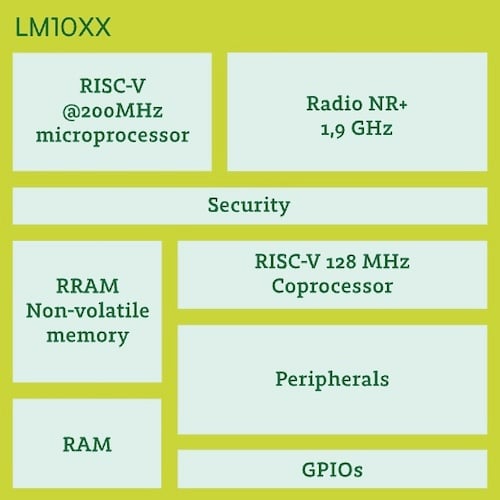
Block diagram of the RISC-V-based LM10XX SoC. Image used courtesy of Last Mile Semiconductor.
Ultra-low-power operation is a defining characteristic of the LM10XX. The SoC is engineered for battery-powered and energy-harvesting deployments, allowing nodes to remain active for extended periods without maintenance. This capability is essential for industrial IoT and infrastructure environments where physical access is limited or costly.
Security: Foundational Silicon Capability
Security is treated as a foundational silicon capability rather than an add-on. LM Semi embeds a secure element directly into its SoCs, establishing a hardware root of trust for device identity, secure boot, encrypted communications, and protected key storage. This architecture supports secure onboarding, authenticated updates, and long-term lifecycle management of deployed devices.
This security foundation also enables a dual revenue model. Customers purchase silicon while subscribing to guaranteed ongoing optimization, software updates, and AI-as-a-Service capabilities delivered securely on top of the hardware over its operational lifetime.
A defining characteristic of LM Semi’s vision is the concept of self-healing mesh networks. Each node functions as both a compute engine and a network participant, dynamically routing data, sharing inference results, and adapting to failures without centralized coordination. This distributed intelligence eliminates single points of failure and enables organic scaling as networks grow.
The Needs of Smart Applications
LM Semi’s platforms address professional and consumer markets including industrial IoT, smart energy, smart buildings, smart cities, and advanced smart home systems. Across these domains, the technical value proposition remains consistent: local intelligence, private and scalable connectivity, ultra-low-power operation, and security integrated at the silicon level.
It could be said that Last Mile Semiconductor is not simply delivering another edge AI chipset. It is defining a new architectural layer for ubiquitous node-level intelligence, built on license-free spectrum, mesh networking, and tightly integrated AI acceleration. By collapsing compute, connectivity, and security into a unified silicon platform, LM Semi addresses one of the central challenges of the coming decade: deploying AI safely, efficiently, and autonomously across billions of connected devices.