Facebook
 Google
 GitHub
 Linkedin
AI-RAN: The Technology Pushing Mobile Networks Toward AI-Native 6G
AI-RAN integrates AI workloads directly into cellular network infrastructure. Industry leaders, including Nvidia, Nokia, Ericsson, Intel, Keysight, and Samsung, are now collaborating to move the concept from research toward real-world deployment.
At Mobile World Congress in Barcelona, much of the discussion centered on AI-RAN, an emerging architecture that integrates artificial intelligence directly into the radio access network.
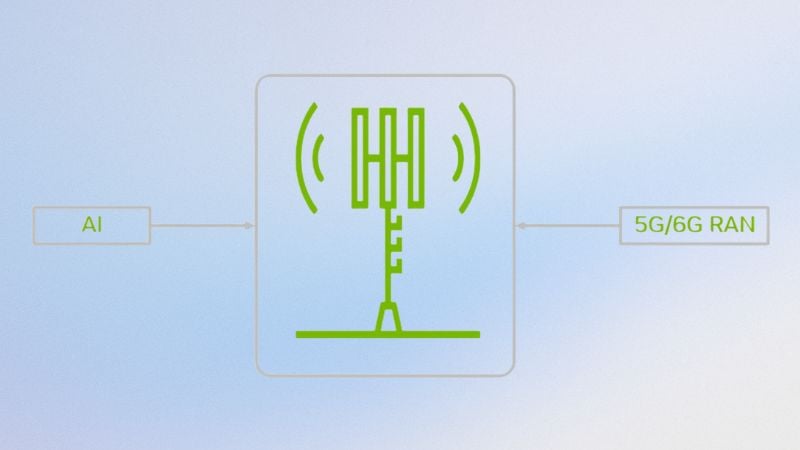
AI-RAN.
Instead of treating AI workloads and cellular infrastructure as separate systems, AI-RAN aims to enable both to run on the same computing platform, opening the door to more efficient networks and new AI-powered services.
What AI-RAN Actually Means
AI-RAN refers to artificial intelligence radio access networks. The idea is to bring AI capabilities directly into the systems that operate cellular infrastructure.
In traditional networks, RAN equipment has relied on specialized hardware built specifically for radio processing. AI-RAN moves away from that model. It relies on general-purpose accelerated computing platforms that can run both cellular network workloads and AI models simultaneously. In practice, this means the same infrastructure can support traditional RAN functions while also running AI applications.
The architecture typically follows cloud-native principles, such as containerized workloads, dynamic scaling, and shared computing resources. By using a unified computing platform, operators can shift unused RAN capacity toward AI processing tasks when network demand is low. That flexibility allows networks to generate additional value from infrastructure that might otherwise sit idle.
Three Ways AI Is Being Integrated Into RAN
The AI-RAN Alliance describes three primary domains where artificial intelligence is being integrated into the radio access network. The first is AI-and-RAN, which focuses on running AI workloads and radio processing on shared infrastructure. This approach improves infrastructure utilization while allowing operators to host new AI services directly on network hardware.
The second area is AI-for-RAN. In this case, machine learning models are embedded directly into radio signal processing functions. These models can improve spectral efficiency, signal quality, and network performance by optimizing the use of radio resources.
The third domain is AI-on-RAN, in which the network edge serves as a platform for delivering AI services. Running AI workloads closer to users reduces latency and allows new applications to operate in real time. Together, these three domains shift the RAN's role from a single-purpose connectivity layer to a distributed computing platform.
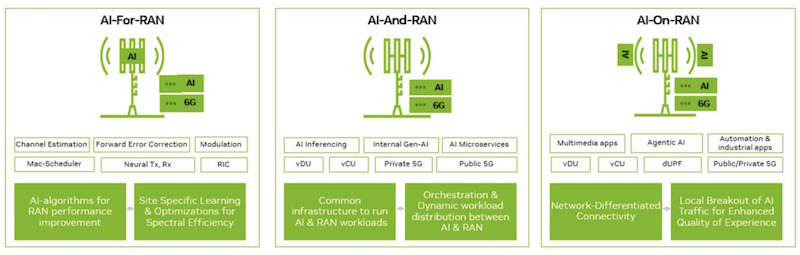
Conceptual diagram showing the three domains of AI-RAN integration: AI-for-RAN, AI-and-RAN, and AI-on-RAN.
Why Telecom Companies Are Interested in AI-RAN
The telecom industry is exploring AI-RAN largely because of two growing challenges. Network traffic continues to increase, driven in part by AI-powered applications, while infrastructure utilization often remains relatively low. AI-RAN attempts to address both issues. By allowing AI workloads and network functions to share infrastructure, operators can better utilize existing resources. At the same time, running AI services on network infrastructure opens potential new revenue opportunities beyond basic connectivity.
Advances in AI-based radio signal processing are also showing promising results compared to traditional techniques. Early research suggests that machine learning models can improve spectral efficiency and coverage, allowing operators to deliver better performance without adding new spectrum or cell sites.
Industry Collaboration Around AI-RAN
A number of major telecommunications and technology companies are now working together to advance AI-RAN development.
Nokia and Nvidia recently demonstrated AI-RAN capabilities with several network operators, including T-Mobile, Indosat Ooredoo Hutchison, and SoftBank. These demonstrations showed that AI workloads and radio access network processing could run concurrently on GPU-accelerated platforms. In one trial, Nokia’s AirScale Massive MIMO radio supported devices performing tasks such as video streaming and AI-generated captioning while running on a shared accelerated computing platform. The test demonstrated how radio functions and AI workloads could operate together within the same infrastructure.
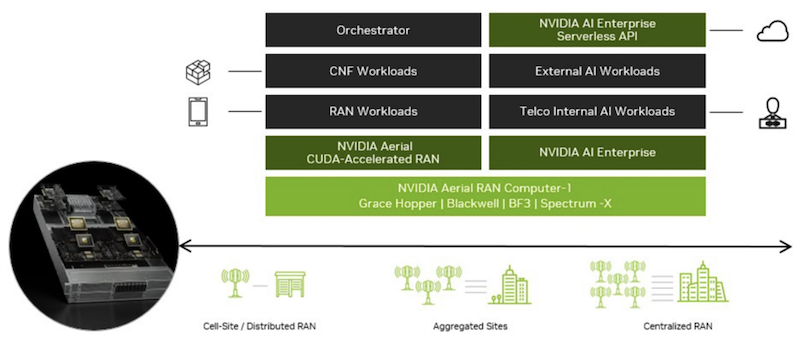
Reference architecture illustrating how AI and RAN workloads can run concurrently on a shared accelerated computing platform within AI-RAN infrastructure.
Other operators, including BT, Elisa, NTT DOCOMO, and Vodafone, are also exploring AI-RAN architectures built on Nvidia's Aerial platform as part of their long-term evolution toward AI-native networks.
A Broader Ecosystem Is Forming
AI-RAN development is also expanding through a broader ecosystem of infrastructure providers and technology vendors.
Companies such as Dell Technologies, Quanta, Supermicro, and Red Hat are contributing server platforms, networking infrastructure, and cloud orchestration tools designed to support AI-RAN deployments. These components are typically built on commercial-off-the-shelf hardware rather than on proprietary telecom equipment.
Keysight, Samsung, and Nvidia are also working together on AI-RAN validation tools designed to help engineers test AI-driven radio functions before deployment. Their demonstration at Mobile World Congress showed how AI models for RAN signal processing can be trained, tested, and benchmarked in a single automated workflow.
The Path Toward AI-Native 6G
As research into sixth-generation cellular technology accelerates, many companies see AI-RAN as a key architectural step toward future networks. Ericsson and Intel recently announced a collaboration focused on AI-native network infrastructure designed to support future 6G deployments. Their work spans compute architectures, cloud platforms, and network technologies intended to support both AI workloads and cellular connectivity.
The broader vision behind AI-RAN is that future wireless networks will function as distributed computing platforms capable of supporting AI-driven services, autonomous systems, and real-time data processing across billions of connected devices.
If those efforts succeed, the radio access network could evolve from a single-purpose connectivity layer into a foundational computing infrastructure for the AI era.
All images used courtesy of Nvidia.
Related Content