Facebook
 Google
 GitHub
 Linkedin
Google Moonshot Company Taara Debuts ‘Radical’ Silicon Photonics Platform
Taara Photonics integrates 1,000+ light emitters in a finger-sized module, enabling electronic beam steering without mechanical parts.
Taara, a former Google X Moonshot project now operating as an independent company, recently announced Taara Photonics, marking what the company calls the world's first commercial wireless communications platform based on optical phased arrays.
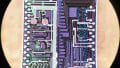
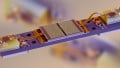
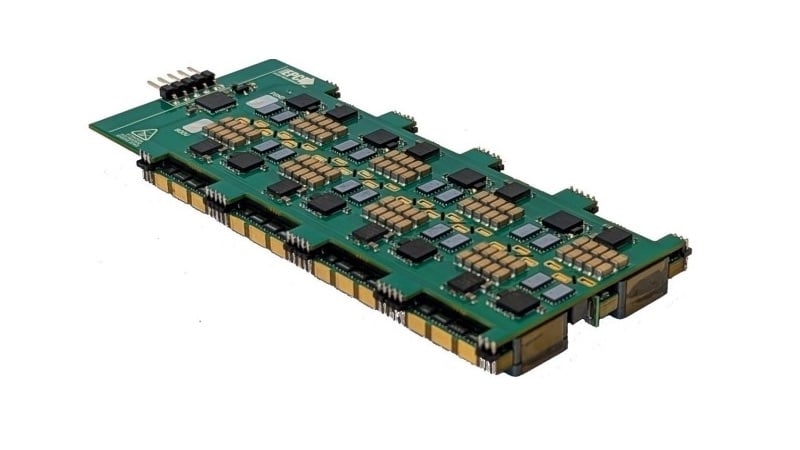
Taara claims its photonics platform can shrink wireless communications systems into a finger-sized photonic module.
The Sunnyvale-based startup simultaneously unveiled Taara Beam, the platform's debut product delivering 25-Gbps connectivity over six-mile distances using invisible near-infrared light beams transmitted through the air.
Representing a fundamental shift from mechanical free-space optical systems to solid-state silicon photonics, the announcement addresses deployment bottlenecks in fiber infrastructure and spectrum scarcity in wireless networks. CEO Mahesh Krishnaswamy will demonstrate the technology at Mobile World Congress Barcelona 2026 on March 2.
From Stratospheric Balloons to Ground-Based Photonics
Taara's technology traces back to Project Loon, Google X's stratospheric balloon internet initiative that attempted to deliver connectivity from 66,000 feet using high-altitude balloons. The Loon team developed free-space optical communications to connect balloons, successfully beaming data between floating platforms in the upper atmosphere. When Loon shut down in 2021 after failing to achieve commercial viability, Krishnaswamy and his engineering team recognized the terrestrial potential of the optical technology they had refined.
The team established Project Taara within X from 2014 to 2019, applying lessons learned from linking balloons to ground-based connectivity challenges. This "moonshot composting" approach, as X.com CEO Astro Teller describes it, allowed the team to repurpose optical communications technology for scenarios where fiber trenching proves impractical or prohibitively expensive.
Taara graduated from X as an independent company in March 2025, backed by Alphabet and Series X Capital. The company has since deployed its first-generation Lightbridge system in more than 20 countries with carriers including T-Mobile, Airtel, SoftBank, and Digicel.
Optical Phased Arrays Replace Mechanical Steering
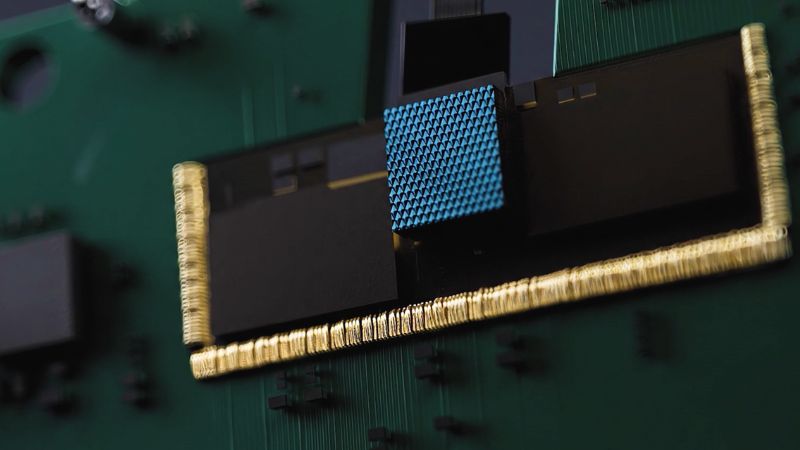
Taara Photonics integrates the core functionality of wireless optical communications into a silicon photonics module measuring roughly the size of a finger. At its core sits an optical phased array containing more than 1,000 miniature light emitters that electronically track, shape, and steer beams of near-infrared light at 1,535–1,565 nanometer wavelengths—the same spectrum used in fiber-optic cables. This eliminates the mirrors, sensors, and mechanical hardware required by traditional free-space optical systems, including Taara's own Lightbridge product.
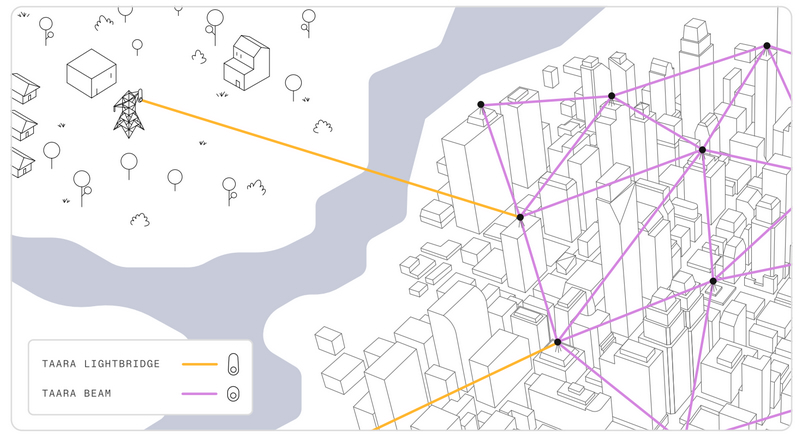
Taara Lightbridge vs. Taara Beam coverage.
The platform operates in unlicensed optical spectrum, avoiding both the congestion plaguing radiofrequency bands and the recurring licensing costs associated with traditional wireless technologies. Taara developed the proprietary optical phased arrays over several years at X and in its own laboratories following the spinout.
Taara Beam Specifications and Deployment Scenarios
Taara Beam, the first commercial product built on the photonics platform, delivers bidirectional throughput of up to 25 Gbps over distances of up to 6.2 miles, with 50-microsecond latency. The shoebox-sized unit weighs 50% less than Lightbridge while occupying half the physical footprint. Deployment requires only hours rather than the weeks or months associated with fiber trenching, as installers can mount units on rooftops, utility poles, or existing infrastructure without securing right-of-way permits or spectrum licenses.
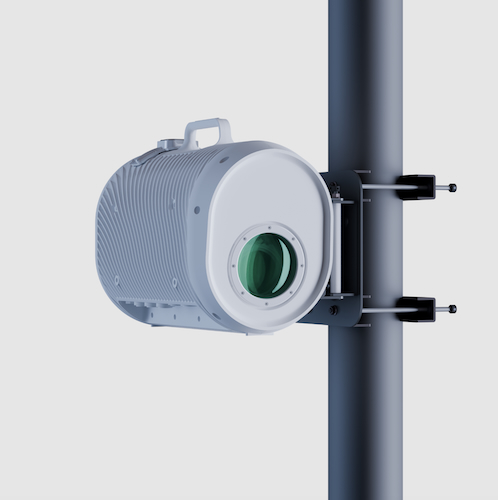
Taara Beam.
Target applications include urban backhaul networks, enterprise campus connectivity, data center interconnects, temporary event coverage, and mesh network formations. The platform enables small-cell backhaul mounted on street furniture, fronthaul networks, and AI infrastructure requiring low-latency, high-bandwidth connections. By comparison, Lightbridge offers 20 Gbps speeds over 20-kilometer distances but relies on mechanical beam-steering systems that measure 2.5 feet tall.
Taara implies that the photonics platform could address AI infrastructure buildout demands, noting that global data center expenditure is projected to reach $7 trillion by 2030. The company emphasizes deployment timelines measured in hours, not the several months typically required for fiber installations, and that it’s designed to complement wired infrastructure rather than replace it.