Facebook
 Google
 GitHub
 Linkedin
R&S and Realtek Validate First Test Setup for BLE High Data Throughput
Rohde & Schwarz and Realtek have demonstrated a test solution for the upcoming Bluetooth LE High Data Throughput (HDT) feature that can enable verification of data rates up to 7.5 Mbps.
Rohde & Schwarz (R&S) and Realtek Semiconductors have demonstrated what they describe as the first test solution for the upcoming Bluetooth Low Energy (LE) High Data Throughput (HDT) feature. The setup uses the R&S CMP180 radio communication tester to verify next-generation Bluetooth chips that support significantly higher wireless data rates.
At Embedded World 2026, All About Circuits spoke to Hagen Heggenberger, R&S senior product manager of mobile radio testers, to learn more about the news.
_and_RS’s_Hagen_Heggenberger.jpeg)
All About Circuits’ Jeff Child (left) and R&S’s Hagen Heggenberger at Embedded World. The R&S CMP180 radio communication tester (shown) was used for Bluetooth LE HDT validation.
Test Equipment for the Forthcoming Spec
Heggenberger explained the background behind the demo.
“The Bluetooth LE High Data Throughput is not released yet. It will be released in the October timeframe,” he said. “But we can do the measurements because we are members of the Bluetooth SIG, and therefore know the spec.”
“The new spec is far enough along that chipset vendors can produce chipsets, and they therefore need test equipment, which we are providing.”
With all that in mind, R&S and Realtek created a demo to test the new HDT spec's functionality.
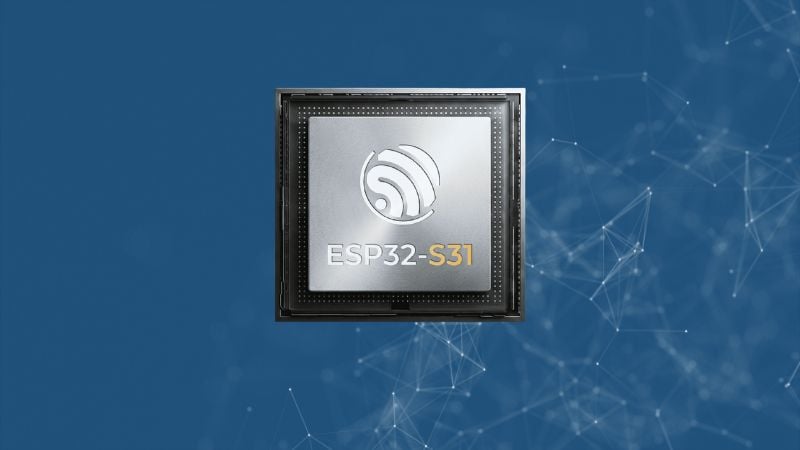
The test system was validated using Realtek’s RTL8922D Wi-Fi/Bluetooth combo chip and the RTL8773J Bluetooth audio SoC. Together with the CMP180 tester, the platform allows engineers to characterize Bluetooth LE HDT performance during development, validation, and production testing as the specification moves toward adoption.
Why Bluetooth LE High Data Throughput Matters
Bluetooth has become the dominant short-range wireless technology for personal devices, wearables, and IoT systems, with billions of devices shipping each year. As applications continue to expand—from wireless audio and smart home devices to over-the-air updates, data throughput has become a growing limitation.
The upcoming Bluetooth LE High Data Throughput feature addresses the increasing maximum data rate from 2 Mbps to 7.5 Mbps—a significant jump for the low-power wireless standard. That improvement allows Bluetooth LE to support more demanding use cases such as low-latency audio streaming, faster file transfers, and accelerated firmware updates.
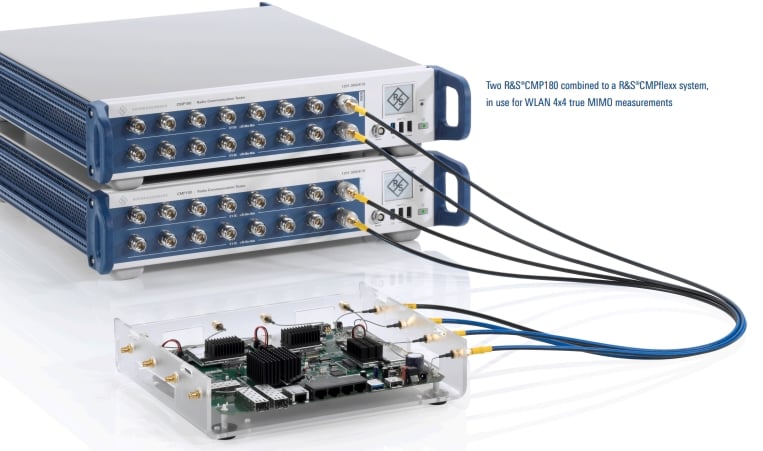
Two CMP180 units are configured for advanced wireless device testing.
Technically, the HDT capability introduces multiple new data rates ranging from 2 Mbps to 7.5 Mbps. These higher speeds are achieved through new modulation schemes and different levels of forward error correction, which together improve spectrum efficiency and overall link reliability.
Test Platform for Development and Production
To validate the new HDT capability, Rohde & Schwarz used its CMP180 radio communication tester, a non-signaling test platform designed for wireless device development and production. The CMP180 supports frequencies up to 8 GHz and bandwidths up to 500 MHz, enabling engineers to evaluate both cellular and non-cellular wireless technologies, such as Wi-Fi, Bluetooth, and 5G.
The instrument includes two vector signal analyzers, two generators, and up to 16 RF ports for simultaneous testing of multiple devices or radio chains. These capabilities are particularly useful when verifying new wireless standards like Bluetooth LE HDT, where developers must measure signal performance, throughput, and modulation behavior throughout the product lifecycle, from early engineering validation to design validation and production testing.
“We call this a ‘communication tester’ for R&D and for production,” said Heggenberger. “It is used in the development of the chipsets. The big chipset vendors for Wi-Fi, Bluetooth, and even for Wi-Fi 8, are using our test equipment, the CMP180, in their R&D efforts for the development of their chips.”
Realtek’s Multi-Protocol Wireless Platform
The HDT testing setup uses Realtek’s RTL8922D Wi-Fi/Bluetooth combo chip alongside the RTL8773J Bluetooth audio processor. Together, they form a platform designed to support next-generation wireless connectivity and audio applications.
A key feature of the RTL8922D is its ability to integrate multiple wireless technologies on a single chip. In addition to Bluetooth LE HDT, the RTL8922D will support Wi-Fi and IEEE 802.15.4 networking technologies, including Zigbee and Thread. This level of integration allows a single device to manage several wireless protocols simultaneously, which is increasingly important for smart homes, consumer electronics, and IoT systems. Devices like smart TVs, PCs, automotive infotainment systems, and connected appliances often rely on multiple wireless standards operating together.
Wireless Testing Across the Product Lifecycle
Before wireless devices hit the market, they go through a few key testing stages: engineering validation (EVT), design validation (DVT), production validation (PVT), and, finally, a few last checks in manufacturing. Each step is about making sure the device works well, performs reliably, and meets the necessary RF standards as it moves from early models to mass production.
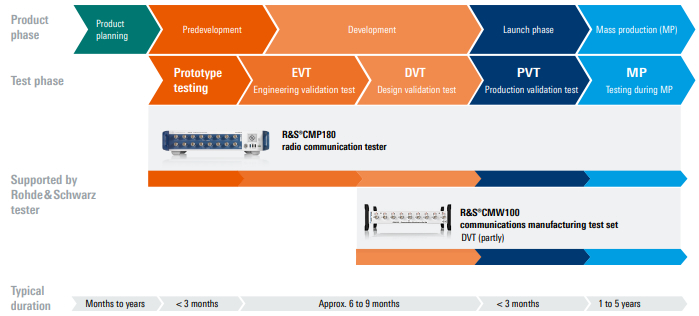
CMP180 supports wireless testing from prototype validation through mass production.
The CMP180 platform is designed to support all of these stages within a single test environment. Using the same measurement system throughout development helps engineers maintain consistent testing methods and avoid switching tools as products mature. This becomes especially important as modern wireless devices integrate multiple radios, antennas, and protocols into increasingly complex RF architectures.
As Bluetooth continues to evolve with higher data rates and new capabilities, having a reliable test infrastructure becomes critical. Platforms like the CMP180 allow engineers to validate new features such as Bluetooth LE High Data Throughput while supporting development from early design work through mass production.
All images used courtesy of Rohde & Schwarz, unless otherwise specified.