Facebook
 Google
 GitHub
 Linkedin
NXP Launches Tiny Applications Processor Blending AI NPU and Tri-Radio
NXP claims that this device represents the first time an applications processor has combined a dedicated AI NPU with tri-radio wireless connectivity.
At Embedded World 2026, NXP Semiconductors expanded its i.MX series by introducing the i.MX 93W applications processor. The i.MX 93W combines a dedicated Neural Processing Unit (NPU) with a secure tri-radio wireless subsystem in one package. It supports physical AI applications, which require local machine learning and low-latency connectivity to enable autonomous decision-making in industrial and consumer edge devices.
All About Circuits spoke with Kyle Fox, NXP’s senior director of i.MX processors, to learn about the i.MX 93W firsthand.

Kyle Fox presents the i.MX 93W at Embedded World 2026 in Nuremberg, Germany.
Combining Compute and Connectivity
The i.MX 93W consolidates heterogeneous compute resources and a wireless stack into a single chip. Specifically, it features a dual-core Arm Cortex-A55 processor running at up to 1.7 GHz, paired with an Arm Cortex-M33 real-time core for low-power system management and sensor hub tasks.
Its tri-radio subsystem supports Wi-Fi 6 (802.11ax), Bluetooth Low Energy (BLE) 5.4, and an IEEE 802.15.4 PHY to support protocols such as Matter and Thread. An internal arbiter coordinates traffic across both 2.4-GHz and 5-GHz bands in real time to prevent interference between high-bandwidth Wi-Fi data and time-sensitive packets.
NXP claims that this chip is the first of its kind to have such a connectivity suite in the same package as an NPU-equipped applications processor. According to the company, consolidating these radios into a single package helps customers avoid multi-chip board layouts, reduce signal deterioration, and ease radio coexistence management.
“We're trying to get as close to 'just-add-water' wireless deployment as you can get,” Fox said.
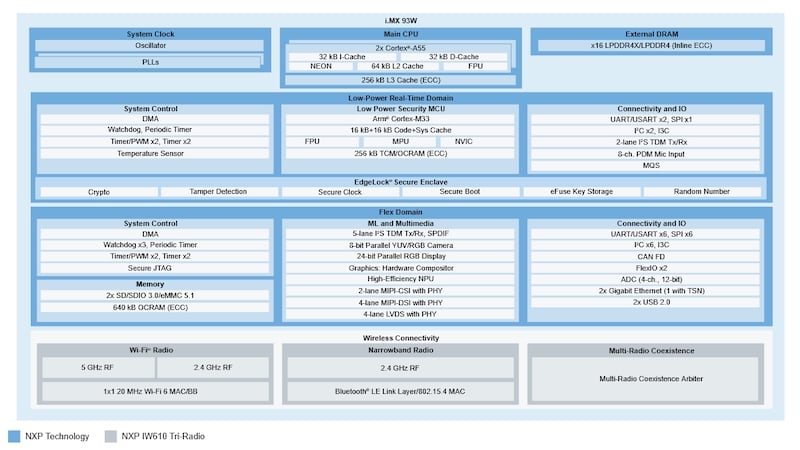
Internal block diagram of the i.MX 93W. Image used courtesy of NXP
For use cases concerning physical AI, the i.MX 93W features a built-in NXP eIQ Neutron NPU. By offloading machine learning workloads from CPU cores, the NPU is intended to process data locally and minimize wireless data traffic. For example, the system can detect objects and communicate only via the tri-radio system when it detects state changes.
“Most customers don't need a giant ChatGPT-qualified transformer,” Fox said. “They need an AI agent that is absolutely a genius at the data that we have.”
Performance and Hardware Security
On the memory side, the i.MX 93W features 640 KB of on-chip RAM with Error Correction Code (ECC) to enforce data integrity in industrial environments. It also includes multimedia capabilities, such as a 2D graphics hardware compositor, MIPI-CSI camera interfaces, and MIPI-DSI or LVDS display outputs.
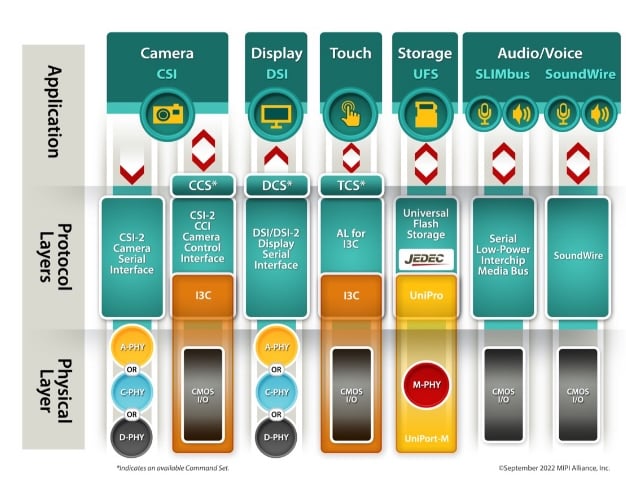
MIPI-DSI application stack. Image used courtesy of MIPI Alliance
Security is managed via the EdgeLock Secure Enclave, a pre-configured, self-contained security subsystem that provides a root of trust and handles cryptographic functions and secure boot. This hardware-level security is designed to protect the AI models stored on the device and the wireless communication channels. The secure enclave also verifies that over-the-air updates delivered via the integrated Wi-Fi 6 radio are authenticated and encrypted, preventing unauthorized firmware changes.
Reducing BOM Complexity and Development Timelines
Beyond its hardware features, the i.MX 93W is meant to reduce BOM complexity and save board area. According to NXP, a comparable discrete design would require an application processor, a separate Wi-Fi and Bluetooth module, an 802.15.4 radio, and up to 60 discrete parts.
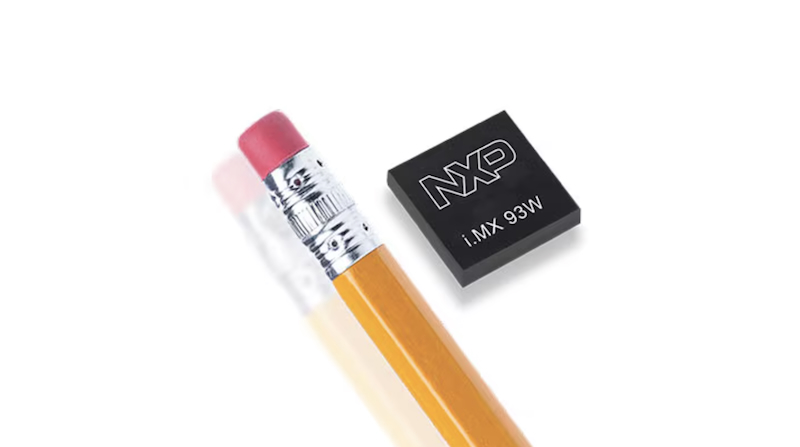
The i.MX 93W comes in a 14.2 mm x 12 mm flip‑chip chip‑scale package (FCCSP). Image used courtesy of NXP
Beyond saving area, NXP also seeks to simplify high-speed signal routing between the application processor and the Wi-Fi 6 radio. To that end, the company offers pre-certified single- and dual-antenna reference designs that have already been validated for regulatory compliance across multiple global regions. NXP claims that this validation lets customers avoid much of the RF tuning and certification process for their own products and ultimately bring products to market faster.
Future Outlook and Availability
When all is said and done, edge device longevity will ultimately be as important as its performance.
"This is a fully industrial-qualified 10- and 15-year longevity part,” Fox said. “We're seeing all of these customers say, ‘We want to do AI, we want to do wireless, but we need a trusted partner that knows industrial, that knows longevity.'"
NXP expects to fill that gap, with i.MX 93W samples coming to customers in the second half of 2026.