
 Facebook
 Google
 GitHub
 Linkedin
Industry White Paper
Advanced Power, Control, and Connectivity Solutions for Drone Embedded Systems
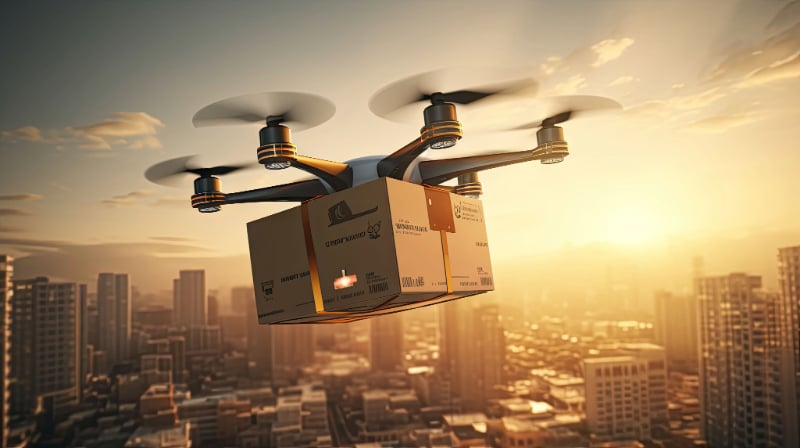
Modern drones are no longer simple radio-controlled aircraft, but compact electromechanical systems that integrate propulsion, power conversion, sensing, real-time control, communication, imaging, diagnostics, and safety functions.
Introduction
In industrial UAVs, the main engineering objective is to maximize flight time and payload capacity while minimizing weight, thermal losses, and wiring complexity. As a result, power distribution and internal communication are fundamental parts of the system architecture. Propulsion, sensing, communication, and payload electronics must all operate efficiently and reliably from a common battery source.
The UAV market is growing as drones provide measurable value in applications such as infrastructure inspection, precision agriculture, construction mapping, emergency response, environmental monitoring, logistics, and security. Different missions require different platforms. Multi-rotor drones are preferred for hovering, vertical takeoff and landing, and operation in confined spaces. Fixed-wing drones offer better cruise efficiency and wider area coverage for long-range missions. Single-rotor platforms support higher payloads but add mechanical complexity, while hybrid VTOL systems combine vertical launch with fixed-wing endurance.
Despite these differences, most drone platforms share similar electronic requirements. Propulsion demands high-current switching and precise motor control, while flight controllers rely on stable low-voltage rails, low-noise timing, memory, protection circuits, and sensor interfaces. Payloads such as cameras, LiDAR, radar, thermal sensors, and communication modules require clean power and reliable data transfer. Battery protection and current monitoring are also essential to prevent subsystem failures from affecting the entire aircraft. As UAVs move toward BVLOS operation, AI-assisted navigation, and multi-sensor autonomy, efficient power conversion and deterministic communication become increasingly important.
The Growing Role of Auxiliary Components
In many UAVs, the propulsion stage consumes most of the available energy, but the surrounding electronics determine how effectively that energy is used. A drone needs high-efficiency DC-DC conversion to generate stable rails for flight control and onboard electronics, compact motor-drive circuitry to manage BLDC stages with minimal thermal overhead, and accurate position feedback to stabilize moving subsystems such as gimbals or actuator-driven mechanisms. When these blocks are poorly implemented, the result is not just lower efficiency; it is degraded control quality, thermal stress, and reduced mission reliability.
This is one reason the industry is moving beyond the traditional view of the drone as only a battery and an Electronic Speed Controller (ESC). As higher-end platforms expand into commercial and defense-related missions, the requirements for environmental robustness, power efficiency, and control precision increase significantly. For drone designers, this creates a strong case for selecting auxiliary components that provide more than basic electrical functionality. The most effective devices help simplify the power architecture, reduce external component count, improve thermal performance, and enhance overall system resilience without adding unnecessary design complexity.
Recommended onsemi Building Blocks for Drone Auxiliary Systems
Low-Voltage MOSFETs and Gate Drivers for Propulsion and Power Switching
Low-voltage MOSFETs are key components in several drone subsystems, including electronic speed controllers (ESCs), battery switching and protection circuits, DC-DC converters, load switches, and payload power distribution. In the propulsion system, they are used in the three-phase half-bridge stages that drive BLDC motors, where their conduction and switching losses directly affect efficiency, heat generation, and flight time. In the power architecture, MOSFETs are also used for battery path control, reverse-polarity protection, hot-swap functions, and regulated power delivery to sensors, cameras, LiDAR, and communication modules.
The onsemi low-voltage MOSFET portfolio, including the T10, T8, T6, and PTNG families, offers low RDS(on), high current capability, and thermally efficient packaging. Low RDS(on) minimizes conduction losses during high-current operation, while low gate charge reduces switching losses in PWM motor control and power conversion stages. This is especially important in multi-rotor drones, where several ESC channels operate simultaneously, and even small efficiency gains per switch can significantly reduce total heat and battery drain. Packages such as Power 33, Power 56, Power 88, TCPAK, and TOLL improve current handling and thermal performance, which is valuable in compact UAV designs with limited PCB area and cooling capacity.
MOSFET performance is closely tied to the gate driver. Devices such as NCV51511, NCP51513, NCP81075, FAN8811T, and NCD83591 provide high-side and low-side gate-drive control for motor drives and power converters. Fast gate charging and discharging reduce transition losses, while accurate dead-time control helps prevent shoot-through in half-bridge circuits. In compact UAV electronics, this improves switching efficiency, simplifies PCB design, and increases reliability under dynamic load conditions.
Sensor Interfaces for Position, Force and Pressure Feedback
Precise sensing plays a critical role in improving both flight stability and payload performance in UAV systems. In BLDC motor drives, accurate rotor-position feedback enhances commutation quality, particularly during low-speed operation, high-torque conditions, and fast transient maneuvers. The NCS32100 inductive position sensor enables contactless angular measurement using a rotor-and-stator PCB arrangement. Compared with optical encoders, inductive sensing offers greater robustness in harsh UAV operating environments, where dust, moisture, vibration, and contamination can compromise long-term reliability.
The NCS32100 delivers high-resolution position feedback suitable for motor commutation and closed-loop speed control. In propulsion applications, precise rotor-angle measurement helps reduces torque ripple, improves phase alignment, and increases overall motor efficiency. Its high angular precision and capability for high-speed operation make it well suited for compact motors and high-RPM rotating assemblies commonly used in drone propulsion systems.
For load, force, and pressure measurement, the NCV7192 bridge signal-conditioning interface supports the acquisition of low-level differential signals from resistive Wheatstone-bridge sensors, including strain-gauge and piezoresistive transducers. The device integrates a low-noise programmable gain and offset stage, digital compensation for temperature drift and sensor nonlinearity, EEPROM-based configuration storage, built-in diagnostics, and support for either ratiometric analog or SENT digital output. In UAV platforms, it can interface with appropriate bridge-based sensors for functions such as payload weight detection, landing-force measurement, structural strain monitoring, thrust-related force sensing, or pressure measurement. By integrating analog front-end conditioning, compensation, and diagnostics into a single device, it reduces external component count, improves measurement consistency across temperature, and simplifies sensor-module design.
Drone Gimbal Control and Stabilization
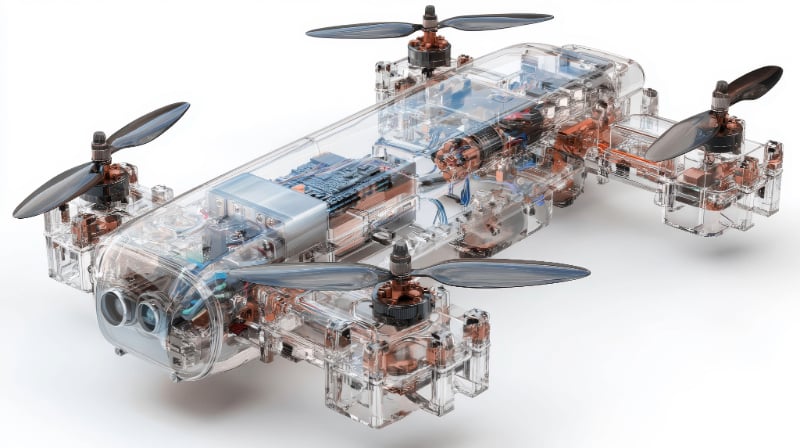
The gimbal is a precision electromechanical subsystem that stabilizes the camera in yaw, pitch, and roll, minimizing image blur caused by vibration, airframe motion, and rapid attitude changes. In UAV applications, effective gimbal control depends on accurate position feedback, smooth motor commutation, and an efficient power stage that can generate fine torque corrections with minimal jitter and heat.
A compact three-axis solution can be built using the NCS32100 absolute encoder, the NCD83591 3-phase gate driver, and the NTMFS0D9N04XM MOSFET. The NCS32100 provides precise angular position feedback for each axis, enabling fast and accurate stabilization without startup homing. The NCD83591 supports smooth BLDC motor control with integrated current sensing, which helps maintain stable torque and reduces visible camera shake. The NTMFS0D9N04XM MOSFET completes the inverter stage with low conduction loss and efficient switching, helping reduce thermal stress in the compact payload module. Together, these components enable accurate camera positioning, smooth three-axis stabilization, and reliable gimbal operation in demanding UAV environments.
Wired and Wireless Communication in Modern UAV Architectures
Modern drones use both wired and wireless communication to connect onboard electronics, exchange telemetry, and support diagnostics or updates. In smaller UAVs, interfaces such as CAN, UART, SPI, I²C, and RS-485 are often enough, but in more complex platforms these separate buses increase cabling, connector count, software overhead, and overall integration effort. For drones equipped with cameras, LiDAR, IMUs, battery monitors, lighting modules, and ESC diagnostics, a more unified communication architecture is more efficient.
For internal wired networking, the NCN26010 and NCN26000 support 10BASE-T1S single-pair Ethernet, which provides 10 Mb/s half-duplex communication over a single unshielded twisted pair in a multidrop topology. This allows multiple nodes to share the same two-wire communication backbone, reducing harness weight and simplifying distributed system integration. An important feature is PLCA (Physical Layer Collision Avoidance), which organizes access to the shared medium and helps deliver more predictable latency for telemetry, sensor data, and diagnostics. The NCN26010 integrates the MAC, PLCA reconciliation sublayer, and PHY, and connects to host MCUs through Open Alliance MACPHY SPI, while the NCN26000 functions as a 10BASE-T1S PHY for controllers that already include an Ethernet MAC and communicate through MII. Both devices also provide enhanced noise tolerance, which is useful in electrically noisy drone environments near motors, ESCs, and switching converters.
Wireless communication remains important for telemetry, configuration, service access, and firmware updates. The RSL15 Bluetooth Low Energy MCU supports Bluetooth 5.2, is built around an Arm Cortex-M33 core, and offers ultra-low-power operation, with sleep currents in the tens-of-nanoamps range. This makes it suitable for battery-sensitive drone subsystems that must remain in standby for long periods while minimizing parasitic power loss. Together, these technologies support a layered UAV communication architecture in which 10BASE-T1S provides the internal wired backbone for distributed onboard electronics, while BLE provides a low-power wireless interface for service and short-range connectivity.
LED Drivers for Status, Navigation and Drone Shows
Drone lighting systems require LED drivers that deliver high efficiency, scalable channel control, and reliable operation across a wide battery-input range. onsemi addresses these requirements with a portfolio that includes the NCV78964, NCV78935, and NCV7683, enabling lighting architectures for navigation lights, inspection illumination, status indicators, and coordinated swarm-based light displays. The NCV78964 is a single-chip, two-phase boost LED driver with synchronous dual-buck regulation, capable of driving two LED strings up to 60 V at up to 1.6 A per channel. For higher-current applications, the NCV78935 provides a synchronous three-channel buck solution for high-power LED strings up to 60 V, delivering efficient current regulation and strong power-conversion performance. These devices support stable LED brightness throughout battery discharge, helping maintain consistent optical output under dynamically changing operating conditions. Their switched-mode architecture also improves energy efficiency, which is particularly important in UAV platforms where lighting must not compromise flight endurance.
For lower-power and segmented lighting functions, the NCV7683 adds flexible multi-channel capability through eight programmable 100 mA linear current sources, integrated sequencing support, configurable stop and tail brightness levels, optional external PWM control, and open-LED diagnostics. This makes it well suited for auxiliary lighting, marker lights, and distributed visual signaling, especially in drone swarm applications that require precise channel-level control and repeatable brightness behavior. Together, these LED drivers enable modular and space-efficient drone lighting designs with reduced external component count, simplified microcontroller integration, and improved diagnostic visibility. The ability to independently control multiple LED strings allows designers to optimize brightness, efficiency, and system complexity while supporting both standalone drones and synchronized multi-drone lighting platforms.

Why These Functions Matter in Real Drone Designs
Power conversion is often undervalued until the system begins to scale. As drone battery voltages rise and onboard electronics diversify, the quality of the power-tree directly affects EMI behavior, thermal performance, and rail stability under transient load. A wide-input buck regulator with integrated switches can simplify this challenge significantly by reducing conversion-stage complexity while maintaining efficiency across a broad operating range. That is exactly the sort of problem the onsemi FAN65008B is intended to solve.
Motor-drive electronics are equally important because control efficiency does not come only from the MOSFETs themselves. Gate-drive strategy, switching behavior, and current feedback all influence heat, response time, and control quality. A compact 3-phase gate driver with configurable drive current and integrated sensing helps developers optimize the switching stage without having to overbuild the surrounding analog circuitry. The NCD83591 is valuable here because it concentrates several of those functions into one device while still allowing the designer to choose the external power FETs appropriate to the platform.
Across the core UAV functional domains, including propulsion, sensing, power conversion, communication, and lighting, onsemi offers a broad portfolio of highly integrated semiconductor solutions that enable more efficient, compact, and reliable system design. By combining high-efficiency power devices, precision signal-chain components, intelligent sensing, and robust interface solutions, these building blocks help reduce conduction and switching losses, lower thermal stress, simplify board-level architecture, and improve overall power-density optimization. Such integration is increasingly important in advanced UAV platforms, where tighter SWaP constraints (size, weight, and power), higher levels of autonomy, and BVLOS operation demand greater electrical efficiency, functional reliability, and fault tolerance. In this context, subsystem-level efficiency gains directly translate into extended flight endurance, increased payload capacity, and more robust performance under real-world operating conditions.
Learn more about drones

