Facebook
 Google
 GitHub
 Linkedin
Roger Harrington: The Man With the Key to Unlock Maxwell’s Equations
Today, we celebrate Roger F. Harrington as he turns 100 years old. His method of moments became the key for engineers in the modern world to put Maxwell's equations into action.
Nearly every device that receives or transmits an electromagnetic signal is made possible by the work of Roger F. Harrington, a renowned engineer and educator. Harrington spent years developing a universal method for converting James Clerk Maxwell's differential equations into manageable forms—today, solvable on digital computers. Today, as he turns 100 years old, we pay tribute to his life and work.
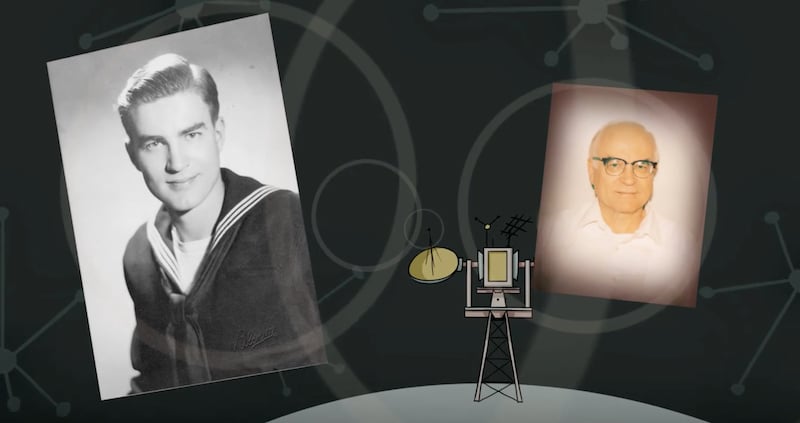
Roger F. Harrington. Image used courtesy of the Franklin Institute
Most well-known for his development of the method of moments (MoM), Harrington is also a highly respected teacher, publishing pivotal textbooks that have shaped electrical engineering and physics education.
Climbing the Educational Ladder
Roger Harrington studied electrical engineering at Syracuse University before the Second World War interrupted his studies. During the war, he continued to pursue his interests by working as a Navy electrical engineer and instructor. During this time, the 19-year-old Harrington puzzled over how to make Maxwell's equations applicable to real-world scenarios, like radar. While Maxwell's equations are useful for determining how, for example, radio waves theoretically bounce off perfect objects in a space, they don't account for how such waves interact with imperfect objects in the real world.

Harrington as a Navy electrical engineer. Image used courtesy of the Franklin Institute
Harrington continued to question the practical applicability of differential equations as he continued his electrical engineering education after the war, receiving B.S., M.S., and Ph.D. degrees.
After graduating, Harrington accepted academic positions at Syracuse University and the University of Arizona and worked on sponsored research projects for leading institutions and government agencies. In these positions, Harrington studied electromagnetic fields and their application in antenna design.
Harrington Dives Deep Into Computational Electromagnetics
Harrington's research projects led to several breakthroughs in computational electromagnetics. In one, he developed several basic formulas to determine the radiation from aperture antennas in cylindrical bodies. In another, he investigated wave propagation in gyrotropic media and developed an extended reciprocity principle for non-reciprocal media. He also analyzed the near-zone fields of antennas, establishing fundamental limits to antenna performance.
During this time, Harrington continued to study James Clerk Maxwell's equations for describing the behavior of electromagnetic fields. While he acknowledged that these equations are fundamental to electromagnetic theory, they cannot be effectively applied to the irregular shapes of real antennas. Harrington transformed traditional integral equations into linear matrix equations to help model complex antenna shapes and radiation patterns. Using Harrington's mathematical techniques, engineers can now design increasingly complex antennas for everything from smartphones to aircraft.
During a visiting professor post at the University of Illinois in 1958, Harrington became interested in using electromagnetic fields in thermonuclear fusion research, leading him to pioneer the mathematical technique method of moments (MoM) in electromagnetic field computations. His work provided a more practical and computationally efficient approach for analyzing and designing antennas with irregular shapes and complex radiation patterns. He later developed a technique known as Harrington's Field Method (HFM), building upon his work with MoM to assess microwave structures with sophisticated shapes and patterns—a technique that is still widely used.
The Impact of the Method of Moments
The method of moments (MoM) is a numerical technique used to solve linear equations and a range of electromagnetic field problems, such as scattering, using simple geometries and transmission line analysis. When applied to computational electromagnetics, MoM can analyze structures, including antennas, conducting surfaces, and scatterers.
MoM divides a structure into small elements, representing electromagnetic fields as a series of basic functions over these elements. It then transforms Maxwell's equations into integral equations over the structure's surface. Applying the MoM converts the equations into a matrix, which can be solved numerically to discern the currents and related electromagnetic fields through the structure.
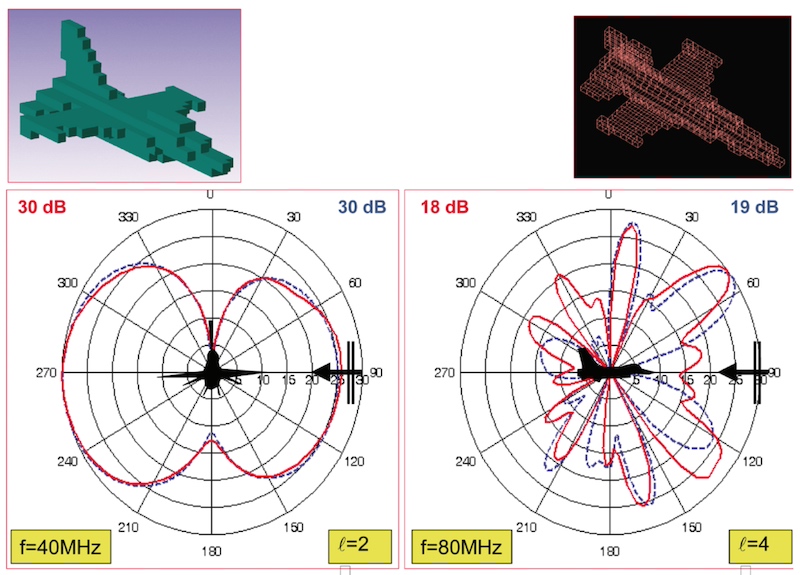
Discrete FDTD and MoM models of 15 m-long aircraft are shown alongside the horizontal and vertical RCS variations computed with both the MoM and FDTD methods. Image used courtesy of Research Gate
The MoM has revolutionized how engineers approach antenna systems and understand electromagnetic behavior in microwave circuits. Thanks to its ability to elucidate electromagnetic wave scattering from complex structures, MoM has become crucial for radar analytics and stealth technology. Combined with modern computational resources, MoM facilitates rapid prototyping, enabling engineers to quickly iterate and optimize antenna and microwave structures.
A Lasting Impact on Engineering Education
Harrington is also revered as an educator. As a Syracuse University professor, he played a significant role in developing the curriculum and several research teams in the electrical engineering department. Throughout his career, he has trained and inspired thousands of students, many of whom have become notable engineers. Harrington is also the author of several influential textbooks on computational electromagnetics, including "Introduction to Electromagnetic Engineering" and "Time-Harmonic Electromagnetic Fields". These books serve as a key resource to students and professionals worldwide and have shaped how the subject is taught.
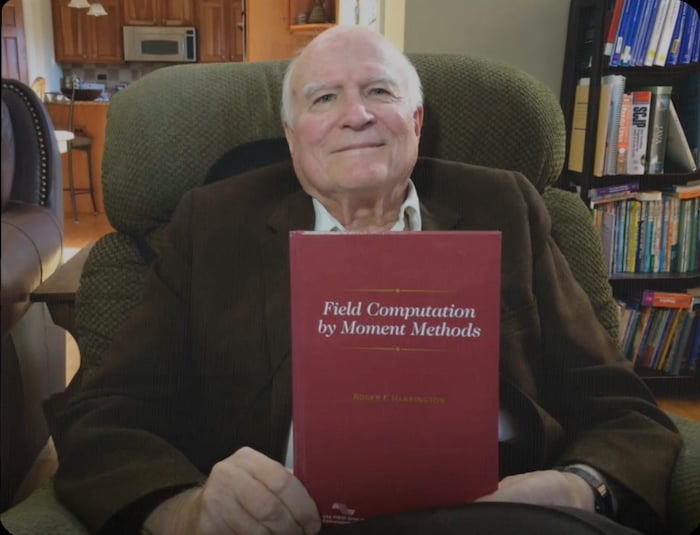
Harrington presenting his book "Field Computation by Moment Methods." Image used courtesy of the Franklin Institute
Harrington holds many honors, including the IEEE Centennial Medal and the Distinguished Alumni Award of Ohio State University. In 2014, he was awarded the Benjamin Franklin Medal in Electrical Engineering for his contributions to the study of electromagnetics. His achievements are pivotal to this day, enabling continued advances in communications, radar imaging, target recognition, and beyond.
Related Content