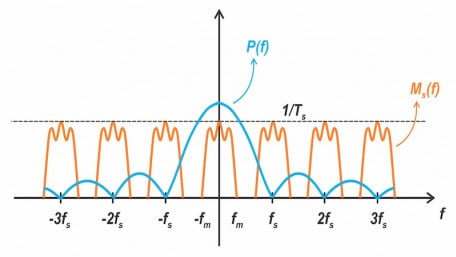
Flat-top PAM holds each sample’s amplitude for the pulse duration, weighting the spectrum with a sinc function. Here’s how that weighting leads to the…
Flat-top PAM holds each sample’s amplitude for the pulse duration, weighting the spectrum with a sinc function. Here’s how that weighting leads to the aperture effect.

Timing failures rarely announce themselves. They usually surface as system instability. Join us for a look at how…
Timing failures rarely announce themselves. They usually surface as system instability. Join us for a look at how SiTime's precision timing solutions keep that dependency silent for decades.

Multiplying a message by a pulse train replicates its spectrum at every harmonic. See why a 1/3 duty cycle and 4x…
Multiplying a message by a pulse train replicates its spectrum at every harmonic. See why a 1/3 duty cycle and 4x oversampling stretch the bandwidth roughly 12-fold.

Simple first-order pre-emphasis and de-emphasis filters can boost FM receiver SNR by more than 13 dB by exploiting the…
Simple first-order pre-emphasis and de-emphasis filters can boost FM receiver SNR by more than 13 dB by exploiting the spectral differences between signal and noise.

Worked examples quantify just how much the FMFB loop shrinks noise bandwidth. We also show how the PLL demodulator offers…
Worked examples quantify just how much the FMFB loop shrinks noise bandwidth. We also show how the PLL demodulator offers a simpler alternative for reducing threshold.

While feedback lowers the FM detection threshold, it offers no noise advantage over conventional receivers when the…
While feedback lowers the FM detection threshold, it offers no noise advantage over conventional receivers when the carrier power is strong. Discover why in this discussion and mathematical analysis.

By closing a feedback loop around the demodulator, the FMFB architecture narrows the noise bandwidth and lowers the FM…
By closing a feedback loop around the demodulator, the FMFB architecture narrows the noise bandwidth and lowers the FM threshold, without improving SNR at high CNR.

Drawing less than 120 mW and tolerating 30 krad of total ionizing dose, the chip-scale atomic clock keeps LEO satellites…
Drawing less than 120 mW and tolerating 30 krad of total ionizing dose, the chip-scale atomic clock keeps LEO satellites synchronized when GNSS timing is unavailable.

Working through examples shows how the threshold effect reshapes FM design choices. See how ignoring it can undershoot…
Working through examples shows how the threshold effect reshapes FM design choices. See how ignoring it can undershoot the required carrier power by over 5x for the same target SNR.

Rohm’s second-generation resonant tunneling diode oscillator reaches 40 µW maximum output in the same package as gen 1.
Rohm’s second-generation resonant tunneling diode oscillator reaches 40 µW maximum output in the same package as gen 1.

The standard FM SNR equation breaks down once the carrier-to-noise ratio drops below a critical threshold, revealing a…
The standard FM SNR equation breaks down once the carrier-to-noise ratio drops below a critical threshold, revealing a hard limit on trading bandwidth for noise performance.

Deriving a general signal-to-noise expression for frequency modulation with any message signal reveals a core trade-off:…
Deriving a general signal-to-noise expression for frequency modulation with any message signal reveals a core trade-off: more deviation buys better noise performance, but only by using more bandwidth.

This article explores how combining signal and noise power reveals how the FM system’s output SNR scales with carrier…
This article explores how combining signal and noise power reveals how the FM system’s output SNR scales with carrier amplitude and modulation index.

Bob Yannes built a three-voice analog synthesizer onto one die in 1982, and its imperfect filter became the signature…
Bob Yannes built a three-voice analog synthesizer onto one die in 1982, and its imperfect filter became the signature sound of an era.
Explore how frequency-modulated waves resist interference. We break down the demodulator architecture and derive the…
Explore how frequency-modulated waves resist interference. We break down the demodulator architecture and derive the exact output signal power for a sinusoidal message.

Envelope detection is simple, but that simplicity has a noise-performance cost. Here’s how much SNR conventional AM…
Envelope detection is simple, but that simplicity has a noise-performance cost. Here’s how much SNR conventional AM gives up compared to its coherent counterparts.

Signetics packed a VCO and phase detector into one 14-pin part, turning a daunting feedback technique into something an…
Signetics packed a VCO and phase detector into one 14-pin part, turning a daunting feedback technique into something an ordinary engineer could build.

Using a graphical approach, we show that coherent SSB demodulation leaves the input and output SNR unchanged, then…
Using a graphical approach, we show that coherent SSB demodulation leaves the input and output SNR unchanged, then compare its noise performance to DSB-SC and baseband systems.

Visualizing how correlated and uncorrelated signals combine offers an intuitive look at power transformation. See how…
Visualizing how correlated and uncorrelated signals combine offers an intuitive look at power transformation. See how this difference boosts baseband power to double the output SNR.

In this article, we'll learn how to calculate the noise power and signal-to-noise ratio (SNR) of a double-sideband…
In this article, we'll learn how to calculate the noise power and signal-to-noise ratio (SNR) of a double-sideband suppressed-carrier communication system.


 Facebook
 Google
 GitHub
 Linkedin