
 Facebook
 Google
 GitHub
 Linkedin
The MOS 6581 SID: Giving the Commodore 64 Its Voice
Bob Yannes built a three-voice analog synthesizer onto one die in 1982, and its imperfect filter became the signature sound of an era.
The MOS Technology 6581, universally known as the SID, or Sound Interface Device, arrived in 1982 inside the Commodore 64. It gave the best-selling home computer of its generation a voice that nothing else on the market could match.
The mind behind SID was Bob Yannes, an engineer and musician at Commodore's chip subsidiary, who wanted a real synthesizer rather than the beeps and buzzes his competitors were shipping.
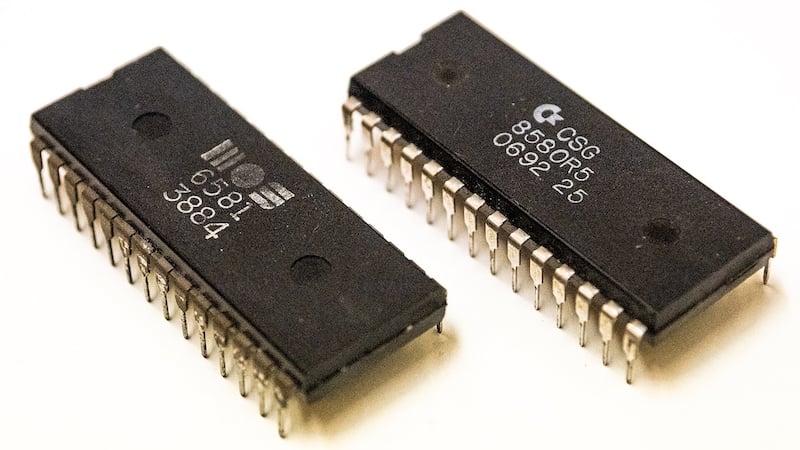
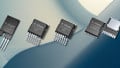
The MOS Technology 6581. Image used courtesy of Taras Young via Wikimedia Commons (CC BY-SA 4.0)
Working with a tiny team over roughly five months in 1981, Yannes produced a chip that put three independent voices, programmable envelopes, and an analog filter onto a single piece of NMOS silicon. In doing so, he set the template for decades of electronic music made on cheap hardware.
A Synthesizer on a Chip
The SID provides three independent voices, each built around an oscillator that can produce four waveforms: triangle, sawtooth, a variable-width pulse, and pseudo-random noise. Each voice has its own ADSR envelope generator, giving a programmer control over the attack, decay, sustain, and release of every note, the parameters that separate a plucked string from a swelling pad. To fit the envelope logic into the available silicon, Yannes encoded the rates in a compact lookup scheme and tuned the values by ear against a Sequential Circuits Pro-One, a hardware synthesizer of the day.
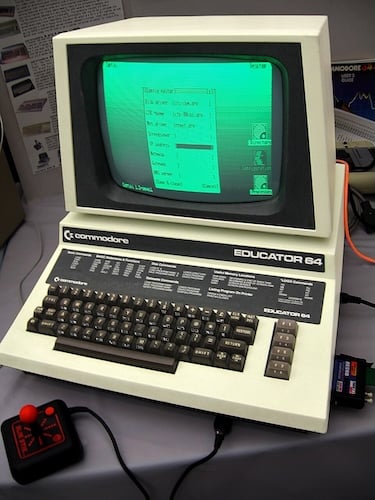
The Commodore Educator 64. Image used courtesy of Marcin Wichary via Wikimedia Commons (CC BY 2.0)
Two features lifted the SID above a simple tone generator. Ring modulation and oscillator sync let voices interact to produce metallic and harmonically rich timbres that the raw waveforms couldn’t. More important was the multimode analog filter, switchable between low-pass, high-pass, and band-pass, which let a programmer carve the brightness of a sound in real time.
The chip presented all of this through 29 eight-bit registers on a standard microprocessor interface, and its oscillators spanned more than eight octaves. The filter was the catch as well as the triumph. Because it was analog and sat at the edge of what the process could hold to tolerance, its cutoff varied from chip to chip, so no two SIDs sounded exactly alike.
Far Ahead of Its Rivals
Set against its contemporaries, the SID was barely in the same category. The sound hardware in many competing machines, including General Instrument's AY-3-8910 and Atari's POKEY, was essentially square-wave generators with limited envelope control. The SID offered three voices of genuine subtractive synthesis with a resonant filter.
Yannes made no secret of his low opinion of the alternatives. In the book On the Edge, he recalled that the sound chips on the market, "including those in the Atari computers, were primitive and obviously had been designed by people who knew nothing about music."
SID's capabilities landed in the hands of a generation of programmers who pushed it far past what its designers expected. Composers including Rob Hubbard, Martin Galway, and Jeroen Tel coaxed multi-layered music out of three voices through rapid register tricks, arpeggios fast enough to imply chords, and timed filter sweeps. The results became inseparable from the games they accompanied.
A later revision of the chip, the 8580, cleaned up the filter and reduced its distortion, producing a more consistent and arguably more accurate sound. Many musicians preferred the older 6581 anyway, precisely because its rougher, less predictable filter gave the music character that the tidier part lost.
Still Relevant Today
More than forty years on, the SID has an active community that few pieces of 1980s silicon can claim. The High Voltage SID Collection archives tens of thousands of tunes, and the chip's distinctive sound continues to define the chiptune and demoscene cultures that grew up around the Commodore 64.
Because original chips are fragile and increasingly scarce, prices for working units have climbed. A small industry of replacements has appeared, from software emulation in projects like reSID to hardware substitutes such as SwinSID and ARMSID and full FPGA recreations of the original design.
The reason for that devotion isn’t just simple nostalgia; the SID is one of the rare cases where a manufacturing imperfection became the USP. Its variable analog filter, a flaw by any engineering standard, gave each chip a slightly different voice and gave the whole platform a warmth that cleaner digital sound couldn’t match. Yannes set out to build a musical instrument rather than a sound effects generator, and people are still composing for it today.








This article evokes fond memories of the C64 and the 6581. The C64 is still my favorite computer because I had full control of both hardware and software. I had the source code and could tap into or modify the OS. I added a plug in second 6581 so I could play 6 part harmony in stereo. I wrote a music editor that could handle 8 voices. I entered the notes for the entire Brahms Requiem. I had the source code for a word processor that I could modify to publish a book.
Thanks.