Facebook
 Google
 GitHub
 Linkedin
Rohm’s New Oscillation Device Paves Path to Terahertz Commercialization
Rohm’s second-generation resonant tunneling diode oscillator reaches 40 µW maximum output in the same package as gen 1.
Recently, Rohm announced a second-generation terahertz wave oscillation device based on resonant tunneling diodes (RTDs), which the company says delivers four times the maximum output power of its first-generation part.
By combining the penetration of radio waves with the straight-line propagation of optics, terahertz waves are ideal for non-destructive testing, medical imaging, and high-resolution radar. However, conventional terahertz sources are bulky and costly, making them impractical for many real-world applications.
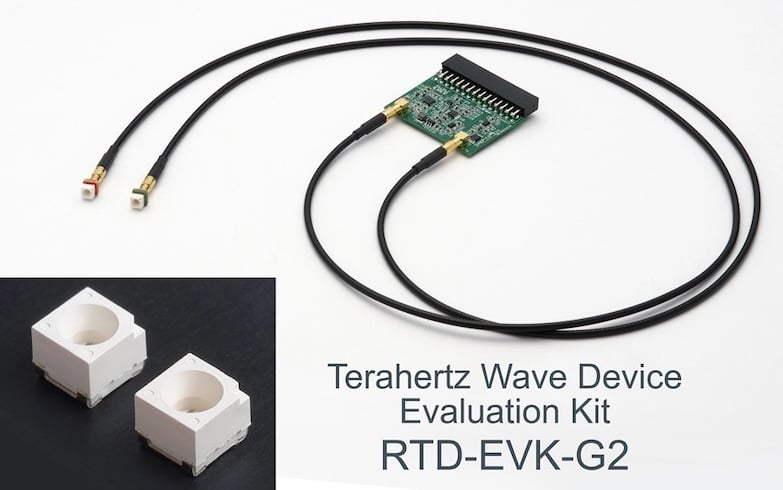
Rohm is making its 2nd Generation terahertz (THz) wave oscillation device available via the RTD-EVK-G2 Terahertz Wave Device Evaluation Kit.
Rohm touts its newest terahertz wave oscillation device as a better alternative with its compact size and low cost.
Rohm’s 2nd Generation Terahertz Wave Oscillation Device
At extremely high terahertz frequencies, waves are highly susceptible to signal attenuation, absorption, and reflection, making a sensor’s resolution strongly affected by incident output power. So, while Rohm’s first-generation terahertz wave oscillation device was impressive for its compact size, it still lacked output power, which affects downstream signal quality. That’s why, with the second-generation solution, Rohm packed significantly more output power into the same 0.5 x 0.5 mm chip.
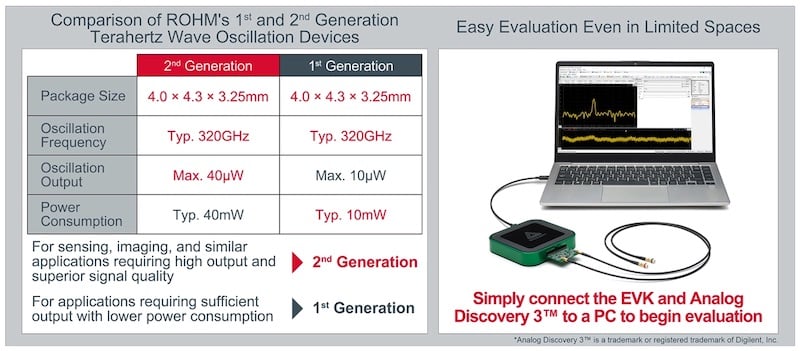
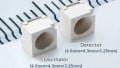
Comparison of Rohm’s 1st and 2nd generation Terahertz Wave Oscillation Devices
Specifically, the second-generation device oscillates at a typical 320 GHz and reaches a maximum output of 40 µW, compared to the 10 µW maximum of the first-generation part at the same frequency. To achieve the higher output, Rohm increased the terahertz device’s power consumption from 10 to 40 mW for the second generation. The newer device retains the same no-cooling-required feature and 4.0 × 4.3 × 3.25 mm PLCC (plastic leaded chip carrier) package from the previous generation.
The company plans to keep both parts in the catalog, positioning the 10 mW first generation for moisture detection and material identification where the power budget is tight, and the 40 mW second generation for object sensing and imaging where power consumption is less important than signal resolution. More information can be found in the “ROHM’s New 2nd Generation Terahertz Wave Oscillation Device Delivers 4 Times Higher Output Power” presentation.
How RTDs Generate Terahertz Waves
The terahertz band has long been called the terahertz gap because no established source technology can reach it comfortably. Electronic oscillators run out of transit-time headroom above a few hundred gigahertz, and semiconductor lasers do not extend downward far enough to cover the range.
To fill the gap, engineers would typically either chain frequency multipliers behind an RF signal generator or mix two laser beams in a photomixer, both of which draw 10 W or more in enclosures measured in centimeters.
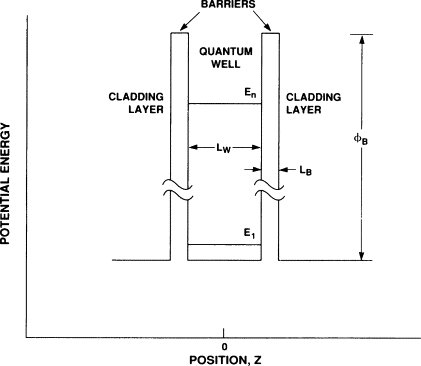
Schematic diagram of the double barrier structure in an RTD. Image used courtesy of E.R. Brown.
In contrast, an RTD reaches terahertz frequencies through a quantum effect. Engineers grow a quantum well between two thin barrier layers, and electrons cross the structure only when their energy lines up with a quasi-bound state inside the well.
As bias climbs past that alignment, the tunneling path closes and current falls while voltage keeps rising, producing a region of negative differential resistance. When engineers bias the diode inside that region, it supplies electrical gain, and an on-chip slot antenna turns that gain into sustained oscillation at hundreds of gigahertz.
What makes RTDs practical is that tunneling works at room temperature, so engineers can avoid the cryogenics that other terahertz sources need. This practicality has led researchers to use RTDs more, especially over the past decade. While they have steadily improved output power and frequency, researchers have also hit bottlenecks inherent to RTD design, like trade-offs between antenna size and output power.
Terahertz Device Availability
Rohm offers its second-generation device as part of the RTD-EVK-G2 Terahertz Wave Device Evaluation Kit, which also includes cables and an evaluation board. Engineers can use the kit to run oscillation and detection measurements by connecting it to a Digilent Analog Discovery 3 and a PC. Rohm has priced the RTD-EVK-G2 at $3,300 and plans to begin sales this month.
All images used courtesy of Rohm unless otherwise specified.