Facebook
 Google
 GitHub
 Linkedin
Liquid Instruments Turns AI Prompts Into Customized Test Instruments
The company's new, first-of-its-kind test software platform leverages AI to replace lengthy custom hardware or FPGA development.
Liquid Instruments recently announced the GenInst Studio AI instrument creation platform for its Moku FPGA-based customizable instruments. The agentic AI system develops complex, custom test and measurement configurations based on conversational language prompts.
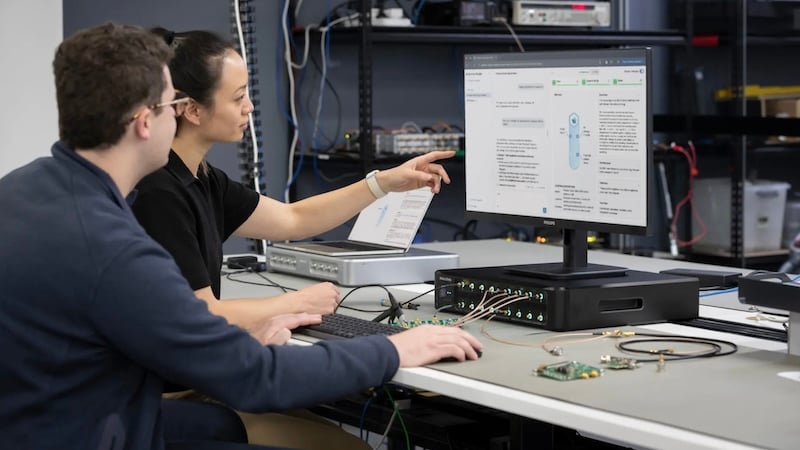
GenInst Studio dashboard with Moku:Delta.
According to the company, test configurations that would take months of development using prior methodologies might take only minutes with GenInst Studio and Moku hardware.
Complex Test and Measurement
Advanced electronic systems, such as those used in research laboratories, scientific institutions, and leading-edge product development organizations, often require customized test circuitry to simulate and evaluate signals. Such equipment requires FPGA development, bespoke hardware add-ons, or multiple sets of equipment with challenging interconnection arrangements. The required FPGA configuration may take weeks or months of development and verification before it is suitable for test situations.
The new Liquid Instruments GenInst Studio utilizes agentic AI to convert natural language instructions into a customized test instrument without requiring direct FPGA coding.
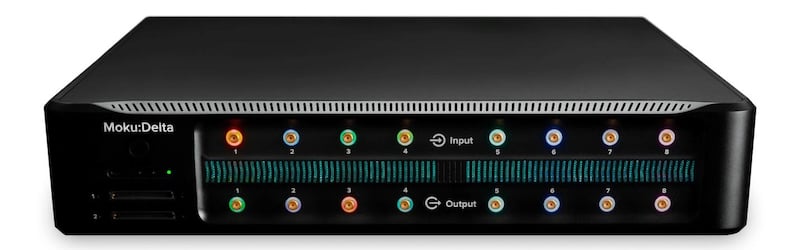
Liquid Instruments’ Moku:Delta configurable instrument system.
GenInst Studio works with Liquid Instruments’ Moku line of customizable test instruments. The Moku line includes four products with inputs ranging from 30-MHz to 2-GHz analog bandwidth. All Moku products are built around field programmable gate array (FPGA) system-on-chip (SoC) processors. The top-end Moku:Delta utilizes an Xilinx UltraScale+ RFSoC FPGA to offer more than two billion possible test configurations, eight independent input and output channels, and 32 digital I/O (DIO) channels for integrated system test.
GenInst Key Features
GenInst Studio removes the need for deep FPGA experience without losing the capabilities that come with an FPGA base. Liquid Instruments breaks the instrument creation process into three stages: describe, build, and deploy.
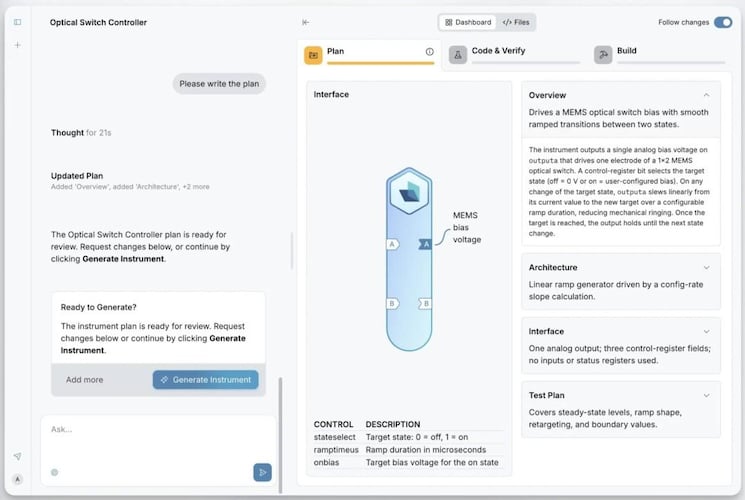
GenInst Studio dashboard in “build” mode.
“Describe” starts with an AI prompt such as: “Make me a LFM chirp matched filter.” GenInst refines the instrument requirements with a follow-on Q&A series. The agent suggests options and accepts user-defined options.
“Build” converts the inputs into a proposed instrument package. It creates automated validation tests and iterates until it and the user are both satisfied. It then codes the solution and verifies it.
“Deploy” gives connection instructions and readies the hardware for application use.
Product Availability
Liquid Instruments is an Australian startup making adaptable and customizable test and measurement equipment for research and advanced product development. Its Moku hardware platform is designed for speeding up test and measurement equipment customization through the use of FPGA-based hardware. The company recently received attention in the form of a $50 million series C investment round co-led by Keysight Technologies and Australia’s National Reconstruction Fund (NRFC).
GenInst Studio is available now under three capability tiers. It starts with a free 14-day trial version. The base is included with the Moku hardware, and a premium version add-on jumps instrument builds from 10 in the base to 100 per year.
All images used courtesy of Liquid Instruments.
Related Content