Facebook
 Google
 GitHub
 Linkedin
Design for the Future: How UALink Interconnects Empower Next-Gen AI Systems
Learn how UALink offers an open, high-speed interconnect for AI accelerators, that enables scalable, low-latency, and energy-efficient AI systems for next-gen workloads.
As artificial intelligence (AI) workloads grow increasingly massive and complex, system architects face mounting pressure to deliver compute environments that are not only powerful but also scalable, low-latency, and power-efficient.
To meet these challenges, the Ultra Accelerator Link (UALink) standard has emerged as a critical innovation, enabling ultra-high-speed, scale-up communication between AI accelerators.
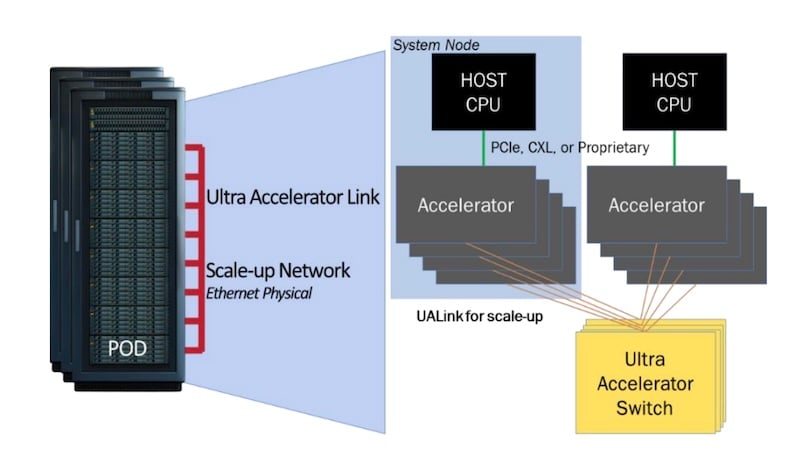
UALink supports multi-node and multi-plane switching. Image used courtesy of the UALink Consortium.
For system designers building infrastructure to support next-generation applications such as large language models, generative AI, and scientific simulations, UALink offers a new foundation for performance and flexibility.
The Rise of AI and the Need for Next-Gen Interconnects
Modern AI workloads operate on vast datasets and involve billions or even trillions of parameters. The computational demands of training and running these models require an architecture in which GPUs, custom accelerators, and memory subsystems can efficiently share data in real time. Traditional interconnect technologies, while powerful in their own right, were not purpose-built for the multi-accelerator topologies required by today’s hyperscale AI workloads.
UALink addresses this gap by providing a standardized, high-bandwidth, low-latency interconnect designed specifically for accelerator-to-accelerator communication. Its first specification, UALink 1.0, supports up to 200 Gbps per lane and enables connectivity across as many as 1,024 accelerators within a single AI pod. For system designers, this unlocks the scale and communication performance necessary to train large models faster and run them more efficiently.
What UALink Brings to System Designers
The UALink standard introduces a number of architectural advantages that help system designers meet the rapidly evolving needs of AI infrastructure. These benefits go beyond speed and bandwidth, influencing how future-ready, flexible, and sustainable a system can be.
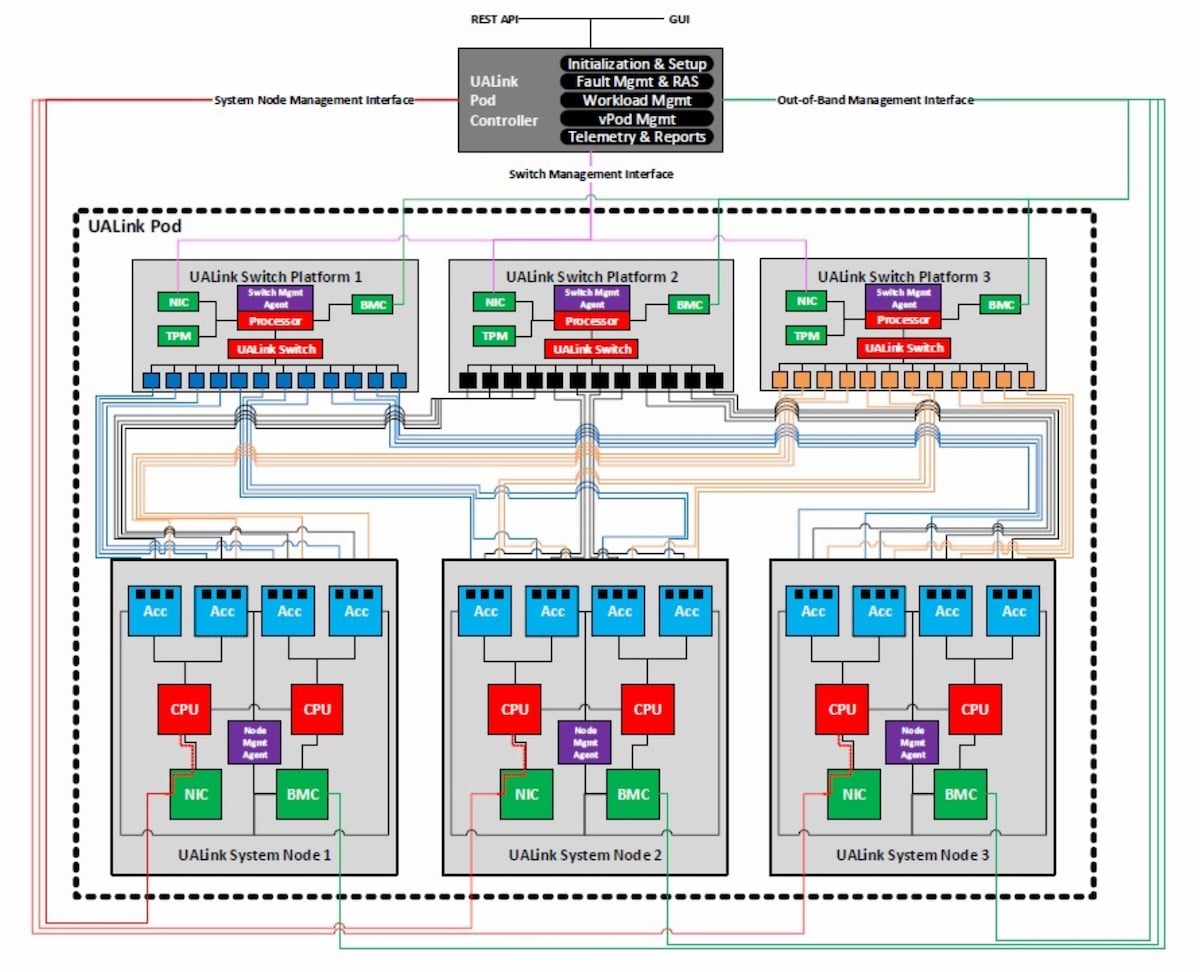
UALink rack-scale system management interface. Image used courtesy of the UALink Consortium. (Click on image to enlarge)
Here are four key ways UALink helps enable next-generation designs.
- Open, Vendor-Neutral Architecture. Unlike proprietary interconnects that can lock developers into a single vendor’s ecosystem, UALink is being developed as an open standard by a powerhouse consortium including AMD, Intel, Meta, Google, Microsoft, AWS, Cisco, HPE, and others. This open architecture ensures interoperability between accelerators and interconnect switches from multiple vendors. It gives system designers more freedom to build heterogeneous systems that align with performance goals and budget constraints.
- Massive Scale and Flexibility. With support for more than a thousand accelerators in a single pod, UALink enables truly hyperscale AI system design. System designers can architect clusters with unprecedented scale while maintaining high-bandwidth communication between accelerators, a key to efficient parallel training and inference. The standard is also topology agnostic. Designers can optimize for ring, mesh, or fully connected network configurations depending on workload characteristics, power envelope, and cost targets.
- Lower Latency for Real-Time Workloads. High-performance AI applications, especially in areas like generative AI, autonomous systems, and real-time recommendation engines, depend on microsecond-level latency. UALink’s direct scale-up interconnect minimizes latency across accelerators, reducing bottlenecks during both training and inference and improving time-to-results.
- Energy Efficiency and Sustainability. Power is a top concern in AI infrastructure. UALink enables tightly coupled compute fabrics that reduce the need for excessive data movement across external network fabrics. This improves speed and cuts power consumption. For data centers striving toward sustainability goals, this is a major advantage.
Enabling the Next Era of AI Infrastructure
The development of UALink represents a pivotal moment for the industry. The need for standardized, high-performance accelerator interconnects is finally being met by a collaborative and open ecosystem. For system designers tasked with enabling the next wave of AI innovation, UALink provides the tools to build infrastructures that are not only faster and larger but also smarter and more energy efficient.
With the release of the UALink 1.0 specification, organizations now have a new blueprint for building AI clusters that scale as fast as the ambition behind them. By combining open interconnect standards with hybrid switch architectures, the industry is opening the door to a new generation of intelligent, scalable, and sustainable AI systems.
Looking Ahead: UALink’s Role in a Broader AI Ecosystem
As AI workloads continue to evolve—from general-purpose language models to domain-specific agents and real-time inferencing at the edge—interconnect standards like UALink will play a foundational role in shaping not just the systems of today, but the innovation pipelines of tomorrow.
UALink’s roadmap includes plans for higher bandwidth, lower latency, and advanced features such as shared memory models and integrated security protocols, all of which will be essential for the next wave of distributed AI architectures.
Furthermore, UALink isn’t just a hardware play—it’s enabling a new software ecosystem as well. With the support of leading cloud providers and chipmakers, UALink’s open standard is driving the development of optimized software stacks, communication libraries, and orchestration tools that are interconnect-aware. These software innovations will be critical to unlocking the full potential of tightly coupled AI pods, from efficient workload scheduling to fine-grained resource management.
As the UALink Consortium expands and the standard matures, system designers and AI infrastructure providers will increasingly look to it as the backbone of modular, interoperable, and future-ready platforms. In a world where AI performance and energy use must scale together, UALink is emerging as a key enabler of both innovation and sustainability.
The author, Krishna Mallampati, is Vice President of Sales and Marketing at XConn Technologies.