Facebook
 Google
 GitHub
 Linkedin
Edge AI’s Next Battlefield: Development Tools
Learn why the best silicon is useless without the right AI developer tools.
For years, edge AI has been about hardware. Buyers compared architectures, accelerators, and feature sets. But that’s shifting fast. The new priority is ease of deployment.
Building models in the cloud or on a PC has become second nature for AI teams. But getting those models running efficiently on an edge device? That’s still a major pain point. Specialized skills, fragmented tools, and steep learning curves have slowed time to market. Product builders are now demanding something different: streamlined, developer-friendly tools that integrate with familiar workflows.
The Market Shift
Hardware providers saw this change coming and invested in SDKs tied to frameworks like TensorFlow, PyTorch, and ONNX. Still, many of those efforts haven’t measured up. The proof is in the recent wave of acquisitions—Qualcomm, Infineon, Nordic Semiconductor—all aimed at improving deployment tools.
Meanwhile, embedded leaders like Arm, NXP, and ADI have embraced Microsoft Visual Studio (VS) Code as a front end for edge AI development. The message is clear: ease of use is now the battleground. For builders, spec sheets no longer win deals; reducing deployment friction does.
Tools: The Real Differentiator
Because even the most powerful system is useless if developers can’t harness it. Performance isn’t just about silicon; it’s about how easily developers can optimize and deploy their models onto a given SoC. Good tools can make or break the process. That means:
- Model conversion and quantization to adapt TensorFlow or PyTorch models for the edge.
- Profiling and visualization to expose performance bottlenecks layer by layer.
- Pre-validated models and templates that serve as starting points, jumpstarting development.
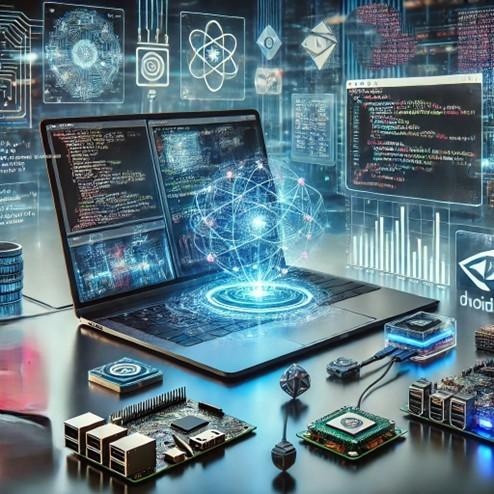
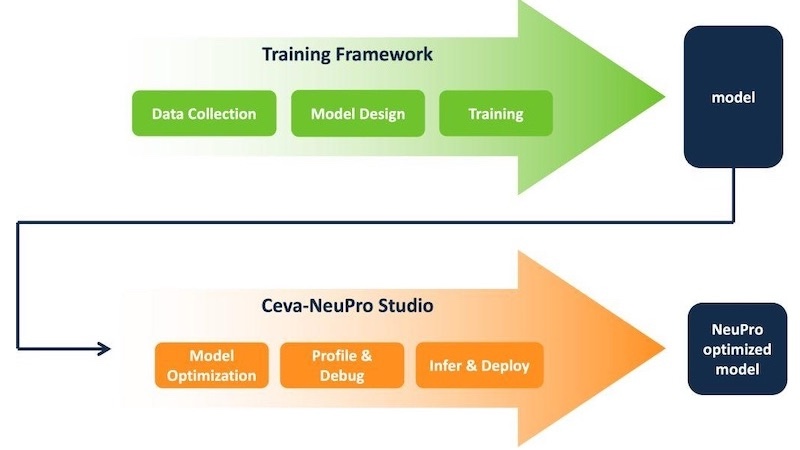
A streamlined edge AI toolchain that takes models from training frameworks to optimize on-device deployment. Image used courtesy of Ceva.
Ultimately, a rich toolchain accelerates time to market and helps developers avoid “performance cliffs”—situations where hardware specs look great on paper but real-world performance stalls. The best hardware is only as good as the software tools that make it usable.
What Great Edge AI Platforms Must Deliver
The future of deployment looks a lot like MLOps for the edge. Current processes resemble software development before DevOps—manual, fragile, and hard to scale. The fix is tools that automate and simplify deployment, using:
- Broad model support: TFL and TFLM as inputs, with conversion from PyTorch, ONNX, and TensorFlow.
- Intelligent optimization: automated quantization, architectural planning, and operation assignment across DSPs and NPUs.
- Deployment automation: hide the messy details of compiling, linking, and runtime setup.
- Developer-friendly interfaces: built-in libraries for inference, image processing, and communication, plus tuning for latency and power.
- Mainstream IDE integration: VS Code provides familiarity, AI-driven features like Copilot, and an ecosystem which developers already know.
- Prebuilt ecosystems: sensing/fusion modules, model zoos, and templates that save builders from reinventing the wheel.
Builder Reactions
At industry events like Embedded World 2025, developers consistently point to fragmentation as their top frustration. While AI training tools are mature and standardized, inference at the edge remains a patchwork of vendor-specific SDKs, compiler stacks, and runtime environments.
Builders say the most valuable tools are those that:
- Let them import and deploy models directly from popular training frameworks without complex conversions.
- Provide transparent visibility into how operators are mapped across heterogeneous cores.
- Offer automated quantization workflows that preserve accuracy while meeting power budgets.
- Deliver one-click build and profiling so developers can focus on models, not makefiles.
One system architect at an industrial automation firm summarized it this way:
“We don’t want another proprietary SDK. We want an AI deployment experience that feels like modern software engineering—version-controlled, automated, and integrated into our IDE.”
This mirrors findings from ABI Research’s 2025 Edge AI Hardware Landscape report, which noted that tools and enablement are now key differentiators across semiconductor vendors. The report observed that “most hardware vendors have moved on from one-dimensional messaging about TOPS, focusing instead on ecosystem building to address deployment pain points”.
In other words, it’s no longer enough to boast performance numbers. The real win is in helping developers get from model to optimized device execution—fast.
Lessons from the Field
The push toward better tools reflects a few critical lessons learned from first-generation edge AI deployments:
- AI talent is scarce. Many embedded teams lack deep ML expertise. Tools that abstract low-level AI operations, yet allows tuning when needed, accelerates adoption across non-AI specialists.
- Heterogeneous compute is complex. Edge devices often blend CPUs, DSPs, NPUs, and microcontrollers. Intelligent orchestration tools that automatically partition workloads across cores can unlock significant efficiency gains.
- Debugging edge AI is painful. Profiling tools that visualize layer-by-layer latency and memory utilization—similar to what Nsight or TensorBoard offer for the cloud—are becoming essential.
- Reproducibility matters. As AI moves into safety- and compliance-sensitive markets (automotive, healthcare, industrial), toolchains must support versioning, deterministic builds, and traceability.
These factors are driving a convergence between AI deployment tools and DevOps principles, often referred to as “MLOps for the edge.”
Building the Ideal Edge AI Toolchain
A complete edge AI workflow should allow developers to:
- Import models easily from TensorFlow, PyTorch, or ONNX.
- Quantize automatically to 8-bit or mixed precision with minimal accuracy loss.
- Map operations efficiently across DSPs, NPUs, and CPUs.
- Simulate and profile performance in a graphical environment.
- Package and deploy as a single runtime image.
Some of the most promising innovations now focus on graph-level optimization and cross-core scheduling—where operators are dynamically assigned to the best-suited compute unit. This makes it possible to balance throughput, latency, and energy efficiency automatically, rather than through tedious manual tuning.
A fragmented edge AI ecosystem makes development harder—reinforcing why unified, developer-friendly tools are now a key differentiator. Image used courtesy of Ceva.
Another rising trend is IDE-based integration. Many developers prefer working in VS Code, and the availability of AI-aware plugins allows tight feedback loops—for instance, integrating model import, compilation, and test visualization directly in the workspace.
The broader implication: edge AI tools are following the same arc as embedded software development did a decade ago—from vendor-specific command lines toward standardized, open, and developer-first ecosystems.
The Road Ahead: Ecosystem Over Exclusivity
As edge AI adoption widens, success will depend less on any one chip and more on ecosystem openness. Hardware vendors that insist on closed SDKs risk isolating themselves. In contrast, those who embrace open frameworks, community collaboration, and cross-platform interoperability will benefit from faster developer traction and broader reach.
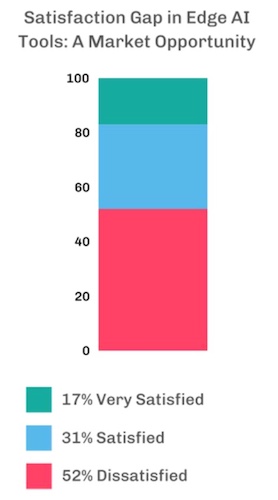
According to Latent AI, current AI tools fall to keep pace with the needs, with 52% of organizations expressing dissatisfaction with available edge AI development tools and platforms. Image used courtesy of LatentAI.
The edge AI ecosystem remains fragmented, with unique hardware and SDKs across dozens of vendors. But the leaders are the ones building bridges—supporting multiple frameworks, enabling model portability, and fostering community tools that lower the barrier to entry.
ABI Research predicts that edge AI NPUs will grow at a 111% CAGR through 2030, driven by demand for more demanding, ultra-low-power use cases such as sensor-level AI and small language model inference. To capitalize on this, ecosystem enablement—not raw compute—will determine who captures value.
The Future Is Tool-Driven
Edge AI is no longer a hardware race; it’s a tools race. Builders want deployment to be as seamless as the software engineering flows they already use. The next phase of competition will be defined by accessibility, automation, and integration—where AI deployment at the edge becomes as routine as compiling firmware.
The companies that enable that experience will shape the future of embedded AI. Because at the end of the day, the best silicon only matters when the software makes it usable—and fast.