Facebook
 Google
 GitHub
 Linkedin
From Scripts to Intent: Using MCP to Automate Network and Security Testing
Hyperscale networks now change in weeks, and script-based test automation cannot keep up. Here's how an open protocol could let AI agents drive network test platforms.
Network validation is becoming increasingly difficult to scale. Hyperscaler AI infrastructures adopting high-speed networks and distributed enterprise networks are now changing in weeks, not months or years. Test cycles built on legacy automation scripts cannot keep up. Traditional automation depends heavily on product-specific expertise, scripts, and API integrations. Engineers rely on these to configure, execute, and analyze sophisticated test scenarios.
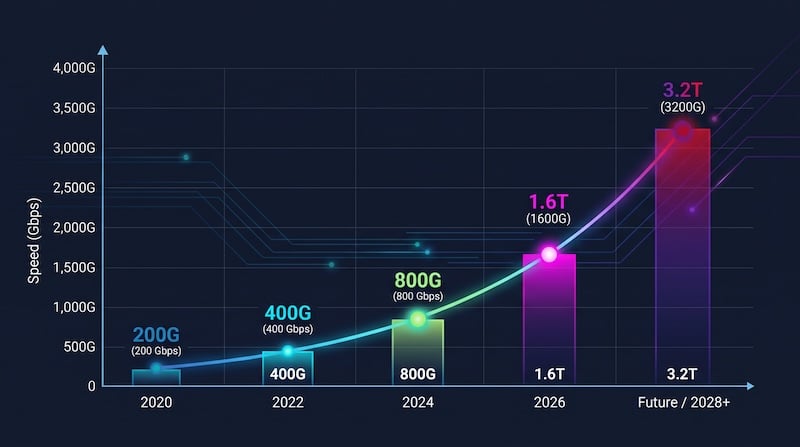
Increasing network speeds create new challenges in testing and validation.
At the same time, AI agents are becoming part of network and security operations. That creates a new requirement for test infrastructure. It must be able to participate directly in AI-driven workflows through standardized interfaces rather than another layer of custom integration.
Without a common integration model, organizations risk recreating the same integration problem for AI. Proprietary connections between individual AI frameworks and test platforms become increasingly difficult to scale and maintain.
Why Proprietary Integrations Don't Scale
Every AI framework-to-test-platform connection built as a custom integration creates another interface to develop and maintain. As both sides grow, that becomes an NxM integration problem. The result is a quadratic increase in complexity. A common protocol changes the model. Test platforms expose capabilities through a standardized interface, and AI clients connect through the same protocol.
Model Context Protocol (MCP) was created by Anthropic and donated to the Linux Foundation’s Agentic AI Foundation (AAIF) in December 2025. It provides a standardized way for AI systems to connect with external tools and data sources. It creates a standardized way for AI agents to discover, understand, and interact with test resources without requiring custom integrations for every instrument or workflow. As a result, the focus shifts from building and maintaining automation scripts to enabling intelligent agents. These agents can dynamically orchestrate testing, execute complex traffic scenarios, and interpret results.
The important shift is not simply from GUI to natural language. It is from implementation-driven testing to intent- and outcome-driven testing.
That shift is what allows test cycles to keep pace with the rapidly changing network and security infrastructures. In the data center, validation must cover AI fabrics and high-speed Ethernet environments, which have become increasingly complex. Security teams must continuously validate resilience against evolving threats. For applications, behavior modeling under real-world conditions is needed to ensure the user experience is as expected.
Proprietary approaches tend to solve individual use cases. They do little to address the broader need for interoperability, portability, and long-term maintainability across multi-vendor environments. And for AI and networking infrastructure, we’ve arguably reached the level where the limits of traditional integration and automation approaches are exposed.
Take a typical command, such as the need to plot latency and jitter as traffic is incrementally ramped up to 100%. The traditional approach would have this request translated into detailed configurations, scripts, and API calls. This previously needed extensive product expertise. At least in older fabrics (200G and 400G) and with lower traffic volumes, it was manageable. But today, AI data centers have grown larger and are running higher-speed networks (800G, 1.6T, and looking to 3.2T).
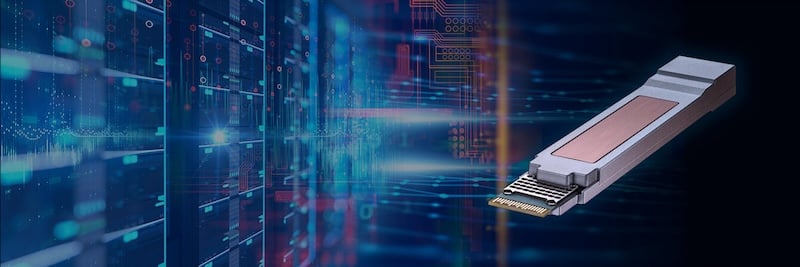
New technologies like this Ultra-Dense Small Form-Factor Pluggable (USFP) from Cisco and NVIDIA are enabling higher-speed networks. Image used courtesy of Cisco.
They are being bombarded by ever more complex threats and are supporting applications that are becoming increasingly distributed. As a result, validation needs are expanding faster than resources.
Integrating MCP Into Test
From a test point of view, MCP can simplify the interaction between infrastructure tools and AI systems. It reduces the need for engineers to interact directly with GUIs, scripts or APIs. Instead, software capabilities can be exposed to AI agents as structured tools that can be discovered, orchestrated, and executed through natural-language interactions.

An MCP server framework enables AI-driven test workflows using natural-language prompts. Image used courtesy of VIAVI Solutions.
For this, MCP servers would cover configuration and execution, real-time monitoring, and results analysis across test domains, when paired with an external AI agent. Once a request is made, whether as a conversational prompt or a Markdown-based test description, it is translated into a series of steps. For example, a request to run an RFC 2544 throughput test on the 800G ports across frame sizes from 64 to 9000 bytes, with binary search results for each size, would be broken down this way. These steps would then become REST API calls to configure and run the required test traffic profiles and gather the relevant statistics.
MCP server frameworks can go further by incorporating live event data to support real-time decision-making and allow AI agents to adapt test execution dynamically. Validation feedback mechanisms, such as autonomous error-correction loops, can help detect and self-correct test-tool misconfigurations. For high-stakes test scenarios, human review checkpoints can provide additional oversight at critical points in the testing process. Because the MCP server executes well-defined, deterministic test operations, every tool call can be logged, reviewed, and replayed. Results therefore stay repeatable and auditable, even though the agent's reasoning is not.
For test and measurement teams, this approach offers benefits in three key areas. First, it can accelerate validation by reducing the effort required to translate test intent into product-specific configurations, scripts, and API interactions. Second, natural-language interaction can make sophisticated test workflows accessible to a broader range of engineers. This reduces dependence on specialized domain and scripting expertise. Finally, standardized tool discovery provides a more scalable integration model. AI clients can interact with testing capabilities through a common interface rather than individually hard-coded connections.
Together, these capabilities provide a more extensible foundation for integrating test infrastructure into AI-driven workflows as network and security environments continue to evolve.
MCP and the Future of AI-Native Testing
AI is compressing every lifecycle in network design and deployment, and testing cannot be the step that slows it down. As AI agents become part of infrastructure operations, test systems must participate in the same workflows. The answer is not another layer of scripts or a custom connector for every AI framework. It is an open handshake between AI agents and test platforms, with the rigor of professional test and measurement domain expertise beneath it.
Open protocols such as MCP let engineers state intent and drive the outcome. As a result, network and security validation moves at the pace of modern infrastructure. Teams that adopt this model will not just test faster; they will deploy scalable, secure networks with greater confidence.
Related Content