
 Facebook
 Google
 GitHub
 Linkedin
Industry White Paper
Engineering Trust Into Electro-Mechanical Braking
Explore the electrical engineering strategies behind fail-operational electro-mechanical braking (EMB), from 12V/48V power distribution and ASIL-D decomposition to high-precision wheel-end motor control and sensing. Download this white paper to learn how to design robust, hydraulic-free braking architectures for next-generation by-wire vehicles.
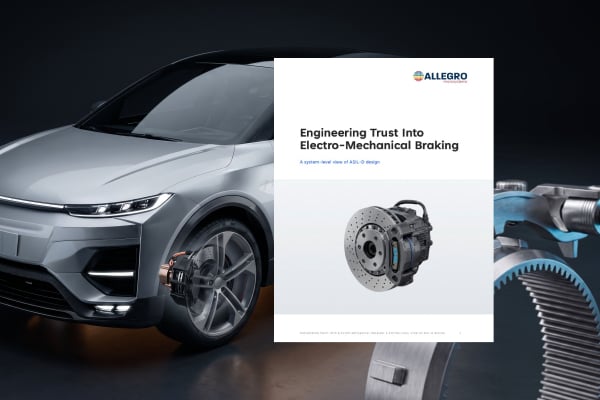
White Paper Overview
As automotive architectures evolve toward software-defined and automated mobility, electro-mechanical braking (EMB) replaces centralized hydraulics with independently controlled electric actuators at each wheel. Direct electromechanical actuation slashes command-to-clamp response times to roughly 80–100 ms, enables fine wheel-selective dynamic control, and eliminates brake-fluid maintenance. However, removing the hydraulic fallback places the entire burden of vehicle deceleration, stability, and fail-operational availability directly onto the electrical power, sensing, and actuation domains.
Achieving ISO 26262 ASIL-D capability without a mechanical backup demands a comprehensive, system-level approach to motor control and safety. Critical engineering challenges include navigating 12V versus 48V power delivery trade-offs to manage harness mass and transient thermal loads, executing ASIL decomposition, and implementing robust diagnostic monitoring without redundant sensors. Delivering a reliable fail-operational wheel-end hinges on intelligent gate driver selection, high-precision rotor position and current sensing, wheel-speed interfaces, and supply rail supervision capable of containing faults well within strict fault-tolerant time intervals (FTTI).
Whether evaluating intermediate semi-dry architectures or designing full-dry four-corner by-wire platforms for upcoming vehicle programs, explore the technical depth needed to bridge the gap between high-level functional safety requirements and silicon-level hardware execution.
Download this white paper to learn more about architecting ASIL-D electro-mechanical braking systems, resolving electrical power and transient constraints, and engineering trust into next-generation by-wire chassis designs.

