
 Facebook
 Google
 GitHub
 Linkedin
Industry White Paper
Hardware Engineering as the Next Frontier for Agentic AI
Agentic AI has already changed how software gets built. Here's why hardware engineering and electronics are next, and why it starts with requirements.
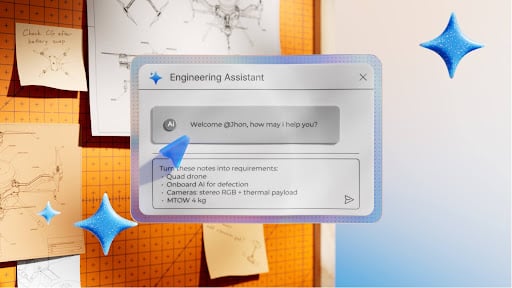
You know how every tool now comes with an AI chatbot on the side? You ask it something, it answers, and that's about it. When you close it, nothing in your project has actually changed. That's an AI chatbot; it talks about your work.
In software engineering, AI stopped just answering questions and started doing the work itself. It reads the code you're working on, proposes changes, and carries them out for you to approve. That's agentic AI, and it's the move from doing every step yourself to directing the work.
The same shift is now starting to reach hardware engineering, and it starts with Agentic Requirements Engineering.
The Shift Began in Software Engineering
So why software, and not everywhere else?
Part of it is who built the tools. The people creating these AI models are software engineers, and they built them first for their own work. The AI companies building these models also have a direct reason to start there, since better coding tools help them build their next models faster.
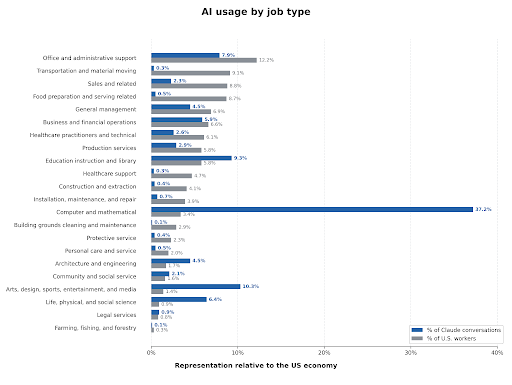
The Anthropic Economic Index (Feb 2025) shows coding extremely over-represented.
But more importantly, software engineers now have AI agents that can directly access and modify their actual work context.
There’s more fundamental reasons why software got there first. The first is direct access: an AI agent can modify the actual project, not just talk about it. It doesn't need to be re-explained every time it starts; it picks up from the existing work instead of waiting for someone to paste in context by hand.
The second is verifiability: how easily you can check if the code is correct. That's exactly Andrej Karpathy's point: an AI is much easier to train well on a task when you can verify its answer quickly and cheaply. For code, that check is built in: compilers and automated tests handle it for you. An AI agent earns the trust to do the work, not just suggest it, only when you can check the result; and with code, you can. You write it, compile it, run the tests, and in minutes you know whether it holds.
Both come down to the same thing: code is just text. It's readable, it lives in one place, and it can be run and tested, so an AI agent can reach it and verify its results automatically. Hardware has never had that equivalent. A flaw in code shows up in minutes; a flaw in an electronics design can take months to surface.
What Needs to Happen to Make AI Useful for Hardware?
Why hasn't the same thing happened in hardware engineering? Verifiability was part of it, but never the whole story. Two things still stand between an agent and real hardware work: context and access.
The Context Problem
An AI chatbot only knows what you paste in, not the project around it. Think about your systems engineer, the one accountable for a subsystem's requirements. An AI chatbot can discuss one requirement, but it can't see how that requirement fits into the overall architecture, which sub-requirements a change would break, and the thousands of linked items downstream. So it answers in general terms, when the work is specific.
The Access Problem
Now think about your electronics engineer, the one developing the board. The live requirements that the board must satisfy sit right next to the schematic. An AI chatbot can talk about them, but it can't edit them, flag which components fall out of spec as tolerances tighten, or point to the tests to rerun. So the answer just stays on the screen, and someone has to enter it manually.
An AI agent could handle both. When an agent has context and access, its answers fit the real work. And instead of retyping a suggestion, you get changes prepared for review.
First Step: Start with AI for Requirements

Requirements describe what the product has to do, captured in text, which is exactly what AI reads well. But the best engineers treat them as something more: a shared mental model of the product, one that evolves as the design does. Get them right, and your team builds better products and iterates faster.
They're also the one place every discipline (systems, electronics, mechanical, software) traces back to. Keep them in a requirements tool and you get exactly what gives code its head start: text an agent can read, all in one place it can reach. Requirements are the context; requirements engineering is the area of hardware work that comes closest to what coding agents already do.
What This Looks Like in Practice
Picture what that looks like on a Monday morning. An upstream change tightens the operating temperature range overnight. By the time you sit down, the agent has identified which sub-requirements no longer align, drafted edits grouped by discipline, and flagged the affected test procedures. You approve in fifteen minutes what used to take a week to trace.
Key Takeaways
-
Most of today's AI still only talks about your work; an agent needs the context and access to act on it.
-
Software engineering got agents first because code is easy to check; hardware never had that.
-
Requirements are the starting point: agents can now act on your data while you stay in control.
Get Started with Agentic Requirements Engineering
That's what we've been building towards at Altium's Requirements Portal, now with Agentic Requirements Engineering — not an AI chatbot pinned to the side of the app, but agents that work directly on your live requirements:
- An AI-Assisted Importer to get started from what you have.
- An Engineering Assistant that acts on your data.
- AI Skills to encode your process.
Agentic Requirements Engineering removes unnecessary friction when working with requirements, closing the gap between the mental model in your head and the shared model your whole team works from.
Watch the video below to see a preview of the tool in action.
Teams that move now will have a structural head start: shorter design cycles, and risks surfaced before they become costly mistakes. That window is what makes the timing matter.
To learn more and test out the tool we developed yourself, follow this link and get started with Agentic Requirements Engineering.

