Facebook
 Google
 GitHub
 Linkedin
Industry White Paper
Humanoid Robot: The Five Core Technologies Enabling Physical AI
Artificial intelligence has moved from perception and content generation toward systems that can reason, plan and act.
By Michal Csiba, onsemi
Physical AI extends these capabilities into machines that sense, understand and influence the physical world. Humanoid robots are one of its most demanding forms because they must combine intelligence with safe, coordinated movement in environments designed for people.

Adobe Stock image
Unlike fixed industrial robots that repeat defined motions within controlled work cells, humanoids are intended to operate in changing surroundings, use human-scale tools and interact with people and objects. Their performance therefore depends on more than an AI model or a powerful processor. It emerges from the coordinated operation of actuation, sensing and perception, power, compute and connectivity.
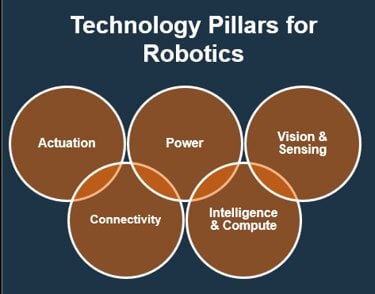
Figure 1. Technology pillars for robotics
These five technology domains form a tightly coupled system. A stronger actuator increases demand on the battery and thermal design. Higher-resolution sensors generate more data for processors and networks. Distributed compute reduces latency but requires reliable communication between subsystems. Practical humanoid design is therefore a system-level optimization problem in which improvements in one domain must be balanced elsewhere.
Actuation converts commands into movement and physical force. Sensing and perception provide information about the robot and its surroundings. Power systems store, convert and distribute energy. Compute platforms process sensor data, run AI models and coordinate behavior. Connectivity links sensors, controllers, actuators and external services.
Architectures are also becoming more distributed. Instead of sending every raw signal to one central processor, designers place control and preprocessing closer to sensors and actuators. Local processing can reduce communication traffic, shorten response time and make the architecture easier to scale. Central processors can then focus on perception, planning and higher-level decision-making while embedded controllers handle deterministic tasks such as current regulation, joint position control and safety monitoring.
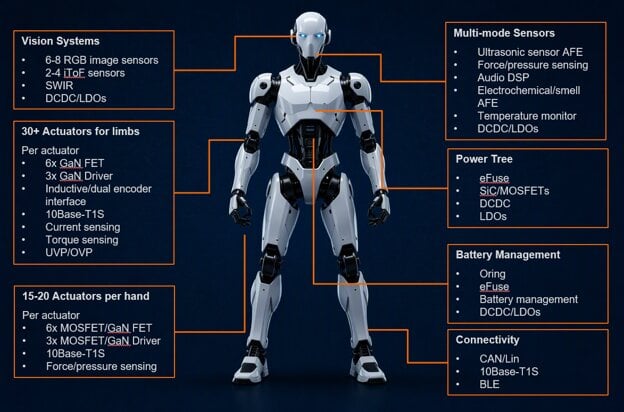
Figure 2. Humanoid Robot Subsystems
Actuation: Transforming Decisions into Motion
Actuation converts electrical energy into controlled motion and typically represents a major share of a humanoid robot's peak power demand. Each joint may combine a motor, power stage, position sensing, current sensing, gearbox, brake, local controller and communication interface. Coordinated control allows the robot to walk, maintain balance, manipulate objects and respond predictably to changing loads.
Requirements vary significantly by body zone. Fingers need compact, low-mass actuators with fine position and force control. Arms require a balance of reach, speed, payload capacity and back drivability. Hips, knees and ankles must deliver higher torque and withstand repeated dynamic loads. This variation makes a single actuator design unsuitable for every joint.
Degrees of freedom, or DoF, describe the independent motions available to a mechanism. One DoF often corresponds to one controlled actuator, although mechanical coupling can change that relationship. A neck may use only a few DoF while a dexterous hand can require more than 20. Complete humanoid platforms can therefore contain dozens of motor drives, making size, efficiency, cost and synchronization critical system concerns.
|
Arms |
Legs |
Neck and torso |
Hands |
|
About 7 per arm |
About 6 per leg |
About 4 total |
20+ per hand |
Figure 3. Illustrative degrees of freedom by functional zone
Common drive approaches include direct drive, high-ratio geared actuation and quasi-direct drive. Direct-drive systems avoid gearbox compliance and backlash but can require larger motors. High-ratio gearboxes increase output torque in a compact package but may reduce back drivability and introduce friction. Quasi-direct-drive actuators use a high-torque motor with a relatively low gear ratio to combine responsive control with useful torque density.
In low-voltage distributed robotic motor drives, GaN FETs reduce switching losses and dead time through low switching charge, fast transitions and no reverse-recovery charge. Higher switching frequencies can reduce current ripple and passive-component size, improve torque-control bandwidth and enable compact power stages near or inside actuators. These benefits support smoother torque, faster response and precise low-speed motion, but require careful gate-drive design, layout, electromagnetic interference control, current sensing and protection to limit overshoot and noise.
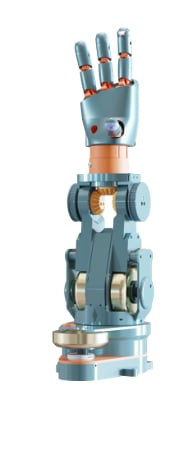
Figure 4. Dexterous humanoid hand
Many current robot-joint designs use 48 V-class supplies. Higher-voltage architectures may reduce current for the same power level and therefore reduce conduction losses and cable cross-section, but they also increase insulation, protection and safety requirements. The appropriate bus voltage depends on robot size, peak power, wiring constraints and the applicable safety architecture.
Closed-loop joint control depends on an encoder that provides the rotor or output-shaft position needed for commutation, position control and motion synchronization. Magnetic, inductive and optical encoders can be selected according to the required resolution, environmental robustness and cost. Accurate position data, combined with phase-current and force or torque measurements, enables the controller to regulate motion precisely and implement compliant behavior.
The joint communication interface carries motion commands, encoder feedback, measured current or torque, temperature and diagnostic information between the actuator and the robot controller. Deterministic timing is important because dozens of joints must update in coordination to maintain balance and execute stable trajectories. CAN-based links remain practical for compact control messages, while single-pair Ethernet can provide a common Ethernet-based path for control, synchronization and diagnostics. A multidrop network can connect several nearby joints on one shared pair, reducing cable and connector count in moving limbs, but designers must still validate update rate, worst-case latency, fault containment and electromagnetic compatibility for the selected control architecture.
Sensing and Perception: Understanding the Environment
Humanoids rely on sensors to estimate both the external environment and their internal state. Cameras, depth sensors, radar, ultrasonic sensors and microphones help identify objects, people and obstacles. Encoders, inertial measurement units, current sensors and force or torque sensors support balance and motion control. Tactile arrays and pressure sensors provide contact information for stable grasping and safe interaction.
Each sensing technology has strengths and limitations. Cameras provide rich image detail and color information but are affected by lighting, glare and occlusion. Time-of-flight cameras and LiDAR estimate distance and support three-dimensional mapping, although range, reflectivity and environmental interference can affect performance. Radar and ultrasonic sensing can complement optical systems in difficult conditions but generally provide less visual detail.
Sensor fusion combines measurements from multiple sources to produce a more useful estimate than any single sensor can provide. It can improve coverage, suppress noise and maintain partial awareness when one input becomes unreliable. Fusion does not automatically guarantee robustness: the system must account for calibration errors, timing differences, conflicting measurements and common failure modes. Reliable perception therefore depends on sensor diversity, synchronization, diagnostics and algorithms that represent uncertainty.
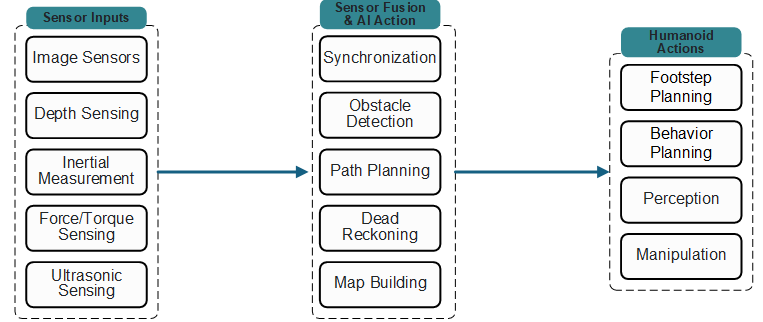
Figure 5. Multimodal sensor fusion converts visual, depth, motion and force measurements into environmental awareness and robot actions
Touch and force feedback become more important as manipulation grows more dexterous. A robot must control not only where its hand moves but also how much force it applies. Joint torque sensing, fingertip force sensors and tactile arrays can help detect slip, estimate contact location and protect fragile objects. These signals also support compliant behavior, which is essential when a robot shares space with people.
Power Systems: Enabling Mobility and Runtime
The power subsystem includes the battery pack, battery management system, protection, power distribution and conversion stages that supply the robot's electronic loads. A main DC bus feeds motor drives and intermediate converters, while point-of-load converters and linear regulators generate the lower voltages required by processors, sensors and communication devices.
Runtime remains a central design constraint because the battery must support locomotion, manipulation, sensing, communication, safety functions and AI processing. Increasing battery capacity can extend operating time, but it also adds mass that the actuators must move. Power design must therefore balance energy density, peak power, conversion efficiency, weight, thermal limits, charging strategy and serviceability.
The battery management system monitors cell voltage, current and temperature and supports balancing and protection. Power distribution circuits detect abnormal current or temperature conditions and isolate faults. Designers may also prioritize critical loads so that control, communication and safety functions remain available during faults or low-energy conditions.
Thermal management connects power design with reliability. Losses in batteries, converters, processors and motor drives generate heat within a tightly packaged platform. Excess temperature can accelerate battery aging, reduce semiconductor performance and limit actuator output. Efficient conversion, careful component placement, thermal monitoring and appropriate cooling are therefore integral to the electrical architecture rather than secondary considerations.
Compute: Coordinating Perception, Planning and Control
A humanoid robot's compute platform may contain high-performance CPUs, GPUs or AI accelerators alongside microcontrollers and dedicated safety devices. These resources process sensor data, estimate the robot's state, build maps, plan paths, generate motion trajectories and run learned models. At the same time, local controllers execute fast, deterministic loops for current, torque, position and balance.
Workload partitioning is essential. High-level processors are well suited to perception, reasoning and task planning, while microcontrollers provide predictable timing for motor control and monitoring. Safety functions may use separate controllers or independent circuits so that faults in the main compute platform do not remove every protective layer.
Distributed intelligence moves selected processing closer to the data source. A vision module can filter or analyze an image stream before forwarding results. A smart joint can close its own control loops and report position, torque, temperature and diagnostic status. This arrangement can reduce central bandwidth and latency, but it also requires time synchronization, secure software management and clear allocation of responsibilities between nodes.
Edge AI extends this concept by performing inference on the robot rather than relying on a continuous cloud connection. Local inference supports faster response and continued operation when external connectivity is unavailable. Cloud resources can still support fleet analytics, model development and software distribution, but safety-critical real-time behavior must be designed around the capabilities available on the robot.
Connectivity: The Robot's Nervous System
Connectivity carries sensor data, control commands, timing information and diagnostics throughout the robot. Internal networks may combine CAN, RS-485, industrial Ethernet and other interfaces according to bandwidth, latency, determinism, cost and wiring requirements. Wireless technologies such as Wi-Fi and Bluetooth can support commissioning, monitoring and external communication, but they are not a substitute for appropriately designed real-time control links.
Higher-resolution cameras and distributed processors increase bandwidth requirements, while coordinated motion requires predictable delivery of time-sensitive messages. Ethernet-based networks are therefore attracting attention because they can provide a scalable, IP-compatible architecture from central compute to distributed edge nodes.
10BASE-T1S provides 10 Mb/s single-pair Ethernet for point-to-point links and optional half-duplex multidrop segments. In multidrop operation, multiple sensors, actuators and controllers share one twisted pair without requiring an Ethernet switch at every node. Physical Layer Collision Avoidance, or PLCA, assigns orderly transmission opportunities on the shared medium, reducing collisions and improving performance underload. When the system supports Ethernet-based time synchronization, measurements and commands from distributed joints can also be aligned to a common time base. In a robot, these characteristics may help reduce harness weight, connector count and protocol gateways across limbs, hands and sensor clusters.
Wiring is also a mechanical concern. Cables pass through moving joints where repeated bending, vibration and limited space can affect reliability. Reducing harness mass and connector count can improve mobility and serviceability, but network consolidation must not create unacceptable single points of failure. Designers must evaluate topology, redundancy, electromagnetic compatibility, connector retention and fault containment.
External links enable remote diagnostics, fleet management, software updates and selected cloud services. These connections expand the attack surface, so authentication, encryption, secure boot, access control and update integrity should be treated as system requirements. Connectivity must provide not only bandwidth but also deterministic behavior, resilience and security.
Conclusion
Humanoid robots bring AI, electromechanics and embedded systems into one mobile platform. Their practical capability depends on five interdependent technology domains: actuation, sensing and perception, power, compute and connectivity. No domain can be optimized in isolation.
Advances in motors and power semiconductors can improve torque density and efficiency, but they must be supported by the battery, thermal system and control algorithms. Richer sensing can improve awareness, but only when compute and communication resources can process the data reliably. Distributed intelligence can shorten response time, but it increases the importance of synchronization, diagnostics, cybersecurity and system-level safety.
The most successful humanoid platforms will not be defined by one component or model. They will be defined by disciplined integration that balances performance, runtime, mass, reliability, cost and safe behavior. As these technologies mature together, humanoids can move from controlled demonstrations toward useful operation in factories, warehouses, commercial facilities, and other human-centered environments.