
 Facebook
 Google
 GitHub
 Linkedin
Industry White Paper
LVDS and M-LVDS Circuit Implementation Guide
In this application note from Analog Devices, learn how LVDS and M-LVDS enable high-speed, low-power, and noise-immune data transmission for industrial and high-performance digital systems. It outlines key design considerations including topology selection, signaling characteristics, termination, PCB layout, and managing jitter and skew to maintain signal integrity at data rates up to and beyond 1 Gbps.
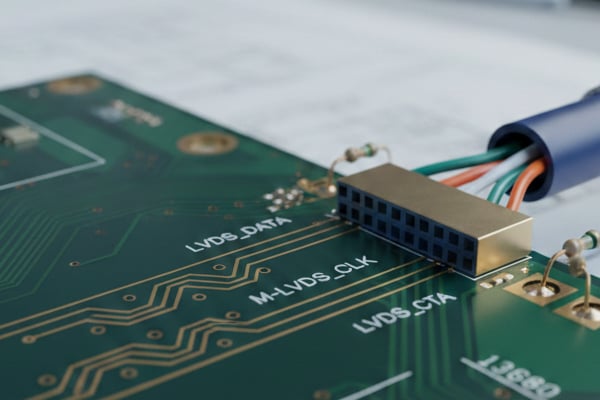
Application Note Overview
Used in industrial backplanes, instrumentation systems, and high-speed board-to-board links, LVDS and M-LVDS enable reliable, low-power data transmission with strong noise immunity and minimal electromagnetic emissions. This application note from Analog Devices explains the fundamentals of Low Voltage Differential Signaling and Multipoint LVDS, comparing them to standards such as RS-485 and CAN while outlining their advantages for high-data-rate, short- to medium-distance communication.
Download this application note to learn how to design robust LVDS and M-LVDS networks, including point-to-point, multi-drop, and multipoint topologies. The guide details signaling characteristics, receiver thresholds, termination strategies, controlled-impedance PCB layout, and data rate versus distance tradeoffs, along with practical techniques to reduce reflections, jitter, and skew for reliable operation from tens of Mbps to beyond 1 Gbps.
The note also addresses timing and synchronization challenges, including channel-to-channel skew, source-synchronous clocking, and embedded clock schemes. In addition, it explores galvanic isolation using iCoupler and isoPower technologies to protect systems from ground loops and high-voltage transients.

