
 Facebook
 Google
 GitHub
 Linkedin
Industry White Paper
Rethinking Automotive Networking: How Automotive Ethernet Enables Software-Defined Vehicles
As vehicle platforms evolve, the traditional model of more than one hundred ECUs, each running independent software, will give way to centralized computing supported by three to five zonal domains and a dramatically reduced ECU count.
It’s common among senior car mechanics to frown upon modern cars and how “everything has become electronics.” Our grandparents can proudly recall how they were able to fix and maintain their cars entirely on their own. Yet when looking under the hood of a modern car, one quickly discovers a complicated electromechanical system. If it feels more like a computer to you, then you are not far from the truth. This system brings increased cost and integration challenges as vehicles grow in complexity.
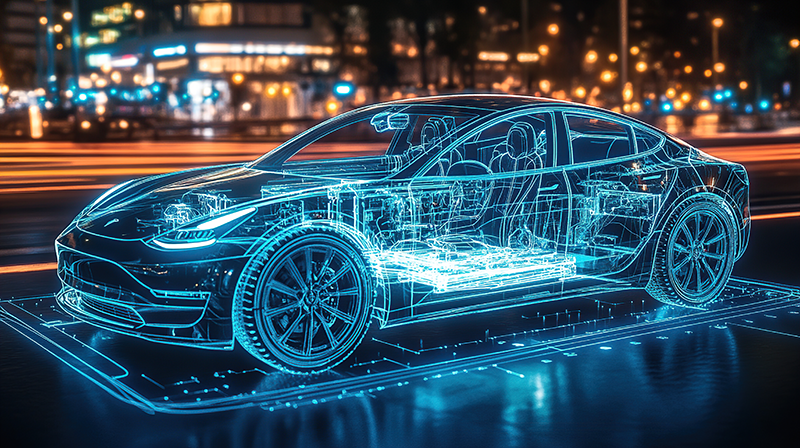
This rapidly growing complexity is a key driver behind new architectural concepts such as software-defined vehicles (SDVs) and zonal architecture. Beyond multiple layers of electrical power distribution and the need for high-bandwidth communication, modern vehicles may incorporate more than 100 ECUs from different suppliers, each with its own software approach. This fragmentation makes software updates, version control, and long-term maintenance increasingly difficult, while extensive wiring and integration requirements contribute to higher manufacturing and tooling costs, particularly in mid- to premium-class vehicles. Several factors contribute to the architectural shifts, including a change in the automotive business model toward subscriptions and services. OEMs are no longer selling only a physical vehicle; instead, they are delivering a continuously evolving digital platform.
To support this model, vehicles must be deeply integrated into the digital ecosystem, enabling them to exchange data, receive updates, and unlock new features over time. Features can now be activated wirelessly through over-the-air (OTA) software updates or via wired connections, such as when an electric vehicle is connected to a home charging station. Let’s look at the vehicle as a connected, upgradable system rather than a static product.
Zonal architecture offers a solution to reducing wiring harness complexity, both for power distribution and in-vehicle communication. This approach divides the car into three to five physical zones, each managed by a zonal controller and controlled by one or a few central computer units, running the main control and functionality software. The SDV concept builds upon this architecture and addresses the software complexity of modern, zonal-based vehicles, enabling more scalable development, simplified updates, and future evolution.
From Distributed ECUs to Centralized Intelligence
Why Software-Defined Vehicles Enable Smarter and Safer Cars
In the software-defined vehicle (SDV) concept, the main application software is run on high-performance computers rather than being distributed across a hundred individual ECUs. While the vehicle still contains the same number of sensors and loads distributed throughout the car, this approach aims to reduce the need for microcontrollers in each ECU and instead emphasizes direct communication from the central computer down to the vehicle’s sensors and actuators.
By pulling software out of individual ECUs and centralizing control and computation in the powerful central computer, software development, updates, and lifecycle management become significantly simpler. With most of the software residing in the central computer, updates and feature upgrades can be deployed more efficiently. Vehicle functionality can be defined at the software level, enabling additional features to be unlocked post-sale through customer service and software updates.
Remote Control Protocol (RCP) is another innovative technology that further supports this model by removing software from edge nodes and sensors. Using RCP, the central computer can send control messages directly to actuator devices over Ethernet, allowing intelligence to remain centralized while keeping edge nodes simpler and more cost-effective.

However, all centralized software must ultimately interface with the vehicle’s physical hardware backbone. To support centralized computing, hierarchical network architectures are required. In these architectures, high-speed Ethernet links, such as 100 and 1000Mbps automotive Ethernet, form the primary communication backbone. This backbone branches off to the zonal controllers and all the way to edge nodes.
Zonal controllers typically connect upstream to the central computer using dedicated 100BASET1 links, forming a robust and deterministic communication backbone. Downstream, zonal controllers interface with sensors and actuators using lower-speed networks such as 10BASET1S, CAN-FD, and LIN. Communication speeds downstream of the zonal controller range from 10 Mbps down to 1 Mbps, and even as low as ~20 kbps for legacy interfaces. Such a hierarchical system requires an architecture that supports flexibility, scalability, and configurable options to accommodate various use cases.

Backward compatibility further complicates system design. Vehicle electronics are rarely redesigned from scratch within a single model generation, requiring designers to bridge legacy and next-generation systems. Vehicles today may integrate multiple communication protocols, often specific to certain subsystems or ECUs, including unconventional interfaces that must remain supported. Some edge nodes continue to rely on low-speed LIN communication for simple, cost-driven applications. Designers must carefully evaluate the trade-offs between maintaining existing in-vehicle networks and introducing new technologies to extend functionality.
Robust Ethernet Communication in Electrically Noisy Automotive Environments
Maintaining signal integrity over long cables has always been a challenge in electrically noisy automotive environments. By combining the properties of the 10BASET1S standard with innovative transceiver IC technology, the T30HM1TS2500 Ethernet transceiver implements Enhanced Noise Immunity (ENI) to ensure reliable vehicle communication over long distances in zonal architecture. With ENI enabled, the communication network can tolerate noise levels well beyond conventional expectations.
Testing has demonstrated reliable signal detection with as little as a 50 mV signal margin, even in the presence of up to 950 mV of noise on a 1 V signal. This capability enables a substantial extension of network reach. While the 10BASET1S standard specifies a minimum supported link length of 25 m, the T30HM1TS2500 has demonstrated robust operation on links up to 150 m. This extended reach provides greater flexibility when implementing two-wire multidrop topologies across long zonal wiring connections.
The combination of multidrop topology and zonal approach significantly simplifies complex network wiring, making systems easier to design, manage, and maintain. Multiple edge nodes can be connected in a bus-like structure using a single twisted-pair Ethernet cable, similar in concept to traditional CAN networks. The 10BASET1S standard supports at least eight nodes on a single multidrop segment, with the ability to connect more depending on implementation and cable length. New nodes can be added with minimal wiring changes, providing the flexibility required for modern and future vehicle platforms.
Physical Layer Collision Avoidance (PLCA) is a key mechanism that enables multiple nodes to share a single multidrop bus while ensuring deterministic and orderly data transmission. In addition to improving timing predictability, PLCA further enhances noise immunity by eliminating collisions entirely. In simple terms, any reflected signal that differs from the transmitted signal can be regarded as noise.
The picture at the bottom shows an example of a vehicle front zone with 4 nodes connected to a 10BASE-T1S network. The front zonal controller handles applications such as the left headlight module, right headlight module, and front door module, connected in a multi-drop configuration.

Each module displays a different standardized way of connecting to the 10BASE-T1S network. A basic transceiver would have a PHY with a standard MII interface. T30HM1TS2500 transceiver has an additional MAC layer, forming a Media Access Controller (MAC-PHY). Different variants of the transceiver complement the complexity of an MCU located inside a module. RCP interface proposes the removal of the MCU (software) from the module entirely.
Bridging Legacy Vehicle Networks with Ethernet‑Based Architectures
As discussed earlier, vehicle electronics are rarely redesigned from the ground up within a single model generation. Cost and simplicity remain decisive factors for many automotive subsystems, particularly in lower-class (economy) vehicles. As a result, some vehicles may continue to use multiple communication protocols, combining high-speed Ethernet with CAN, CAN FD, and LIN across different functional layers. CAN FD provides an interface for combustion engine vehicles, supporting powertrain, chassis, and body electronics where deterministic control is essential. CAN FD transceivers such as the NCV7343 and NCV7344 continue to serve these domains. LIN is predominantly used for low-cost, non-safety-critical edge nodes that don’t require high bandwidth. LIN transceivers such as the NCV7321 and NCV7428 typically support window lifts, seat motors, mirror adjustment, and simple in-cabin functions.
Within zonal architecture, legacy networks are typically terminated at zonal controllers acting as gateways. The zonal controller aggregates CAN and LIN traffic locally and connects upstream to the centralized compute platform via the high-bandwidth Ethernet backbone. This approach enables the integration of existing ECU designs into a modern Ethernet-based architecture, allowing OEMs to evolve toward SDVs while retaining legacy technologies if it’s necessary.
Ecosystem inertia and safety qualification reinforce the continued use of these legacy networks. Replacing these networks requires careful technical and economic evaluation. Despite the investment to redo existing architecture, transitioning to entirely Ethernet-built vehicles is where the biggest cost savings lie. Building the sole Ethernet network allows you to get rid of expensive gateways that are only translating between protocols. SW maintenance goes down drastically, and even some power lines can be removed thanks to Ethernet’s PoDL ability.
As the automotive industry moves toward higher levels of autonomy and connectivity, software-defined vehicles (SDVs) become a critical enabler of both innovation and quality of life. Autonomous driving technologies promise improved safety and greater comfort, transforming time spent in traffic from an active, stressful task into productive or relaxing moments. Achieving this vision requires a fundamental shift in vehicle architecture.
The ultimate goal of an SDV is a system where data flows seamlessly from centralized computing platforms to the furthest edge nodes. Automotive Ethernet, with its scalable bandwidth, consistent frame structure, and inherent support for cybersecurity, enables hierarchical network designs that span from gigabit backbones to low-speed zonal and edge connections.
Smart actuators and edge sensors capable of reporting their state and receiving commands complete this architecture. Together, zonal design and Automotive Ethernet provide a robust, future-proof foundation that allows automakers to deliver safer vehicles, richer digital services, and continuous innovation throughout the vehicle lifecycle.
Additional Resources
- Automotive Solutions - Zonal Architecture
- Webinar - Streamlining Vehicle Designs with Automotive Zonal Solutions
- How 10BASE-T1S Enables a New Generation of Software-Defined Vehicle

