
 Facebook
 Google
 GitHub
 Linkedin
Industry White Paper
ROHM’s RS7xxxxBx Series MOSFETs: Driving Performance & Reliability in Server Power Applications
Cloud computing and AI applications have exponentially increased the power needs of data center infrastructure.
Cloud computing and AI applications have exponentially increased the power needs of data center infrastructure. With higher computational demands, power management solutions at these facilities must also advance to support reliable and efficient operation. Server power supplies are critical components in this ecosystem, directly influencing system performance, reliability, and total cost of ownership (TCO). The challenge lies in simultaneously achieving high power density and efficiency in these systems with fluctuating workloads, and ensuring reliability in mission-critical environments.

Image used courtesy of Adobe Stock
The RS7xxxxBx Series MOSFETs from ROHM address these challenges through advanced semiconductor design and packaging, achieving industry-leading performance metrics. This whitepaper explores how ROHM’s MOSFETs achieve high performance, improved reliability, and efficiency in enterprise and AI server power applications.
Power Supply Design Challenges in Server Applications
Engineers working on modern server designs face the challenge of delivering more power in increasingly small spaces while maintaining or increasing the efficiency. As computational capabilities rise, power supplies are handling greater loads—sometimes exceeding 3kW in high-performance applications—while conforming to standardized rack dimensions.
Power density challenges are stark in AI servers, where accelerator cards typically demand substantial power in short bursts. Moreover, efficiency standards are becoming stricter, with regulations like 80 PLUS Titanium and ErP Lot 9 (in the European Union) pushing minimum efficiency requirements to unprecedented levels. For example, 80 PLUS Titanium certification requires up to 96% efficiency at 50% load, placing immense pressure on power component selection and design. Such high efficiency targets must be maintained across varying load conditions, from light loads in idle states to full power during computational peaks.
The Need for Low On-resistance in Power MOSFETs
One of the main factors affecting power supply efficiency in server applications is conduction losses within power MOSFETs. The reason for this is that the on-resistance, RDS(on), of the MOSFET influences the power dissipated during operation. Lower conduction losses tend to translate into low operating temperatures, simplifying thermal management complexity while reducing thermal stress on semiconductor materials. However, achieving low on-resistances involves the use of larger silicon die sizes, which increases the overall size of the MOSFET.
High Safe Operating Area (SOA) Capability
Power supply systems for AI servers must be designed to withstand frequent load transients during operation. For example, AI accelerators rapidly shift from idle to full power, placing demand on power delivery components. However, MOSFETs with high Safe Operating Area (SOA) capability can withstand demanding conditions without failure. A high SOA provides protection in abnormal conditions, including short-circuit, input voltage fluctuations, and load transients. For example, in Hot Swap Controller (HSC) circuits for protecting server systems during live insertion and removal of components, MOSFETs can handle current and voltage spikes. This ability ensures that the components downstream remain protected and avoids system failures that may result in unplanned downtime.
Space Constraints & Thermal Management Considerations
Servers pack increasing computational power into smaller form factors, leaving limited PCB room for power components. This constraint drives the need for compact, higher-performing MOSFETs to handle power needs without excessive space requirements.
Thermal management is another challenge. In high-efficiency components, the concentrated power in AI servers create substantial heat that must be dissipated efficiently. MOSFETs with low thermal resistance and improved heat dissipation are ideal to reduce server cooling requirements and help to maintain safe operating temperatures.
ROHM’s 6th-Generation Si MOSFET Technology
ROHM’s 6th-generation Si MOSFETs are designed for power supplies in high-performance enterprise and AI servers. These devices offer high current density and high SOA capability while minimizing the on-resistance.
Industry-leading Low On-resistance
ROHM RS7xxxxBx Series achieves remarkable improvements in on-resistance compared to previous-generation devices. Specifically, the RS7E200BG (30V) achieves a 39% reduction in on-resistance compared to ROHM's RS6E120BG in an HSOP8 package, with a RDS(on) value of 0.53mΩ at VGS = 10V. Similarly, the RS7N200BH (80V) achieves a 39% reduction compared to RS6N120BH, offering a RDS(on) of 1.7mΩ at VGS = 10V.
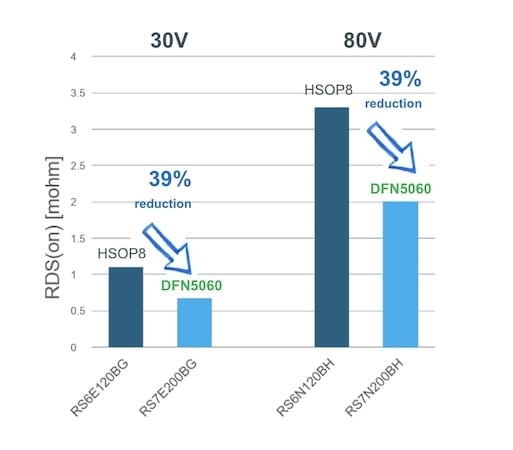
Figure 1. Reduction in on-resistance in the DFN5060-8S vs. HSOP8 package.
DFN5060-8S Package Technology
The DFN5060-8S package of the RS7xxxxBx Series MOSFETs offer several improvements over HSOP8 designs while maintaining a compatible footprint for backward compatibility. A key advantage of the DFN5060-8S is its approximately 65% larger die size compared to HSOP8 in the same dimensions. This enlarged die area directly contributes to lower on-resistance and improves current handling—maximizing performance within the given footprint constraints.
Notably, the DFN5060-8S contains an internal copper clip design that replaces the standard aluminum wire bonding in older package technologies.
The copper clip structure provides the following advantages:
- Lower resistance path for current flow, reducing internal package resistance
- More uniform current distribution across the die, eliminating hot spots
- Improved thermal conductivity, improving heat dissipation
- Reduced parasitic inductance, improving the switching performance
- Increased durability against thermal cycling and mechanical stress
RS7xxxxBx Series MOSFETs Key Specifications
RS7E200BG (30V)
The RS7E200BG is ROHM’s flagship 30V MOSFET designed specifically for 12V enterprise server power supplies and HSC circuits.
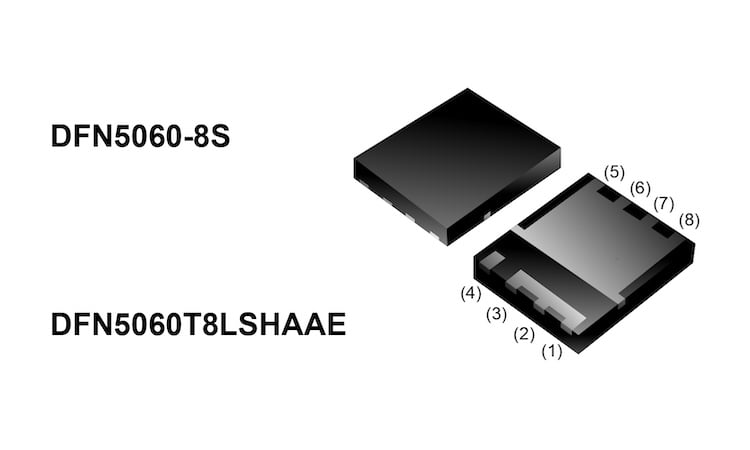
Figure 2. Outline of the DFN5060-8S package.
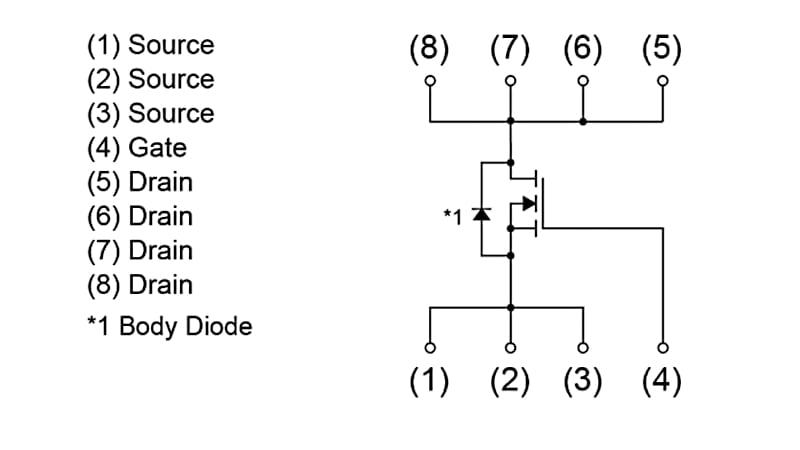
Figure 3. Inner circuit schematic for the DFN5060-8S package.
Below are key specifications of the RS7E200BG:
- On-resistance: 0.53mΩ (Typ.) @ VGS = 10V, 0.67mΩ (Max.) @ VGS = 10V
- Continuous drain current (ID): 390A
- Power dissipation (PD): 180W
- Gate charge (Qg): 180nC (Typ.) @ VGS = 10V
- Input capacitance (Ciss): 18900pF (Typ.)
- Gate-drain charge (Qgd): 25nC (Typ.)
- SOA capability: over 70A (pulse width = 1ms, VDS = 12V)
The combination of ultra-low on-resistance and high SOA capability makes the RS7E200BG ideally suited for 12V point-of-load (POL) converters, as well as secondary-side synchronous rectification in enterprise server power supplies.
RS7N200BH (80V) & RS7N160BH (80V)
48V power distribution architectures in AI server applications require Si MOSFETs with high voltage rating and high-performance characteristics. RS7N200BH and RS7N160BH address these requirements with 80V ratings and optimized specifications for 48V systems.
The RS7N200BH offers:
- On-resistance: 1.7mΩ (Typ.) @ VGS = 10V, 2.0mΩ (Max.) @ VGS = 10V
- On-resistance: 2.1mΩ (Typ.) @ VGS = 6V, 2.9mΩ (Max.) @ VGS = 6V
- Continuous drain current (ID): 230A
- Power dissipation (PD): 180W
- Gate charge (Qg): 110nC (Typ.) @ VGS = 10V
- Input capacitance (Ciss): 9200pF (Typ.)
- Output capacitance (Coss): 860pF (Typ.)
The RS7N160BH offers:
- On-resistance: 2.2mΩ (Typ.) @ VGS = 10V, 2.6mΩ (Max.) @ VGS = 10V
- On-resistance: 2.7mΩ (Typ.) @ VGS = 6V, 3.8mΩ (Max.) @ VGS = 6V
- Continuous drain current (ID): 160A
- Power dissipation (PD): 160W
- Gate charge (Qg): 84nC (Typ.) @ VGS = 10V
- Input capacitance (Ciss): 7000pF (Typ.)
- Output capacitance (Coss): 650pF (Typ.)
Key Applications
12V System AC-DC Conversion and HSC Circuits in Enterprise Servers
Enterprise servers typically employ a multi-stage power architecture with AC-DC converters, followed by DC-DC stages. For secondary-side synchronous rectification in 12V outputs, the RS7E200BG's ultra-low 0.53mΩ on-resistance minimizes conduction losses, which often dominate in low-voltage, high-current outputs.
In HSC circuits, the RS7E200BG’s high SOA capability (70A at pulse width=1ms, VDS=12V) ensures protection against current surges and transients during live insertion and removal events, reducing the risk of device failures. In addition, the RS7E200BG’s low on-resistance reduces the voltage drop across the HSC circuit during normal operation.
48V System AC-DC Conversion in AI Servers
AI servers with GPU/ASIC accelerators currently use 48V power architectures to support high power densities and lower distribution losses. RS7N200BH/RS7N160BH MOSFETs are optimized for applications like 48V Buck converters and Bus converters, for example, where the devices can achieve the right balance of conduction and switching losses.
Servers also experience substantial load transients as accelerators shift between computing and “idle” states. The high SOA capability of the RS7N200BH/RS7N160BH offers protection during transient events, while low thermal resistance maintains safe operating temperatures, even under dynamic loading conditions.
Industrial 48V Power Supplies
Industrial automation and control systems require reliable power MOSFETs that can handle various environmental conditions. Industrial-grade variants of the RS7xxxxBx, with operating temperatures from -55°C to +175°C, ensure reliable performance in the harshest conditions. Efficiency improvements from using the MOSFETs can ultimately translate into reduced heat generation and small heatsink requirements. In space-constrained designs, these MOSFETs also provide high density power without compromising reliability or performance.
Manufacturing Capabilities & Supply Chain
ROHM has established reliable manufacturing infrastructure to support volume production of the RS7xxxxBx Series MOSFETs. Front-end wafer fabrication takes place at ROHM’s Shiga Factory in Japan, leveraging the company’s vertically integrated manufacturing model. This facility employs state-of-the-art equipment and processes to ensure consistent high quality and performance. Vertically integrated manufacturing provides ROHM control over the entire production process, enabling tight process monitoring and quality assurance at every step.
Back-end assembly and testing are also performed at ROHM’s Outsourced Semiconductor Assembly and Test (OSAT) facility in Thailand. Current production for the RS7xxxxBx Series stands at 1 million units per month, with scalability to meet growing market demand. ROHM continuously monitors market trends and customers’ needs to align production capacity with anticipated demand, ensuring stable supply for server and industrial applications.
Conclusion
ROHM’s RS7xxxxBx Series MOSFETs address the challenges of power efficiency, density, and reliability in servers. These devices contribute to more sustainable and capable data center infrastructure, while supporting the growth of cloud computing and AI workloads.
ROHM is committed to continued innovation in power semiconductor technology with future expansions to the current product lineup. This expansion includes power MOSFETs optimized for AI server hot swap controller circuits planned for release in 2025.
For additional information on RS7xxxxBx Series MOSFETs or to discuss specific application requirements, please visit the ROHM website or contact ROHM online.
This Industry White Paper was written by Heath Hiroyuki Ogurisu, ROHM Semiconductor.

