Facebook
 Google
 GitHub
 Linkedin
Ambient Scientific Lends AI Processor to Women’s Safety Wearable
The MAI device from Dimension NXG runs AI models continuously on a 180-mAh battery for up to 14 days, using analog in-memory compute to keep power consumption at microwatt levels.
Ambient Scientific and Indian deep-tech firm Dimension NXG announced a partnership at Embedded World 2026 to produce MAI, an AI-powered wearable designed for women's health monitoring and personal safety in India.
The device is built around Ambient Scientific's GPX-10 processor, which runs sensor-fusion and audio-classification models directly on the device, without requiring cloud connectivity or a paired smartphone. The companies have already launched field trials, with thousands of units shipping to pre-order customers and trial participants across India.
GP Singh, CEO of Ambient Scientific, spoke to All About Circuits at Embedded World about the chip at the heart of the device.

Ambient Scientific CEO GP Singh holds the MAI wearable in one hand (right) and the tiny GPX-10 chip on his index finger (left).
Practical, Always-On AI
The GPX-10's efficiency comes from its DigAn architecture, which combines digital and analog components to sidestep the Von Neumann bottleneck that limits conventional processors.
“It's called GPX-10. It has 10 of our own AI cores which we developed from the ground up,” Singh said. “And it has a very complex, sophisticated sensor fusion mechanics. And all this runs on just a few hundred microwatts.”
Rather than shuttling data back and forth between memory and compute units, the GPX-10 performs matrix multiplication directly within custom memory arrays. Its 10 AI cores execute up to 2,560 multiply-accumulate operations per clock cycle, delivering a peak throughput of 512 billion operations per second (GOPS).
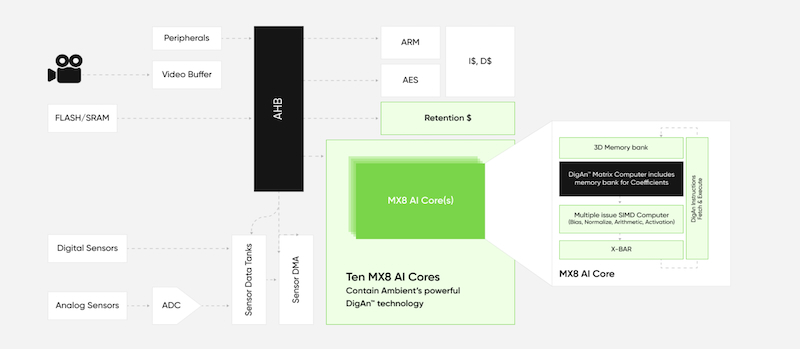
The GPX10 architecture. Image used courtesy of Ambient Scientific
For the MAI wearable specifically, that translates to 10 to 14 days of continuous AI processing on a 180-mAh battery. Abhiskeh Tomar, Dimension NXG’s CTO, said that it’s Ambient Scientific’s process that gave them the “performance headroom” to run intelligence on the wearable itself, with low latency and privacy, while still achieving up to 14 days’ battery life on the 180-mAh battery.
Speaking to All About Circuits, Singh was blunt about the design philosophy behind always-on operation.
“We don't believe in this ‘sleep mode’ crap,” he said, adding that sleep mode means electronics go to sleep. “It just takes a second for something to go wrong. If somebody else has to wake it up, where is the intelligence?”
The chip includes an Arm Cortex-M4F co-processor, a built-in, ultra-low-power ADC, and interfaces for up to eight simultaneous analog sensor inputs. Ambient Scientific's SenseMesh hardware layer handles low-latency sensor fusion by offloading sensor polling entirely from the CPU.
Health Monitoring and a Built-In Safety Layer
MAI continuously tracks heart rate and SpO2, building a personalized baseline over time so it can flag meaningful deviations. Dimension NXG says the device can also identify early risk indicators for conditions like PCOS and PCOD by identifying long-term physiological trends that might otherwise go unnoticed before clinical intervention is needed.
The safety features include fall detection, SOS gesture recognition, and opt-in stress-cue monitoring, all processed locally on the device. Because the GPX-10 handles data on-chip, sensitive biometric information stays private by default. Only data that the user explicitly agrees to share gets sent to the cloud.
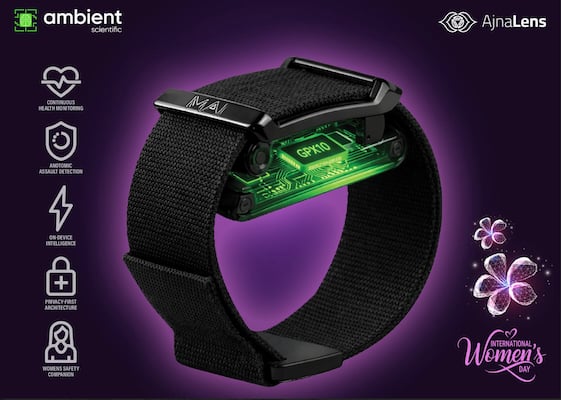
The MAI device. Image used courtesy of Ambient Scientific
Singh says the project grew out of personal loss.
“The company got launched because of my personal problem,” he said. “I lost a family member. When that person fell, there was nobody around. Before somebody could come, he could not survive.”
He described searching for an existing solution and finding only bulky devices with manual panic buttons.
“I said, ‘Man, everything is wrong with this damn thing,’” Singh recalled. “It has to look like jewelry.”
That emphasis on form factor and affordability carried through to the MAI design. Singh said the device will retail for less than $30, a price point intended for mass adoption in India.
Field Trials to Begin
Following the Embedded World announcement, MAI entered its first major field trial phase on March 19. Dimension NXG plans to scale deployment to more than 10,000 units by the end of 2026 as the product pursues additional medical-grade certifications. The extended battery life and offline processing are designed specifically for regions of India where consistent access to electricity and mobile network coverage cannot be guaranteed.
Related Content