Facebook
 Google
 GitHub
 Linkedin
Keysight Fits Two 20 GHz Signal Generators Into a Single 2U Chassis
The PSG XG7-class SG6311A achieves a phase noise of -135 dBc/Hz at 10 GHz and calibrated output power up to +22 dBm across both channels.
Keysight Technologies has introduced the SG6311A, a dual-channel, 20-GHz analog signal generator in the PSG XG7 class. The instrument houses two fully independent signal-generation channels in a standard 2U rack-mount chassis, doubling test capacity without adding rack space.
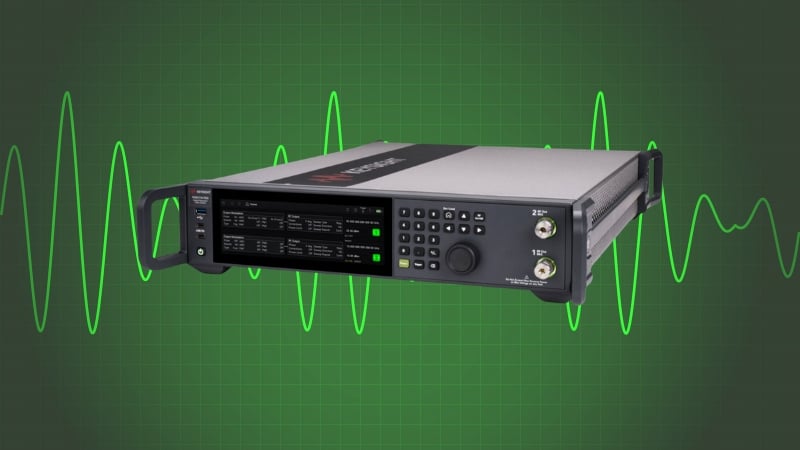
The SG6311A analog signal generator.
The SG6311A targets aerospace and defense, advanced wireless, and high-speed digital test environments where signal purity and measurement throughput are both critical.
Ultra-Low Noise Across Three Metrics
The SG6311A's noise specifications focus on three measurements at 10 GHz. Phase noise reaches -135 dBc/Hz at a 10 kHz offset, amplitude modulation noise sits at -150 dBc/Hz at the same offset, and the broadband noise floor measures -166 dBc/Hz. Together, these figures define how cleanly the instrument can stimulate a device under test without its own noise contributions masking the device's true performance characteristics.
In sensitive measurements such as receiver characterization, radar component testing, and phase-array antenna evaluation, the test signal source itself can become the limiting factor. A signal generator with insufficient spectral purity adds its own noise signature to the measurement, making it hard to distinguish the device's genuine performance from artifacts introduced by the test equipment. The SG6311A's noise floor is designed to push that boundary, giving engineers greater visibility into the devices they characterize.

Measured phase noise of reference outputs.
Calibrated output power of up to 22 dBm helps compensate for signal losses in long cable runs and complex fixturing setups. In test configs with significant path loss between the generator and the device under test, insufficient output power forces engineers to add external amplifiers or accept reduced measurement dynamic range; the 22-dBm ceiling provides headroom for lossy test setups without additional amplification hardware.
It’s worth noting the emphasis on calibrated power. Raw output power specs are common across signal generators, but calibrated figures account for the instrument's internal losses and variations, giving engineers a more reliable reference for what reaches the cable connector.
Dual Channels and Backward Compatibility
Each of the two channels operates independently, allowing engineers to run separate signal-generation tasks from a single instrument. Users can run two-tone intermodulation testing, differential signal generation, and parallel device characterization without dedicating a second rack-mount slot or a second instrument.
For labs already running near capacity, two generators in the space of one frees up physical rack units for other equipment. In high-throughput production test environments, where multiple devices must be characterized simultaneously, the dual-channel design can halve the per-station instrument count for signal generation.
The SG6311A (datasheet linked) uses a hybrid architecture with software-based mode switching, allowing engineers to optimize the instrument's operating configuration for different application requirements without hardware changes. The instrument supports SCPI commands for test automation and maintains rear-panel connections compatible with previous-generation PSG instruments. This backward compatibility means existing test setups, cabling, and automation scripts built around earlier PSG signal generators can transition to the SG6311A with minimal rework.
Well-Defined Applications
Signal generators at this performance tier serve a well-defined but demanding set of applications. Aerospace and defense programs require clean stimulus signals for radar subsystem testing, electronic warfare receiver evaluation, and satellite communications payload characterization.
Meanwhile, advanced wireless development demands precise signal sources for 5G and 6G component validation, where modulation quality and spectral purity directly affect system-level performance. High-speed digital applications rely on low-jitter clock sources and reference signals from instruments with tight phase-noise specifications, where even small degradations in signal purity can measurably increase bit error rates.
Keysight's PSG line has been a fixture in RF and microwave test laboratories for over two decades. The XG7-class designation positions the SG6311A as the current generation of that product family, with the dual-channel architecture representing a departure from the single-channel designs that characterized earlier PSG models such as the E8257D. For labs that have standardized on PSG instruments and built institutional knowledge around their operation, the familiar interface and automation compatibility lower the barrier to upgrading.
All images used courtesy of Keysight Technologies.
Related Content