Facebook
 Google
 GitHub
 Linkedin
MediaTek Redefines Generative AI at the Edge With Two IoT Platforms
IoT devices today have steep demands: fast edge processing, low power consumption, and advanced multimedia features. MediaTek aims to deliver on all of these fronts with two new platforms.
At Embedded World 2025, MediaTek introduced the Genio 720 and Genio 520, two AI-enabled IoT platforms designed to accelerate edge computing for generative AI applications. These chipsets are built on a 6-nm process to optimize performance and efficiency for smart home, retail, industrial, and commercial IoT devices.
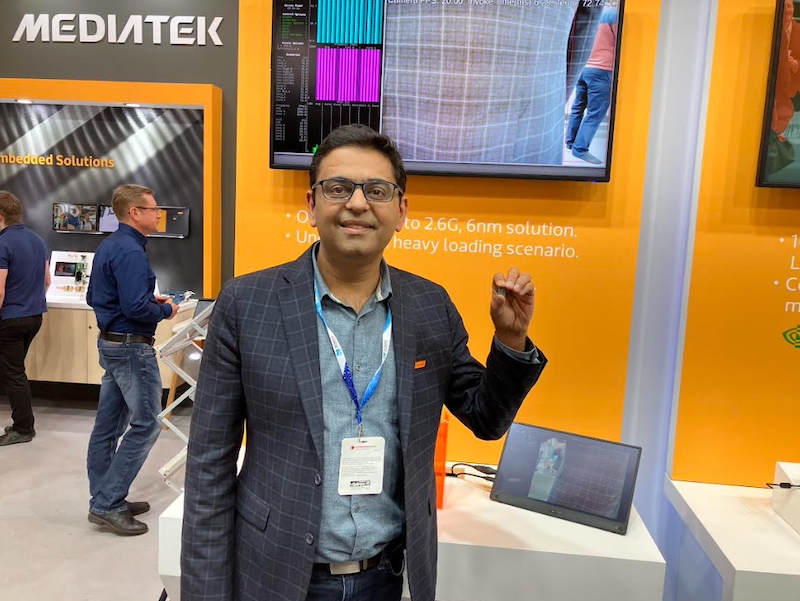
MediaTek’s Sameer Sharma at Embedded World 2025.
Genio 720: An Advanced IoT Platform With Gen AI
The newly released Genio 720 integrates an octa-core CPU, a dedicated AI accelerator, and extensive connectivity support for generative AI applications at the edge. The CPU architecture includes two Arm Cortex-A78 cores, which operate at up to 2.6 GHz for computationally intensive workloads, and six Arm Cortex-A55 cores, which optimize power efficiency for background processing. The integrated Arm Mali-G57 MC2 GPU is clocked at up to 1.1 GHz and supports OpenGL, OpenCL, and Vulkan APIs.
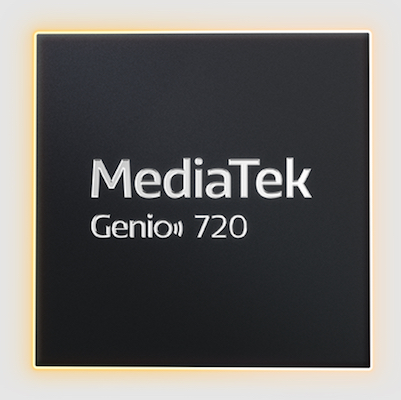
MediaTek Genio 720.
For AI acceleration, the platform incorporates an 8th-generation neural processing unit (NPU) that achieves a combined AI performance of 10 TOPS through hardware acceleration for transformer and convolutional neural network (CNN) models. Meanwhile, the memory subsystem supports up to 16 GB of LPDDR5 memory with a data rate of up to 6,400 Mbps and the storage interface includes UFS 3.1 (two-lane) and eMMC 5.1.
Genio 720 supports multi-camera processing with an internal dual image signal processor (ISP) that handles up to 32 MP at 30 fps or dual 16 MP sensors. The display pipeline includes support for single 5K or dual 2.5K displays with DisplayPort over USB Type-C, embedded DisplayPort (eDP) 1.4, and MIPI DSI. The video engine supports 4K60 HEVC and H.264 decoding and 4K30 encoding for high-efficiency video applications.
For connectivity, the platform features integrated Wi-Fi 6 and Wi-Fi 6E with optional Wi-Fi 7 and 5G RedCap module support. The I/O suite includes PCIe Gen2, USB 3.2 Gen1, and multiple UART, I2C, and SPI interfaces to ensure flexible peripheral expansion.
Genio 520: Adding Multimedia and Interactive HMI
Similar to the 720, the MediaTek Genio 520 provides an efficient edge AI computing platform for IoT applications. This device’s octa-core CPU architecture integrates two Arm Cortex-A78 cores at a lower 2.2 GHz alongside six Arm Cortex-A55 cores operating at up to 2.0 GHz for commercial-grade applications and 1.8 GHz for industrial-grade configurations. An Arm Mali-G57 MC2 GPU reaches clock speeds up to 880 MHz and also provides support for OpenGL, OpenCL, and Vulkan to enhance AI-accelerated graphics workloads. Like the Genio 720, the Genio 520 features MediaTek’s 8th generation, 10 TOPS NPU with the same memory subsystem.
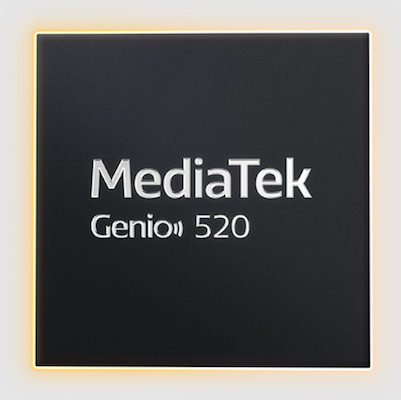
MediaTek Genio 520.
For display connectivity, the Genio 520 supports multi-camera applications through an internal ISP that processes dual 16 MP sensors at 30 fps. The display pipeline enables single 5K60, 4K60, or dual FHD+ configurations to accommodate high-resolution human-machine interface (HMI) applications.
Genio 520 comes with the same wireless and I/O connectivity options as Genio 720.
Scaling AI at the Edge
As generative AI applications expand beyond cloud infrastructure, hardware optimized for efficient, real-time inference at the edge becomes increasingly necessary. The MediaTek Genio 720 and Genio 520 may address this demand by integrating AI acceleration, high-speed connectivity, and broad OS support into a compact, power-efficient design.
MediaTek plans to sample the Genio 720 and Genio 520 to customers in Q2 2025, with reference designs supporting Open Standard Module (OSM) compatibility available now.
All images used courtesy of MediaTek.