Facebook
 Google
 GitHub
 Linkedin
New Automotive Sensors Drill Down on Control, Precision, and Heat
Allegro Microsystems, TDK, and Diodes Incorporated have released new magnetic sensors to tackle motor control accuracy and thermal management in next-gen vehicles.
The drive toward electrification and advanced driver assistance systems (ADAS) has spiked demand for precise current and position sensing in automotive applications. Industry leaders like Allegro Microsystems, TDK, and Diodes Incorporated have each recently launched new magnetic sensor products to sharpen performance in automotive systems. Let’s look at the highlights of each company’s new releases.
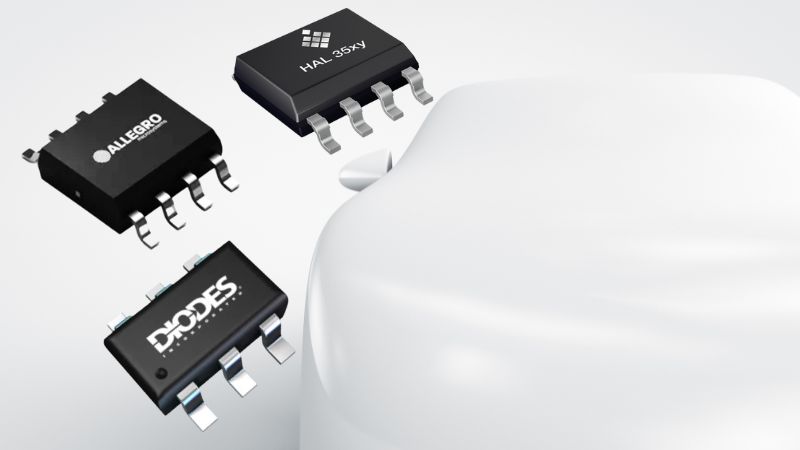
Allegro's Current Sensors and Fan Driver IC
Allegro Microsystems recently introduced three components to improve automotive motor control accuracy and thermal management.
The first is the ACS37035 current sensor (datasheet linked), which integrates a 1-MHz bandwidth and achieves a typical response time of 0.45 µs to support fast control loops. The sensor's differential sensing architecture and 4-mA/Gauss CMRR help to reject external magnetic interference. Allegro calibrated the device for a ±3% sensitivity error over temperature and a ±15-mV maximum offset voltage to provide high linearity and precision in switch-mode power supplies and servo motor controllers.
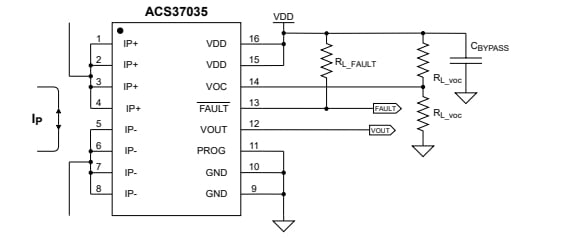
Typical application circuit of the ACS37035. Image used courtesy of Allegro Microsystems
The ACS37630 current sensor uses vertical Hall technology to detect current flowing parallel to the surface of the IC package. Allegro designed the device for U-core current sensing in EV traction inverters and battery management systems. Its contactless operation removes the need for bulky C-core magnets. The device provides 250-kHz analog bandwidth with a 1.6-µs typical response time and operates from -50°C to +150°C. It also features ±0.7% sensitivity accuracy and a ±5-mV offset.
Finally, Allegro’s A89347 fan driver IC is an automotive-grade, sensorless, three-phase BLDC driver with embedded sinusoidal commutation. The chip integrates closed-loop speed control to minimize noise and vibration during fan operation. An EEPROM-configurable speed curve supports fine-tuned airflow control. Slew rate control and lock detection protect motor integrity, while a low-power standby mode draws only 10 µA to extend battery life.
TDK’s Hall-Effect Position Sensor
TDK has announced the HAL/HAR 35xy 2D Hall-effect position sensor family for automotive and industrial applications.
Within the family, the HAL 3550 and HAR 3550 are 2D position sensors designed to measure either angular position over a full 360° range or linear displacement. These sensors use proprietary 3D HAL technology with a Hall plate array to measure magnetic field vectors and reject stray magnetic interference. With this technology, they only require a two-pole magnet to detect rotation, and they support off-axis measurements.
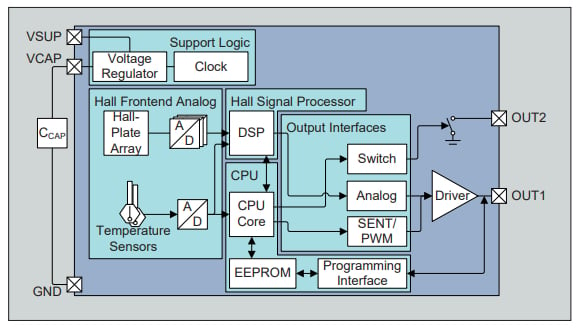
Block diagram of the HAL 3550. Image used courtesy of TDK
The HAL 3550 is a single-die sensor in an SOIC8 package, while the HAR 3550 integrates dual dies in a TSSOP16 package to provide redundant measurements for functional safety. Both devices comply with ISO 26262 as ASIL C-ready SEooC components and operate between -40°C and 150°C. They also support supply voltages from 4.0 V to 18 V. Output interfaces include ratiometric analog, SENT (per SAE J2716 Rev. 4), and PWM with configurable frequencies from 0.1 kHz to 2 kHz. Each sensor provides a separate switch output derived from position data. Output linearization supports 17 equidistant or 7 custom-spaced setpoints to accommodate non-linear magnetic circuits.
Diodes’ 3D Magnetic Hall Sensor
Diodes Incorporated’s new AH4930Q is a 3D magnetic linear Hall sensor for automotive and industrial applications.
The new device (datasheet linked) integrates three orthogonally-oriented Hall elements with a signal chain that includes a:
- Fully differential analog front-end
- Chopper-stabilized amplifier for offset reduction
- 12-bit ADC for high-resolution magnetic flux measurement
- Digital signal processor configured as a finite state machine to process X, Y, and Z vector components
With this configuration, the sensor supports magnetic field measurements across ±1,300 Gauss in each axis with a resolution of 1 Gauss per least significant bit. It maintains a low RMS noise floor of 1 Gauss.
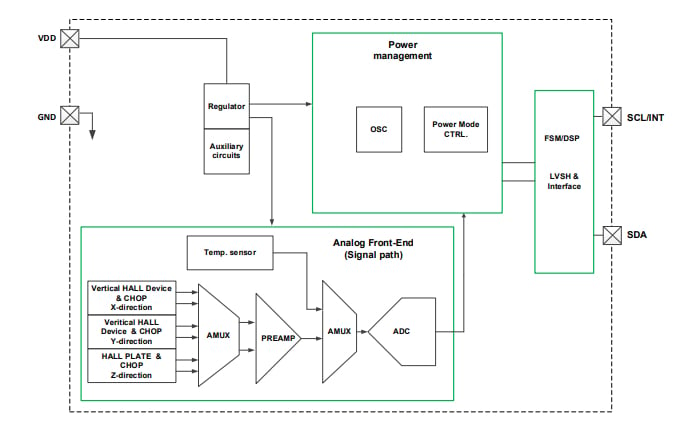
AH4930Q functional block diagram. Image used courtesy of Diodes Incorporated
The device operates across a supply range of 2.8 V to 5.5 V and remains functional from -40°C to +125°C. It also features multiple programmable operating modes, including continuous (3.3 kHz), low-power (83.3 Hz), and ultra-low-power (10 Hz) modes, with corresponding average current consumption of 3.8 mA, 95 μA, and 13 μA. Power-down current drops to 9 nA. An integrated bandgap-referenced temperature sensor provides ±10°C accuracy at 25°C with 1°C resolution to unlock temperature drift compensation.
Magnetic Sensing Evolves With System-Level Demands
OEMs and Tier 1 suppliers continue to pursue more compact and reliable electronic architectures, and that means magnetic sensors must offer greater functional density without introducing system complexity. These new devices from Allegro, TDK, and Diodes meet these requirements by merging high-accuracy current and position sensing with diagnostic and power-saving features.
Related Content