Facebook
 Google
 GitHub
 Linkedin
NXP Unwaps Unified Robotics Platform for Trusted Physical AI Designs
Announced today, NXP’s new unified robotics platform provides a "neural axis" architecture and pre-validated drone reference designs to accelerate trusted physical AI system deployment.
Today, ahead of Electronica this week, NXP Semiconductors introduced a unified robotics platform aimed at accelerating the deployment of trusted physical AI systems. Featuring a modular, open-source software development kit (SDK) and pre-validated hardware reference designs, the platform provides a consolidated foundation for robotic development.
By integrating AI processing, real-time control, sensor networking, and motor control into a single interoperable ecosystem, NXP states that developers can achieve initial drone functionality out of the box in 30 minutes.
Biomimetic "Neural Axis" Architecture
The foundation of NXP's new platform is its proprietary "neural axis" architecture, which distributes system requirements across three distinct functional layers:
- Cerebrum (Reasoning Layer): Handles high-level processing, scalable compute, and AI inference.
- Cerebellum (Coordination Layer): Manages real-time coordination, safety-protected control, and motion intelligence.
- Spinal Cord (Reflexive Layer): Operates edge sensing capabilities, deterministic networking, and direct motor control.
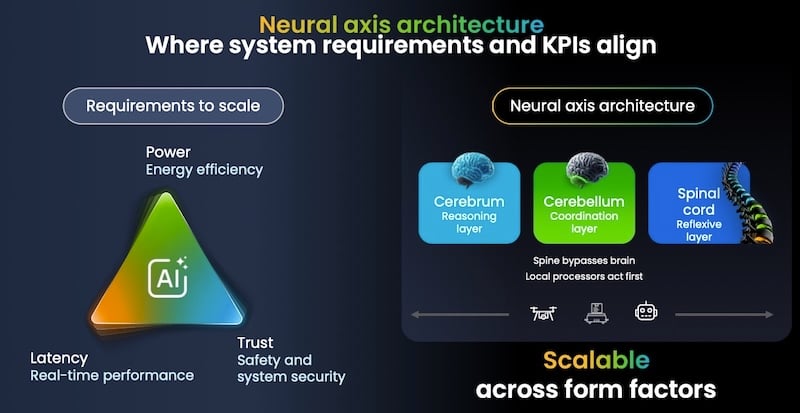
The news platform offers a ‘neural axis’ architecture.
A core hardware design principle of this architecture is that the "spine bypasses the brain". Local processors are permitted to act immediately on sensory data, reducing network latency and ensuring highly deterministic control without waiting on the central computing cluster.
Pre-Validated Drone Hardware Reference Designs
To shorten development cycles and reduce integration risks, the platform includes a suite of hardware building blocks. The initial reference designs target drone applications and deploy a range of NXP microcontrollers (MCUs) and application processors:
- NavQ95: Acting as a companion compute module, this hardware utilizes the i.MX 95 applications processor to handle onboard AI perception and real-time vehicle management. It utilizes a PCIe-based interface for scaling AI acceleration and relies on an open-source Yocto design running Ubuntu 24.04 and ROS 2 Jazzy.
- Tropic VMU/FMU: A compact flight management unit built on the i.MX RT1064 crossover MCU. It manages deterministic real-time flight control and integrates UART, I2C, SPI, and CAN networking interfaces.
- 100Base-T1 Sensor Node: Powered by the MCX N947 MCU, this node facilitates intelligent networking for distributed sensors. It features 100BASE-T1 Ethernet, dual CAN interfaces, and utilizes the ZROS and Zenoh frameworks to process data locally and convert hardware operations into ROS 2 software topics.
- AM32-Compliant ESC: An open-source electronic speed controller based on the MCX A13 MCU. Designed for optimal size, weight, and power (SWaP), the controller measures 42 mm by 24 mm and executes trapezoidal brushless DC (BLDC) motor control.
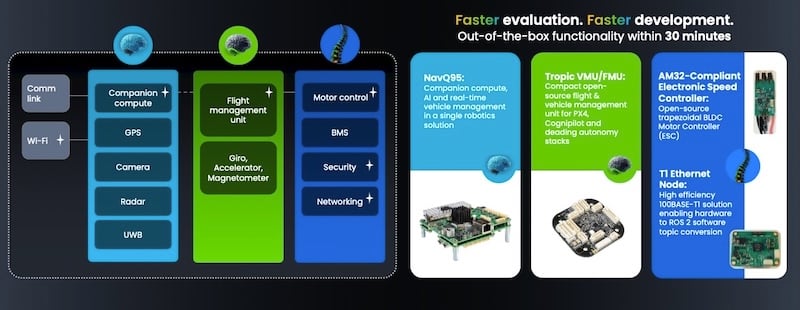
The platform includes a Robotics SDK and drone reference designs.
Open-Source SDK and Future Availability
NXP’s open-source robotics SDK supports the hardware by offering unified middleware integration, drivers, and reusable software components. The software stack natively integrates established industry frameworks, including ROS 2, Linux, NuttX, Zephyr, and PX4. This unified entry point allows developers to build, flash, and configure applications seamlessly across the entire neural axis.
While the immediate release focuses on drone systems and unmanned aerial vehicles, NXP is expanding the unified architecture's capabilities. Additional platform enablement targeting service robots, humanoids, and autonomous mobile robots (AMRs) is scheduled for release in the second half of 2027.
All images used courtesy of NXP.