Facebook
 Google
 GitHub
 Linkedin
Recent Semiconductor Deals Reflect Uptick in AI and Quantum Development
Recent semiconductor business moves from Nvidia, MediaTek, GlobalFoundries, Qualcomm, Amazon, and Analog Devices highlight growing investment in AI infrastructure, quantum manufacturing, optical connectivity, and edge intelligence.
Semiconductor business activity is increasingly clustering around a few major technical priorities: more AI compute, more efficient connectivity, stronger manufacturing ecosystems, and better processing closer to the physical world.

Analog Devices' world headquarters in Wilmington, Massachusetts. Image used courtesy of Baker Design Group
Four recent announcements show that shift from different angles. Nvidia and MediaTek are expanding a long-running AI platform partnership. GlobalFoundries has secured federal R&D funding for quantum semiconductor manufacturing. Qualcomm and Amazon are collaborating on AI data center silicon and optical connectivity, and Analog Devices is moving to acquire Alif Semiconductor to strengthen its edge AI processing roadmap.
For engineers, the important part isn't just the deal language. These moves can eventually shape reference platforms, foundry access, chip-to-rack integration paths, optical interconnect options, and more complete edge AI design ecosystems.
Nvidia and MediaTek Expand AI Platform Collaboration
Nvidia and MediaTek are deepening their collaboration across AI infrastructure, local AI computing, and automotive platforms. As part of the expanded partnership, MediaTek will adopt Nvidia's NVLink Fusion platform to help customers develop custom XPUs that can connect to Nvidia NVLink-based rack-scale AI factories. The announcement also includes a $3.5 billion Nvidia investment in convertible bonds issued by MediaTek. While that financial piece adds weight to the partnership, the main technical story is the push toward custom AI infrastructure.
Nvidia brings accelerated computing, AI software, graphics, NVLink connectivity, and rack-scale system architecture. MediaTek brings custom silicon experience, power-efficient SoC design, advanced packaging, interconnects, and connectivity. Together, the companies are targeting customers that want differentiated AI accelerators without engineering every surrounding system element from scratch.
NVLink Fusion gives MediaTek a design foundation for multi-die XPU development. The platform includes NVLink Fusion chiplet technology, NVLink-C2C connectivity, and Nvidia NVHBM memory capabilities. The goal is to let customers focus more resources on their own compute architecture while relying on Nvidia and MediaTek for connectivity, memory, packaging, manufacturing, and rack-scale integration.
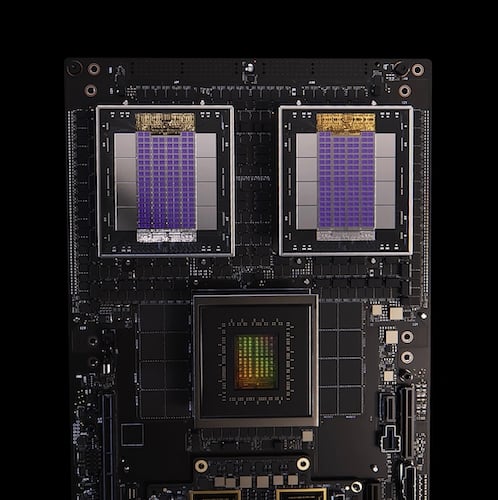
Nvidia's NVLink Fusion offers AI scale-up performance and a rack-scale architecture for building semi-custom AI infrastructure. Image used courtesy of Nvidia
That is where the engineering impact starts to show up. The collaboration could create more mature paths for custom accelerators, tighter GPU-to-SoC integration, and more standardized routes into Nvidia rack-scale infrastructure. Instead of treating custom AI silicon as a standalone chip project, the partnership pushes it toward a full chip-to-rack model.
The partnership also extends into local AI computing and automotive. Nvidia and MediaTek are continuing work on RTX Spark and DGX Spark PC chips, combining Nvidia GPUs with MediaTek SoCs for AI PCs, developer systems, and enterprise-class workstations. In automotive, the companies are building on MediaTek's Dimensity Auto platforms that integrate Nvidia technologies for cockpit AI and RTX graphics.
GlobalFoundries Secures Quantum R&D Award
GlobalFoundries has finalized a definitive agreement with the U.S. Department of Commerce’s CHIPS Research and Development Office for a $375 million R&D award supporting the company’s Quantum Technology Solutions business. The funding is structured over five years and tied to specified milestones. The stated goal is to help scale domestic quantum semiconductor manufacturing and build a secure U.S. based ecosystem for quantum chip development and production.
For GF, the award fits into a broader roadmap of technologies moving from research environments to manufacturable platforms. Through Quantum Technology Solutions, the company is focused on cryogenic CMOS, advanced packaging, and heterogeneous integration. Those areas matter because quantum systems need more than qubits alone. They also need control electronics, packaging methods, and manufacturing processes that can scale beyond lab prototypes. GF brings foundry manufacturing experience, process development, packaging capability, and customer relationships across data center, automotive, aerospace and defense, IoT, and mobile markets. The Commerce Department award adds public R&D support to strengthen the quantum semiconductor supply chain.
The announcement also ties into GF’s broader advanced technology strategy. The company noted a recent $300 million letter of intent with the same office to accelerate R&D in silicon photonics. Quantum computing and optical connectivity both point toward infrastructure that could support future AI and advanced computing systems.
On the design side, the practical impact may come through better access to foundry-backed quantum process platforms, more mature cryogenic electronics options, and a clearer path from prototype to production. That matters because quantum hardware still carries plenty of lab-to-fab friction. A stronger manufacturing ecosystem could help engineering teams spend less time wrestling with process uncertainty and more time improving system architectures.
Qualcomm and Amazon Collaborate on AI Data Center Silicon
Qualcomm Technologies and Amazon have announced a multi-generational product collaboration focused on next-generation AI data center infrastructure. The companies are working together on customized silicon for large-scale AI inference, along with optical connectivity solutions extending to 1.6T and future-generation links.
The collaboration fits Qualcomm’s push beyond mobile and edge devices into data center infrastructure, especially where power efficiency and custom silicon are major design priorities. It also supports Amazon’s continued expansion of AI infrastructure for AWS customers.
Amazon brings large-scale cloud infrastructure, AI services, and data center deployment experience. Qualcomm brings power-efficient processing, silicon design, system-level integration, SerDes, and optical DSP technologies. The partnership targets two major AI infrastructure pressure points: compute efficiency and high-bandwidth connectivity.
As AI workloads grow, data centers need more than faster accelerators. They also need interconnect systems that can move data efficiently between processors, memory, storage, and clusters. That is why the optical connectivity part of the announcement matters. Qualcomm’s SerDes and optical DSP technologies are positioned to support higher-bandwidth AI data center networks.
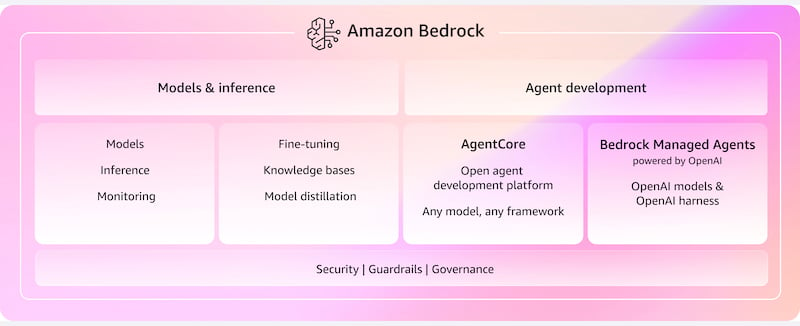
Amazon Bedrock's core capabilities. Image used courtesy of Amazon
Qualcomm also plans to deepen its use of AWS AI infrastructure, including Amazon Bedrock, for electronic design automation workloads. The goal is to reduce chip design cycles by applying cloud AI infrastructure to parts of the silicon development process. Engineers may eventually see the effect in more custom inference silicon inside AWS infrastructure, expanded optical connectivity options and faster chip development workflows. The deal is another sign that AI hardware is no longer only about the accelerator. Networking, optical links and EDA workflows are now part of the same infrastructure puzzle.
Analog Devices Moves to Acquire Alif Semiconductor
Analog Devices has entered into an agreement to acquire Alif Semiconductor in an all-cash transaction valued at $1.35 billion, with up to $200 million in additional contingent consideration. The transaction is expected to close before the end of calendar year 2026, subject to closing conditions and regulatory review.
The acquisition supports ADI’s push into what it calls Physical Intelligence, meaning systems that can sense, reason, and act locally in real time. That framing fits ADI’s existing strength at the boundary between real-world signals and digital systems. Alif adds the AI native processing layer needed closer to the sensor.
Alif brings secure, connected, power-efficient edge AI microcontrollers and fusion processors. Its architectures scale from single-core to multi-core systems and include integrated neural processing units and advanced graphics acceleration. The platform supports real-time sensor fusion, low-latency inference, and on-device AI. ADI brings analog and mixed-signal expertise, sensing, signal processing, power, connectivity, software, and application knowledge across industrial, data center infrastructure, defense, energy, robotics, digital health, and wearables. Combining those capabilities with Alif’s digital platform gives ADI a more complete path for edge AI systems.
This is not just about adding another MCU line. It lets ADI pair analog front ends, sensors, power, and connectivity with processors built for local intelligence. That matters as more systems need to interpret motion, sound, vibration, RF signals, temperature, and other physical-world data without sending everything to the cloud.
For engineers, the acquisition could lead to more integrated signal chain and processing platforms, especially in systems constrained by power, latency, security, and reliability. Instead of stitching together sensors, analog components, power management, connectivity, and AI processors from separate vendors, design teams may eventually see more complete ADI-backed platforms for real-world edge intelligence.
What These Deals Signal
Each announcement touches a different aspect of the semiconductor industry. The business layer may look distant from daily design work, but it guides what comes next. The deals are different, but the direction is similar. The semiconductor roadmap is being pulled toward AI systems that need better compute, better connectivity, stronger manufacturing paths, and more intelligence at the edge.
Related Content