Facebook
 Google
 GitHub
 Linkedin
STMicro Launches UWB IC Family Aimed at Next-Gen Ranging and Sensing
Announced at Embedded World, the new IEEE 802.15.4ab-compliant SoC extends wireless ranging to hundreds of meters.
Recently, STMicroelectronics announced the ST64UWB family, which they’re calling the industry’s first integrated ultra-wideband (UWB) solution to support both the IEEE 802.15.4z standard and the upcoming IEEE 802.15.4ab specification.
Comprising three primary SoCs: the ST64UWB-A100 and ST64UWB-A500 for automotive applications, and the ST64UWB-C100 for consumer and industrial use cases, the new family hopes to enable a new wave of UWB use cases.
All About Circuits met with ST’s Ranging and Connectivity Division General Manager Ghiath Al-kadi and Jean-Marie André, Head of UWB Marketing, at embedded world 2026 to hear about the new SoC firsthand.
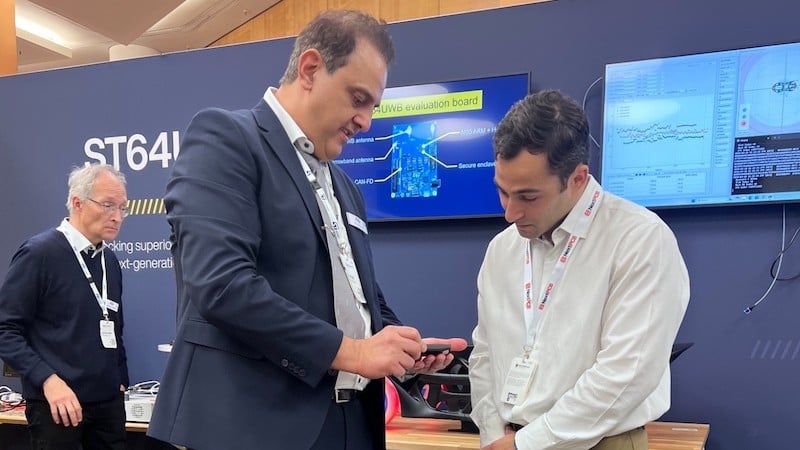
ST’s Ghiath Al-kad (left) with All About Circuits contributor Jake Hertz (right).
Architecture and Processing Power
According to ST, the ST64UWB family is designed to address the limitations of previous-generation UWB chipsets by offering improved range, robustness, and processing power.
From a processing perspective, the ST64UWB family is built on a high-performance Arm Cortex-M85 core, which ST states is a major improvement in local processing capability for UWB chipsets. Specifically, the core features the Helium M-Profile Vector Extension for dedicated hardware acceleration in digital signal processing and machine learning workloads. In the premium ST64UWB-A500 variant, the processor scales from 100 MHz to 256 MHz, whereas the entry-level A100 and consumer-focused C100 models operate between 40 MHz and 100 MHz.
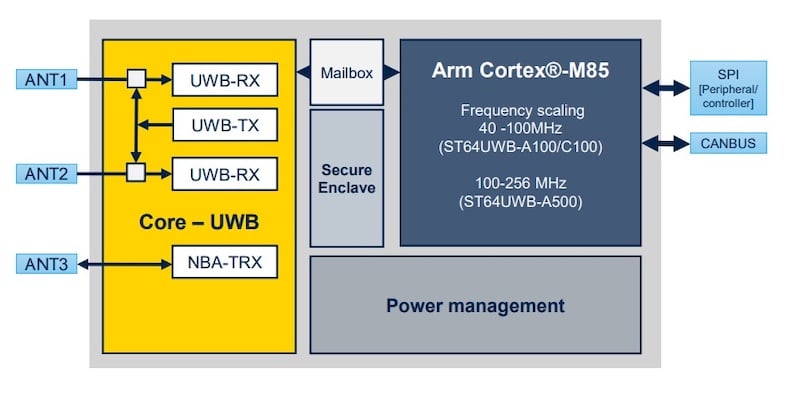
A block diagram of the ST64UWB chipset
According to ST, the computing complex lets the SoC execute complex radar algorithms and multi-application sessions simultaneously on-chip to reduce the system's reliance on an external application processor. As Al-kadi explains, “The chip has an MCU subsystem with AI acceleration, which allows it to run algorithms for radar and other applications and remove the need for an external MCU.”
Improved Ranging via NBA and MMS
On the UWB side, the main performance drivers for the ST64UWB family are its implementation of Narrow-Band Assistance (NBA) and Multi-Millisecond Ranging (MMS). As André tells us, “We are very proud to be the first company to come up with an automotive solution that is based on this new standard.”
Whereas the 802.15.4z standard relies on high-power UWB pulses for both data and ranging, 802.15.4ab offloads data frames to a narrowband assist radio while utilizing extended MMS frames for time-of-flight measurements. This configuration allows for a massive increase in the link budget, reaching 18-30 dB beyond legacy implementations.
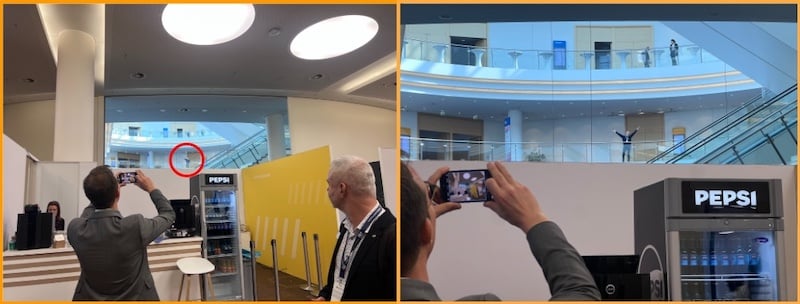
ST’s Jean-Marie André demonstrating the extended UWB range possible via 802.15.4ab
Quantifiably, the 1MMS mode alone delivers an eightfold increase in range over 802.15.4z, enabling reliable device tracking and localization at distances exceeding several hundred meters.
Advanced Radar and Sensing Capabilities
The ST64UWB family also introduces standardized radar capabilities that ST claims go beyond the proprietary solutions currently on the market.
For example, by expanding the UWB channel 11 bandwidth to 1.3 GHz, the chipset achieves twice the absolute distance measurement accuracy of standard 500 MHz channels. This high-bandwidth mode yields a radar range resolution of less than 7.5 cm, making it suitable for more granular sensing applications such as Child Presence Detection (CPD). “We are increasing the radar capability to have higher bandwidth, which allows us to have better angular separability,” says Al-kadi.
“With a higher bandwidth, we can differentiate between objects in a way that would be impossible at lower frequencies.”
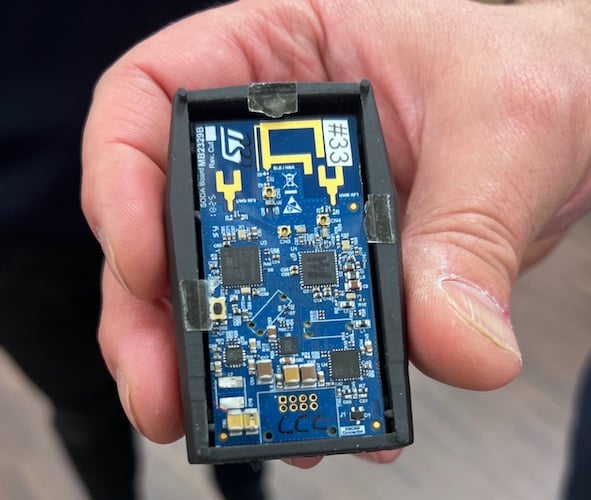
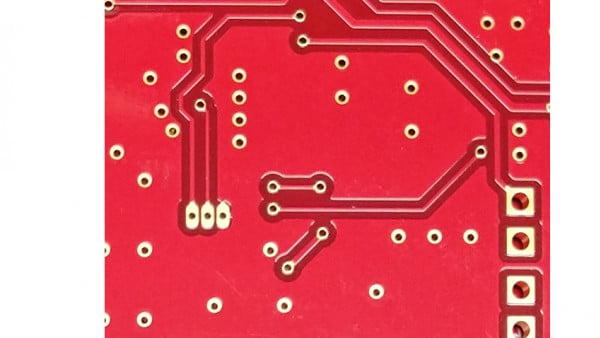
A reference design with the ST64UWB
To process this high-resolution data, the ST64UWB-A500 variant leverages integrated AI acceleration to execute edge AI-powered radar algorithms on-chip, enabling the system to differentiate between complex reflections without relying on an external application processor. Furthermore, ST has implemented a specific Kaiser window pulse shape to refine signal integrity.
In radio-frequency applications, standard pulses often generate sidelobes that can interfere with the primary signal. By using the Kaiser window to suppress these sidelobes to near-zero levels, the ST64UWB can more accurately separate and identify objects that are very close to one another.
Moving Forward
Reflecting on the new chip and the evolution of the technology, André says "It's an instrumental increment in terms of user experience." Moving forward, the company is positioning this hardware as a more complete solution. "And we, for sure, believe that 15.4 AB is the future," says Al-kadi.
The devices are now sampling to major Tier 1s and original equipment manufacturers.
Images used courtesy of STMirco and All About Circuits.