
 Facebook
 Google
 GitHub
 Linkedin
AC Electric Circuits
Impedance Matching With Transformers
19 questions By Tony R. Kuphaldt
-
Question 7 of 19
A step-down transformer has a winding turns ratio of 20:1. Calculate the impedance ratio from primary to secondary. Also, determine the amount of impedance “seen” at the primary winding if the secondary winding is connected to a 90 ohm load.
Impedance ratio = Zprimary =
Reveal answerImpedance ratio = 400:1 Zprimary = 36 kΩ
Notes:Most transformer problems are nothing more than ratios, but some students find ratios difficult to handle. Questions such as this are great for having students come up to the board in the front of the classroom and demonstrating how they obtained the results. In this particular case there is more to the solution than just a simple ratio, which is even more reason to have students show their different solution techniques!
-
Question 8 of 19
What would happen to the impedance transformation ratio if a short-circuit developed between some of the turns in the 300-turn winding of this transformer? Explain your answer.
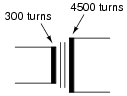
Reveal answerThe impedance ratio would increase.
Notes:This is somewhat of a “trick” question, because students are accustomed to equating a “short” with a decrease in impedance. While this is generally true, what we’re talking about here is an impedance ratio, rather than any one impedance in particular.
-
Question 9 of 19
All electrical sources contain some internal impedance. This explains why voltage sources “sag” when placed under load:
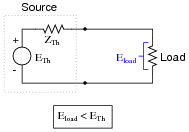
In this diagram, the source’s internal impedance has been “lumped” into a single component, labeled ZTh, the Thévenin impedance. This intrinsic impedance naturally limits the amount of power any source can deliver to a load. It also creates a condition where load power is optimized at a particular load impedance.
Determine the load impedance value necessary for maximum power dissipation, if powered by an audio amplifier circuit with an internal (Thévenin) impedance of 4 Ω.
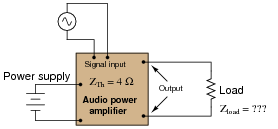
Reveal answerZload (ideal) = 4 Ω
Notes:Discuss with your students the “Maximum Power Transfer Theorem” as it relates to this question.


