Facebook
 Google
 GitHub
 Linkedin
Advancing Telecommunications With Edge AI
By strategically incorporating artificial intelligence throughout their networks, telecom companies can meet demand for better performance, streamlined operations, and improved customer experiences.
A decade ago, telecommunication was largely defined by the ability to deliver significant amounts of bandwidth at ever-higher speeds. The emergence of 5G, IoT, and a growing universe of connected devices has shifted the landscape and introduced new challenges. Today's operators must build networks that aren't just fast—they need to be context-aware, adaptive, and responsive at the edge.
Until now, most network intelligence has been concentrated in cloud and data center infrastructure. While this architecture has supported innovation across the industry to date, the growing volume of data and rising expectations around speed, efficiency, and privacy are exposing its limitations.
Edge AI offers a complementary path forward. Although traditional data centers will always have a role in AI applications, the ability to process certain AI functions locally can yield significant benefits for both businesses and consumers. By moving select AI workloads directly onto network devices closer to telecom users—smartphones, access points, routers, gateways, and so forth—providers can enhance performance, unlock real-time intelligence at scale, and create new revenue streams.
Driving Telecommunications Innovation With Edge AI
In telecommunications, the benefits of edge AI typically fall into two major categories:
- Improving the network.
- Enhancing the customer experience.
In this article, we'll look at some of the most promising use cases for utilizing edge AI.
Real-Time Network Optimization
Telecom networks handle vast amounts of data across thousands of network points. Managing such complexity in real time can be difficult and costly. With edge AI, intelligent algorithms can be deployed on base stations, gateways, routers, or customer premises equipment (CPE) to monitor traffic, detect issues, and make instant adjustments. For instance, edge AI can detect spikes in user demand in a certain area and allocate additional bandwidth or reroute data flows accordingly.
Unboxing, Troubleshooting, and Technical Support
On the user side, AI models deployed on edge processors can quickly diagnose network issues and device problems. AI embedded in CPE such as home routers or set-top boxes can monitor issues and resolve them locally and autonomously. It does this during setup or maintenance, when connectivity isn't available. In this way, edge AI resolves issues before the customer even notices.
The embedded AI can also analyze patterns in customer complaints, identify common issues, and generate troubleshooting steps in real time. Users can even ask questions of locally hosted, secure telecom chatbots powered by generative AI. Combined with AI's ability to autonomously troubleshoot, this reduces call center workloads and avoids costly truck rolls.
Enhanced IoT and Device Management
From smart cameras to autonomous vehicles, the proliferation of IoT devices has resulted in massive amounts of data being generated. Ordinarily, this data is then sent to the cloud for processing and storage. Edge AI, however, uses models embedded in gateways or base stations to analyze information from connected devices, identify patterns, and take immediate action where and when it's needed.

Edge AI allows self-driving vehicles to analyze information more efficiently. Image used courtesy of Adobe Stock
In addition to enabling faster responses, localized data processing using edge AI reduces bandwidth consumption. Finally, it allows for more efficient storage by summarizing data or storing only metadata rather than entire data streams.
Optimized Content Delivery
In recent years, telecom providers have become content providers, which requires efficient use of bandwidth and reduced latency. Edge AI can help networks more intelligently cache and process media closer to the user. It can also optimize the end-user experience by dynamically adjusting video quality at the edge based on network conditions and device capabilities.
Stronger Security and Data Privacy
By detecting threats closer to where they originate, edge AI better protects users' privacy. It also helps telecom companies comply with privacy regulations. Because data is processed locally and not constantly transmitted to the cloud, edge AI reduces the risk associated with personally identifiable data transmission and storage.
Sensitive information—personal, financial, or medical—stays on local devices, minimizing exposure to breaches or unauthorized access. Moreover, a breach in one edge device may be contained without compromising the entire network, especially if segmentation is implemented.
Unlocking New Capabilities With Purpose-Built Edge AI Processors
Conventional SoCs typically lack sufficient compute and memory to meet the high requirements of the applications we discussed above. As a result, telecom companies are beginning to explore the deployment of purpose-built edge AI processors at strategic points in their infrastructure, including points of presence, edge data centers, and CPE.
This can best be accomplished by low-cost, power-efficient edge AI processors such as those developed by Hailo. These have multiple advantages over the processors used in cloud data centers. For example, edge AI processors running directly on a user's cable modem or set-top box can troubleshoot or optimize network performance in real time more efficiently in terms of both cost and power consumption.
Furthermore, edge AI operates even with no cloud connectivity, making it ideal for setup and maintenance of routers and edge boxes. Edge AI accelerators embed intelligence directly into devices, eliminating the need for large amounts of data to be sent to the cloud, processed, and then sent back to the device. This reduces:
- Costs associated with both bandwidth and cloud services.
- Security risks of data transport.
- Latency.
Developers should look for AI processors that offer both high compute power and sufficient memory bandwidth, while also conforming with the power and cost envelope of the edge platform. The recently launched Hailo-10H AI accelerator is well-positioned for these use cases.
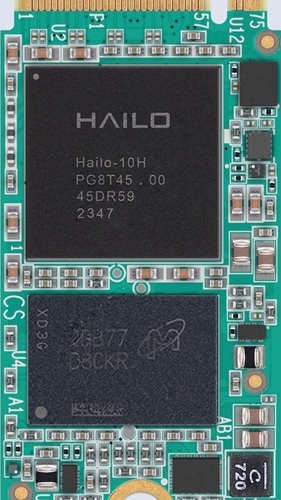
The Hailo-10H AI accelerator. Image used courtesy of Hailo
Although many of the novel applications in this article remain in the early phases of development, telecommunications companies that incorporate edge AI earlier will shape the future of operational efficiency and customer experience. As edge intelligence becomes an industry standard, those that invest now will emerge as leaders.
Featured image used courtesy of Hailo; featured image background used courtesy of Adobe Stock