
 Facebook
 Google
 GitHub
 Linkedin
Beyond Copper and Optical, a New Interconnect Eyes Next Gen Data Centers
Both copper and optical interconnects face limitations as choices for next gen data centers. Learn how a third option promises to enable scaling up AI clusters in data centers for years to come.
In the coming years, scaling up AI accelerator clusters in data centers will face compounding challenges. System architects will need to tackle three challenges at once:
-
Deliver better performance to meet soaring bandwidth demand.
-
Contain costs while scaling in computing capacity and complexity.
-
Continue to increase energy efficiency. It’s this trio of challenges that keeps network operators up at night.
While the emergence of new technologies has created opportunities for innovation, it has also overwhelmed data centers. New AI and machine learning workloads such as generative AI and large language models (LLMs), are driving data bandwidth to beyond the traditional interconnects, with speeds rapidly doubling to 800G and soon 1.6T.
Technology Limits at Terabit Speeds
To keep pace with growing demands, data centers have relied on two solutions: 400 and 800 gigabit (400G/800G) network devices served by copper-based cabling for short reach and optical cabling to support longer reach. However, both types of technologies will reach their technology limits for terabit interconnect speeds.
Copper is the interconnect of choice for short reach applications due to its low cost, simplicity, and high reliability. The limitation with copper is that, due to skin effects, the channel loss severely limits the cable reach while increasing thickness as transmission speeds increase as shown in Figure 1.
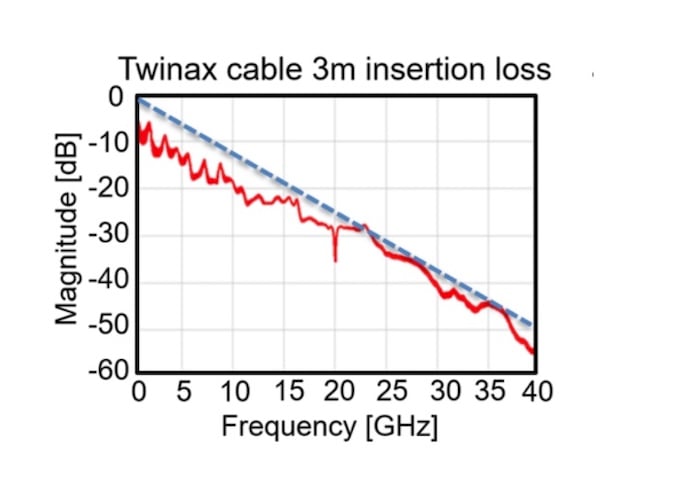
Figure 1. Twinax cable 3m insertion loss
Copper cables are not adequate to handle network speeds of 1.6T and above. At terabit speeds, copper cables are too short and too thick and not scalable for deployment in high-density data center installations.
The Switch to Optical Interconnects
For many AI-related workloads, hyperscalers will turn to optical interconnects, such as active optical cables (AOCs). Optical interconnects can provide connections with kilometer distances, but are more complex, power hungry and expensive due to the electrical to optical conversions that require additional components such as optical DSP, transimpedance amplifiers (TIAs), laser drivers, and lasers.
These cables integrate advanced DSP and complicated optical assemblies to transmit and receive optical signals at high speeds. AOCs can support longer cable lengths than copper and are thinner and lighter to boot. While this makes them easier to deploy, optical technology is inherently unreliable as optics performance varies over temperature and will always fail in time.
The optical DSP electronics add significant latency that degrades network performance. Adding the optical engine and DSP gets very pricey, very quickly, at up to 5x more expensive than copper. The same components also add significant power consumption to a cable that increases the energy demand to data center operations.
A Third Option Beyond Copper and Optical
All of this leaves hyperscalers in need of a solution that overcomes the limitations related to copper and optical technologies while remaining cost-effective for mass deployment. Enter the third option: e-Tube, a scalable multi-terabit interconnect platform using RF data transmission through a plastic dielectric waveguide.
As shown in Figure 2, using the e-Tube technology, the Active RF Cable (ARC) integrates a millimeter wave RF transmitter upconverts terabit data in the electrical domain to the RF domain. An antenna radiates the wireless signal for propagation through the e-Tube core.
On the other end, a complementary millimeter wave RF receiver and antenna receives and converts the wireless signal back to the electrical domain. The interconnect operates like an electrical system to the two systems connected by the ARC. The ARC manages the electrical-to-RF and RF-to-electrical transitions, making the conversion transparent to the two connected systems.
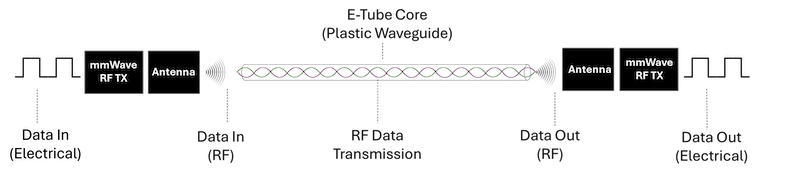
Figure 2. e-Tube architecture
Using plastic as a cabling medium, data can be transmitted with great energy-efficiency at low cost.
e-Tube cables built with common low-density polyethylene (LDPE) material are not impacted by high-frequency loss like copper, making e-Tube a scalable interconnect as it can be used for any data speeds from 56G to 224G and beyond. Low-power RF transmitter and receiver ICs for data transmission achieve industry-best energy efficiency at 3pj/bit with only picosecond latencies.
Lighter, Thinner, Lower Power
The result is cables that are 10x cable reach, 5x lighter, and 2x thinner than copper, and 3x lower in power consumption, 1,000x lower in latency, and 3x lower in cost than optical cables. e-Tube is meeting the bandwidth demands that are not feasible with copper and optical interconnect technologies. It is the ideal replacement of copper for in-rack and adjacent rack connectivity as data centers transition to 1.6T and 3.2T speeds.
To accelerate deployment, this innovative interconnect technology, e-Tube RF SoCs are manufactured with mature, standard semiconductor process technologies and proven IC packaging technologies. Connector and cabling “connectorization” have utilized copper twin-ax manufacturing techniques in volume production for decades. Cables are designed to be compliant with industry-defined MSA form factors such as OSFP and QSFP-DD as shown in Figure 3.
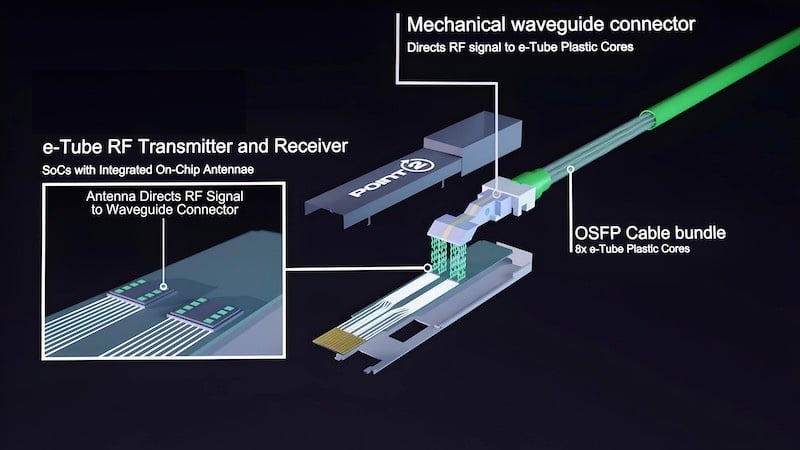
Figure 3. OSFP Active RF Cable (ARC)
This provides flexibility for different system designs, as it helps to ensure compatibility with existing network infrastructure equipment across various manufacturers.
Revolutionizing Compute Fabric Interconnect
As data centers hardware rapidly evolve to support LLMs and generative AI computing demands, a third interconnect option is needed to mitigate the limitations of copper at a price and energy efficiency that is dramatically lower than optical. e-Tube RF over plastic dielectric is poised to revolutionize compute fabric interconnect by offering a unique combination of power efficiency, longer cable reach, lower latency, and cost points to scale up AI clusters in data centers for years to come.
All images used courtesy of Point2 Technology.
Related Content











This is very interesting technology; not something we’ll likely see “at home” any time soon (as it seems this tech doesn’t scale down to “individual” level speeds (well, until we all have 56Gbit+ at-home networks, I guess). But still, interesting from a larger standpoint.
I do wonder, though, if this “cabling” will need to be “custom ordered” and how that would work?
I guess I could ask the same about fiber, but that technology seems to be relatively mature. I guess what I’m getting at, is that this new system seems like something that couldn’t be easily (if at all) terminated “on site”; copper is fairly easy (of course, I have no idea whether that applies in these ultra-high bandwidth applications), fiber can be done (albeit with the same reservations from my viewpoint).
In other words, you can’t just go in with a box of cable, some connectors, and a crimper, and make custom lengths of cable. However, that may be the case today with the copper and fiber inter-connects, too.
But I don’t know how that is handled - regardless of the inter-connect technologies being applied? I mean, you’re building a data center, and have cables running hither and yon - so how are these cables “made to order”? Are they (currently) some standard length, and you size things accordingly as the data center is planned? Plus maybe doing “next size up” (assuming it isn’t something insanely long) to make any allowances that are likely to crop up when the plan goes from “on paper” to “actual construction”?
I can only assume (and I obviously am not knowledgeable in this area) that each “rack” (or maybe “corridor” of racks?) has some kind of “end switch” (of some nature) where these super-fast cable lead to, and then from there cables lead to each system in the rack (or go to each rack, and a second “switch” has smaller cables directed to each system)? That would seem most logical from both a networking standpoint, and from a management, logistics, installation, planning, etc standpoint…such a topology would facilitate ordering of “standard lengths” for everything.
I imagine (maybe?) that as time goes one, there might be some kind of “in-the-field” termination system - maybe something simple like the active “end plugs” and then reels of the “cables” - I guess it would depend on how accurate, etc the installation of the end plugs on to the “cable” would need to be?
Heck - perhaps this already exists; I mean, if I’m asking these questions and wondering about the process, the people and teams who designed and developed this whole thing have to have already thought of such things, and solutions to it - and probably have it implemented. So maybe my reservations about the whole thing are completely unfounded?
I’d welcome any response from those who are more knowledgeable about this area (including present technologies being used, and even better - historical knowledge about how things have evolved from the days of telegraphy forward). It does seem like an interesting kind of career; nothing I could pursue today (I’m a software engineer, with electronics/robotics/etc being a hobby pursuit; I’ve crimped a few ethernet cables along the way, and have made a few null-modem serial cables, too).