Facebook
 Google
 GitHub
 Linkedin
How Electromechanical Switches Deliver Where Digital Interfaces Fall Short
Beyond touchscreens: Learn how physical feedback drives reliability in automotive, consumer, medical, and industrial electronics applications.
Touchscreens have become the defining feature of modern human-machine interfaces. From vehicles and medical devices to industrial equipment and consumer electronics, digital displays now perform functions once assigned to physical buttons and switches.
Yet the switch has not disappeared. In many applications, engineers are deliberately combining digital interfaces with electromechanical switches because physical feedback continues to offer advantages that touchscreens alone cannot provide.

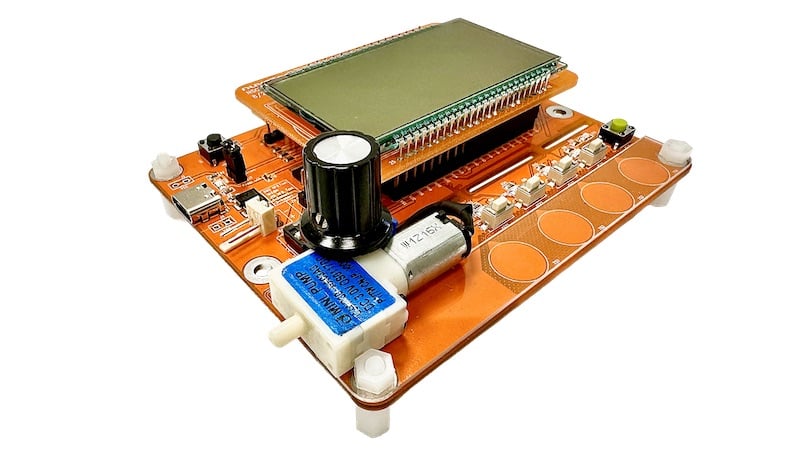
Touchscreens are a key part of any modern HMI, including vehicles, medical devices, industrial equipment, and consumer electronics, but physical feedback from switches offer key advantages over touchscreens.
This article explores why physical controls remain essential, examines the different types of electromechanical switches and their applications, and highlights how modern switch technologies continue to evolve alongside digital interfaces.
The Tactile Advantage: Why Physical Feedback Still Matters
Touch interfaces, whether capacitive touchpads or flat-panel displays, enable multifunctional, reconfigurable designs. However, they also introduce a degree of uncertainty; without physical displacement or tactile feedback, operators must rely entirely on visual or auditory cues to confirm input, which can slow reactions or cause errors in high-stakes environments.
What distinguishes a switch from its digital counterpart is its ability to provide immediate, physical confirmation of an action. The defined travel, audible click, or mechanical resistance of an electromechanical switch helps inform the user that the circuit has closed or opened and the command is registered. This deterministic sequence of actuation and tactile confirmation is difficult for purely digital interfaces to replicate. However, this is vital in safety, timing, and precision-centered applications such as medical instrumentation.
Well-designed switches contribute to user confidence and ergonomic consistency. The tactile resistance and actuation force profile can be tuned to specific force thresholds, ensuring repeatable operation under vibration, stress, or gloved conditions. This mechanical assurance helps maintain precision and reduces the cognitive load on the operator in psychologically stressful environments, such as operating rooms or industrial plants.
Tactile Control in Real-World Applications
Switches enhance accessibility in ways digital interfaces cannot match. Users with limited vision, or those operating in low-light or high-vibration environments, benefit from tactile feedback that enables confident operation without visual confirmation. The mechanical travel and distinct actuation response provide both orientation and certainty. Electromechanical switches play a vital role in several real-world applications.
Switches in Automotive Systems
For years, touchscreen-based dashboards were promoted as a symbol of innovation, but in practice, they can compromise driver safety and ergonomics. For instance, adjusting HVAC controls or changing infotainment settings via layered digital menus forces drivers to take their eyes off the road. Recognizing this, many OEMs are reintroducing tactile interfaces for critical functions.
That shift is now being reinforced by independent safety assessment bodies. Euro NCAP, whose five-star rating is a major objective for most European OEMs, updated its protocols for 2026 to introduce formal assessment of human–machine interface design—specifically evaluating the placement, clarity, and ease of use of essential vehicle controls, including the availability of physical buttons for commonly used functions, which Euro NCAP notes consumer feedback suggests can reduce driver distraction. While not a regulatory mandate, the practical weight of Euro NCAP scoring on OEM product decisions means this guidance is already shaping HMI specifications across the industry.
Littelfuse offers a broad portfolio of electromechanical switch solutions. The KSC XA series combines soft-sound actuation and a long operational life, providing precise tactile feedback while maintaining quiet operation—an important factor in premium automotive interiors. Its compact form factor integrates smoothly into dashboards, steering wheels, and center consoles, allowing drivers to locate and operate key controls by touch alone. Its IP67 rating provides protection against moisture and dust ingress. For engineers, this combination of mechanical reliability and compact integration simplifies system design and enhances safety performance.
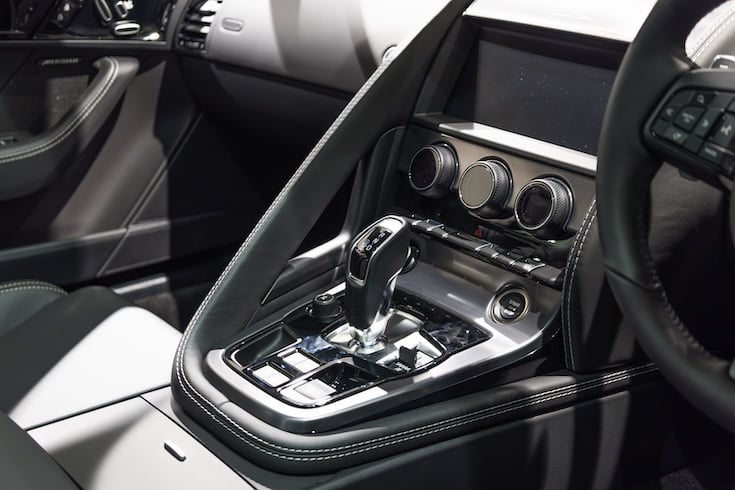
Hybrid automotive interfaces increasingly pair touchscreens with tactile switches for critical controls, restoring driver confidence through physical feedback.
Medical Equipment
In medical environments, tactile feedback becomes critical. Devices are used repeatedly, sterilized frequently, and trusted in high-stakes situations. A surgeon operating a handheld instrument, often while wearing surgical gloves, must receive immediate, unambiguous confirmation of input—a requirement that only a physical switch can reliably fulfill.
The KSC2 series addresses these demands with compact packaging, lifecycle ratings up to five million actuations, and consistent tactile response. For medical device engineers, this combination ensures reliable performance across hundreds of thousands of cycles, maintaining both precision and user confidence.
For applications where the tactile signal itself must be unmistakable—such as surgical instruments where gloved operation and time pressure are constants—the KSC241J SP DELTA LFS offers a compelling solution. This Special Delta variant of the KSC2 delivers a minimum 30% tactile ratio, roughly twice the threshold of standard KSC2 models, producing a sharper, more pronounced click that leaves little ambiguity about whether an input registered. The confirmation it provides is, in those contexts, part of the product’s safety architecture. The KSC241J SP DELTA LFS is already in use with surgical tool manufacturers for precisely this reason.
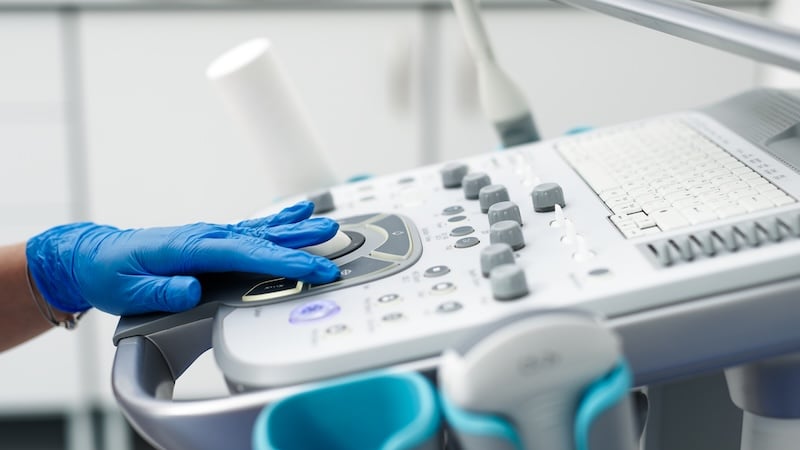
The KSC2 series delivers consistent tactile response across hundreds of thousands of actuations, meeting the rigorous demands of medical instrumentation and surgical devices.
Industrial, IoT, and Consumer Systems
Electromechanical switches are not limited to automotive and healthcare; they are critical across a wide range of applications. In consumer electronics, they define the tactile character of gaming controllers, headphones, and home automation devices, where feel directly shapes user perception of quality. For gaming applications in particular—where users expect immediate, high-frequency actuation with consistent feedback across millions of keystrokes—the KSC11 series is purpose-built for the task. Its hard actuator profile and lifecycle ratings up to three million cycles, at a consistent 25% tactile ratio, make it well-suited to gaming peripherals, drone controllers, and any interface where a firm, definitive click is part of the user experience.
In industrial controls and IoT systems, sealed designs with IP-rated protection ensure consistent operation despite dust, moisture, vibration, and temperature extremes. Unlike touchscreens, which depend on software interpretation and are susceptible to latency or misreads, switches deliver direct, deterministic electrical actuation. This immediate responsiveness is vital in safety-critical systems where milliseconds can determine the outcome.

Industrial operators depend on physical switches for control panel inputs where IP-rated sealing, consistent actuation, and direct mechanical feedback are essential to safe, reliable system operation.
Engineering the Right Switch for Each Application
Electromechanical switches are engineered for endurance, precision, and environmental resilience. Modern designs feature IP-rated sealing against dust and moisture, with lifecycles rated in the millions of actuations.
Mechanical parameters, including actuation force, travel distance, and sound profile, can be fine-tuned to meet specific performance targets. This allows engineers to tailor the tactile experience to both functional and brand requirements. Switch design can be precisely tuned for the environment in which it operates, whether the goal is a soft, silent press for a vehicle interior or a firm, audible click for an industrial panel.
An important advancement within the KSC family is the Special Delta mechanism, which delivers a higher tactile ratio than standard dome designs. Tactile ratio describes the difference between the activation force and the minimum force measured after dome actuation—the higher the ratio, the more distinct and pronounced the tactile click.
For operators in demanding environments, that difference is the signal that input has been registered. KSC variants featuring the SP DELTA designation are available across multiple force profiles, giving engineers the flexibility to tune both the absolute force threshold and the sharpness of the tactile event to match specific use-case requirements.
Tactile switches represent only one subset of a broader electromechanical switch portfolio. Push buttons play a vital role in industrial controls, elevators, and consumer products where a clear, decisive action is required. Slide switches provide simple and reliable on/off or mode selection in portable electronics, instrumentation, and power tools.
Toggle and rotary switches are important for aerospace, automotive, and test equipment, where mechanical robustness and exact positioning are mandatory. Each of these switch architectures is optimized for a specific control scenario, providing users with physical, reliable, and intuitive control in environments where digital alternatives alone cannot fully meet the demands.
Switches are evolving in step with digital interfaces. Hybrid control schemes that combine touchscreens for flexibility with tactile switches for primary functions are becoming common in vehicles, aircraft, and industrial control systems.
Role of Switches in Next-Generation Systems
Advances in IoT, wearables, and robotics are reshaping expectations for switch size, performance, and integration. Electromechanical switches are adapting to meet these expectations through innovations in miniaturization and customizable tactile profiles.
Modern switch designs utilize precision materials and manufacturing to deliver consistent actuation performance within small footprints. Engineers can now specify exact parameters such as actuation force, travel distance, contact resistance, and environmental sealing to align with both functional and aesthetic requirements.
Digitalization may have transformed how we build and operate machines, but it has not diminished the switch’s role. Whether in vehicles, medical devices, or industrial systems, electromechanical switches deliver a direct, unambiguous connection between human intent and machine response.
Engineers looking to explore the extensive Littelfuse/C&K portfolio of electromechanical switches can visit the Littelfuse website to discover how these solutions can enhance their next design.
SIDEBAR: Choosing the Right Switch for the Application
Not all tactile switches are created equal—and the differences that matter most are rarely visible to the naked eye. Footprint, height above the PCB, actuator feel, operating force, and cycle life all interact to define whether a switch performs reliably in the field or becomes the first point of failure. For R&D engineers specifying a switch for a new design, those parameters are not abstractions; they are the selection criteria.
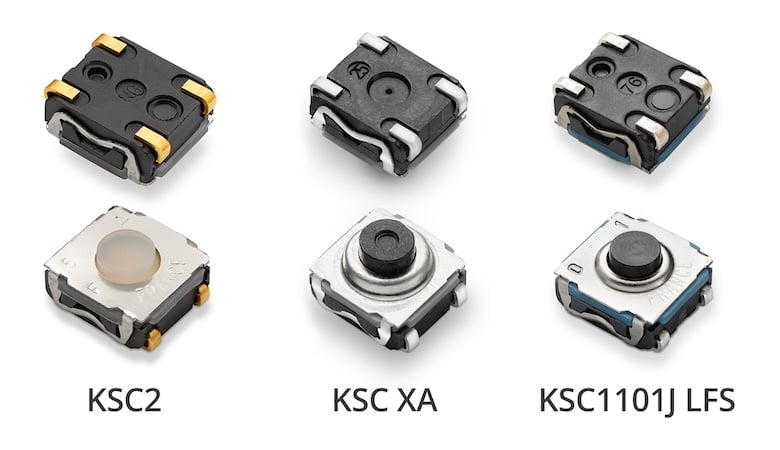
Different KSC variants provide engineers with flexibility in tactile response, lifecycle, and operating force while maintaining a common footprint.
The C&K KSC family from Littelfuse illustrates how much design latitude is available within a single product platform. All four switches below share the same 6.2 × 6.2 mm SMT footprint and IP67 sealing—a common baseline that simplifies board layout and environmental qualification. Where they diverge is where the application-specific decisions live.
KSC2 Series: Broadest configuration matrix, operating forces 1.6–6.0 N, silver or gold contacts, J-bend and Gullwing terminations. Gold contacts extend the temperature ceiling to 125°C. Build-a-switch ordering structure reduces multi-SKU qualification burden.
KSC241J SP DELTA LFS: Special Delta variant with 30% minimum tactile ratio—roughly twice the standard KSC2 threshold. Sharp, unambiguous click suited to gloved operation and time-pressure environments. In use with surgical tool manufacturers.KSC11 Series: Durability-first, rated up to three million cycles at 25% tactile ratio across all variants. Hard actuator profile suited to gaming peripherals, drone controllers, avionics consoles, and industrial HMIs.
KSC XA Series: Acoustically tuned switch with a soft sound profile achieved through a redesigned haptic mechanism. Operating forces up to 9.6 N. Suited to quiet clinical environments, premium automotive cabins, and applications where accidental actuation must be prevented.
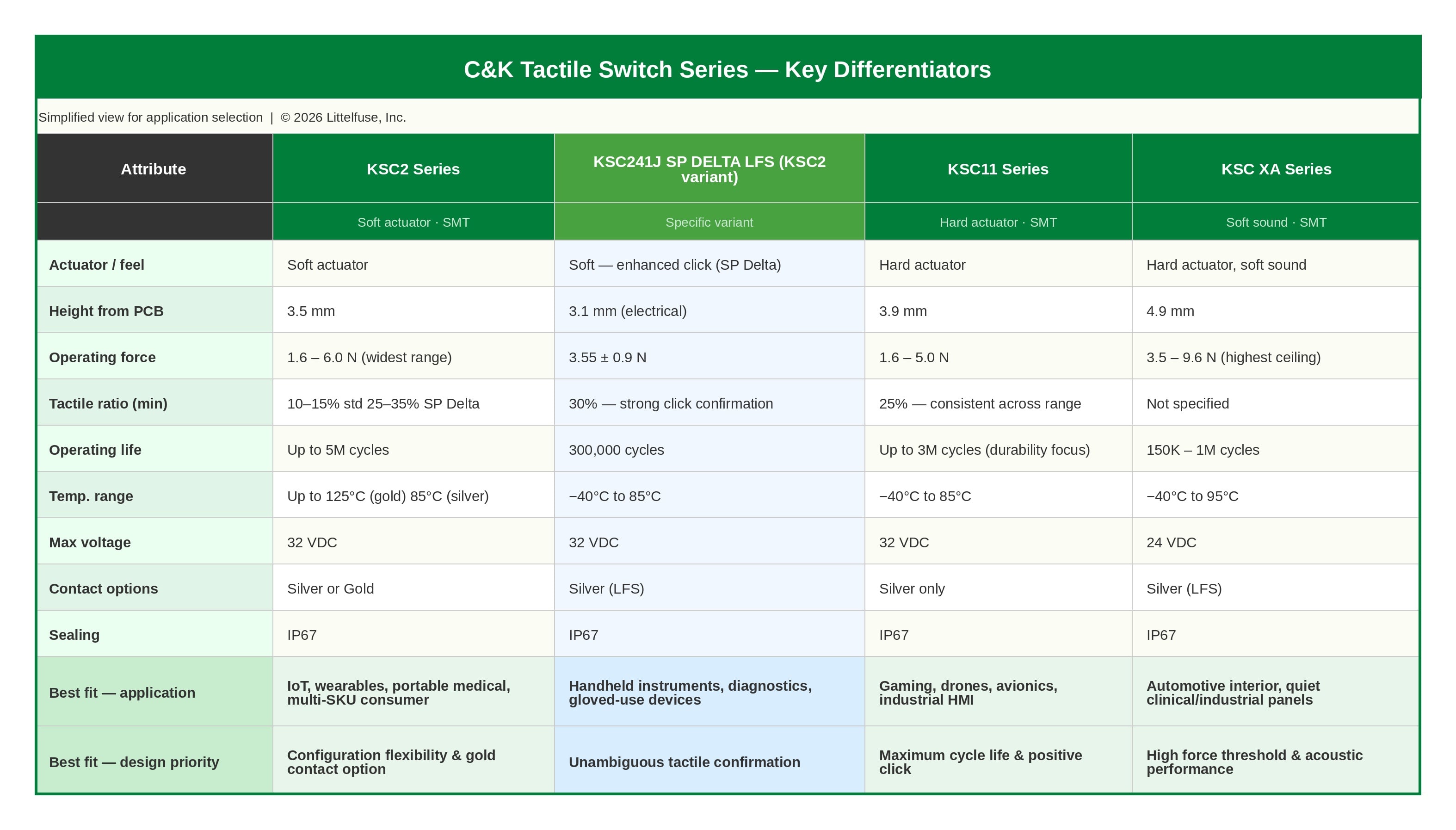
Table shows the key differentiators of the C&S Tactile Switch Series. (Click on image to enlarge).
References
Euro NCAP. “Euro NCAP announces 2026 protocol changes to tackle modern driving risks.” Published November 26, 2025.
All images used courtesy of Littelfuse.