Facebook
 Google
 GitHub
 Linkedin
3 Partnerships Look Ahead for Automotive, Photonics, and AI Innovation
These collaborations will focus on making hardware more efficient: GaN in EVs, scalable photonics, and smarter GPU use in AI systems.
Rohm, Tower Semiconductor, and AMD have each teamed up with specialized partners to tackle hardware efficiency. These collaborations focus on EV power efficiency, scalable photonic circuits, and automated GPU management for AI.
Mazda and Rohm Target EV GaN Inverters
Mazda Motor Corporation and Rohm have announced a deepened partnership to co-develop electric vehicle components built around gallium nitride (GaN) power semiconductors, leveraging Rohm’s EcoGaN technology platform. This next-phase collaboration expands prior work involving silicon carbide (SiC) inverter modules and aligns both companies’ long-term strategies for high-efficiency, compact EV systems.
At the device level, GaN offers superior high-frequency switching characteristics and lower conduction losses than conventional silicon MOSFETs, enabling tighter PCB layouts, reduced passive component sizing, and lower overall system parasitics. Rohm's offering integrates 650-V GaN HEMTs with proprietary control ICs that can handle pulse widths down to 2 ns—optimized via its Nano Pulse Control architecture.

Ichiro Hirose (left) director, senior managing executive officer, and CTO of Mazda, and Katsumi Azuma (right), member of the board and senior managing executive officer of Rohm. Image used courtesy of Rohm Semiconductor
These features translate directly to size and weight reductions in inverter systems, particularly within e-Axle units, which combine the motor, reduction gearbox, and inverter into a single drive module. By transitioning from SiC to GaN in certain sections of the powertrain, Mazda anticipates a 20–30% reduction in volume, alongside measurable gains in power conversion efficiency (5–10%) and improved thermal characteristics under high switching frequencies.
Systemically, the collaboration emphasizes a vehicle-wide design integration model. Rather than optimizing components in isolation, Mazda and Rohm are targeting holistic gains, deploying GaN-based DC-DC converters, onboard chargers, and potentially re-architecting vehicle power distribution networks around GaN’s performance envelope.
Tower Semi and Alcyon Streamline Photonics Production
Tower Semiconductor and Alcyon Photonics announced a partnership to improve how integrated photonic circuits move from design to production. Tower brings its established silicon photonics platform, while Alcyon contributes a library of photonic building blocks and design IP. Together, they’re aiming to make it easier to build and scale photonics hardware.
At the heart of the partnership is Tower’s high-yield SiPho platform, which integrates optical waveguides, modulators, and photodetectors on silicon substrates. This foundry-ready platform supports scalable and reproducible fabrication of photonic integrated circuits (PICs), enabling low-loss, high-density optical routing with co-packaged electronics. Tower’s manufacturing capabilities across multiple global fabs support the volume production of PICs with tight process control.
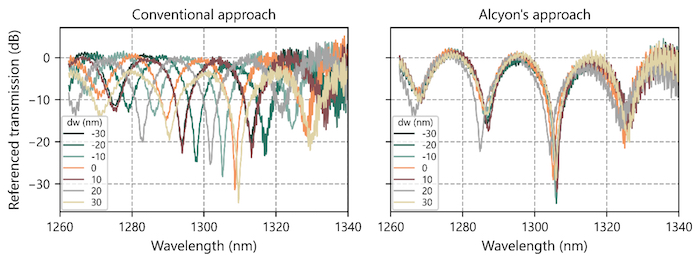
The transmission characteristics of cascaded Mach-Zehnder interferometers with a 20-nm free spectral range (FSR). Image used courtesy of Alcyon Photonics
Alcyon Photonics enhances this manufacturing foundation with a library of silicon-validated photonic IP, optimized for SiPho and fabricated with channel drift stability below 3 nm—even under ±30-nm process variation. This level of stability is critical for wavelength-selective applications and ensures consistent performance across wafer lots, a key requirement for commercial optical systems.
Target applications include:
- CWDM transceivers for O-band (1260–1360 nm) optical interconnects in hyperscale data centers, where minimized power consumption is essential
- Coherent communication modules in the C+L bands (1530–1625 nm), supporting higher-order modulation and extended reach for long-haul and metro networks
- Next-gen photonic sensing systems in industrial, environmental, and automotive domains, where PICs reduce size, weight, and power constraints
AMD and Rapt AI Reduce GPU Waste in AI Infrastructure
AMD and Rapt AI have partnered to improve how AI workloads run on AMD’s Instinct GPUs. The focus is simple: reduce idle GPU time and get more throughput from the same hardware. For most teams, GPUs sit underutilized. This partnership addresses that by combining AMD’s hardware with Rapt’s automation layer.

AMD's Instinct MI325X GPU accelerator. Image used courtesy of AMD
Rapt’s platform analyzes AI workloads and allocates resources automatically. It doesn’t require any code changes. It replaces manual job tuning with a scheduling engine that adjusts for load, demand, and hardware capabilities in real-time. That helps teams use more of what they’re already paying for.
The system integrates directly with AMD’s Instinct GPU line:
- MI300X: 192-GB HBM3 memory, 5.3 TB/s bandwidth, 8,192-bit memory interface
- MI325X: 256-GB HBM3E memory, 6 TB/s bandwidth
- MI350 Series: Launching mid-2025, tuned for AI in cloud and enterprise systems
- MI400 (planned): Adds deeper CPU-GPU-network integration for 2026 deployments
With Rapt’s layer on top, organizations can cut optimization time from hours to minutes and run more models without adding hardware. That matters for any team moving from training to production-scale inference. GPU job density goes up, latency drops, and AI workflows stop getting bottlenecked by resource contention.
The partnership shifts the conversation away from raw GPU specs and toward usable performance. If you're running AMD Instinct GPUs and you're not hitting high utilization, this is designed to fix that without rebuilding your stack.
Related Content