
 Facebook
 Google
 GitHub
 Linkedin
Microchip’s CLB MCUs Marry Programmable Logic and Embedded Control
The configurable logic block microcontrollers grant developers the flexibility of an MCU-based design with the deterministic capability of dedicated hardware.
Microchip recently introduced the PIC16F13276 and PIC18-Q35 families of configurable logic block (CLB) microcontrollers, targeted for automotive, industrial, and IoT applications. The new chips add to both the PIC16F and PIC18F lines. The PIC16F13276 family devices include 32 logic elements, and the PIC18-Q35 family device includes 128 logic elements.

The PIC16F13276 and PIC18-Q35 families.
The speed of small microcontrollers has increased greatly over the years. However, some tasks still require faster response times than MCUs can reliably deliver. Hardware MCU peripherals, such as PWM, address some of these requirements, but specialized applications require greater flexibility. Without the CLB, MCU developers of such designs would need to add a small FPGA chip or discrete logic to their PC board. The Microchip CLB meets this need without additional chips.
How a Microchip CLB Works
Microchip's configurable logic blocks are look-up table (LUT) based, similar to most FPGAs. The CLB operates without CPU intervention. This means that the CLB maintains precise deterministic operation while the CPU is performing other operations or sleeping. Typical applications include timing-based operations such as quadrature decoding for motor speed control, creating complementary PWM signals, and implementing custom state machines.
The CLB configuration can be loaded and set to operate at power-up without the CPU powering up. This allows the system to operate in custom logic mode until the MCU's instant-on functionality is needed. Doing so can keep both power consumption and latency down.
Creating a CLB Configuration
Programmable logic is traditionally configured using high-level hardware description languages (HDL) such as Verilog or VHDL. HDL coding offers great flexibility for complex hardware projects but comes with significant overhead. The overhead is disproportionately high when working with just a few dozen logic cells.
Microchip takes a different approach with its drag-and-drop CLB Synthesizer tool. CLB Synthesizer operates within the MPLAB Code Configurator (MCC) Melody plug-in to MPLAB X IDE. Microchip also offers an online version of the CLB Synthesizer. The figure below shows the available logic blocks on the left and the in-development circuit on the right.
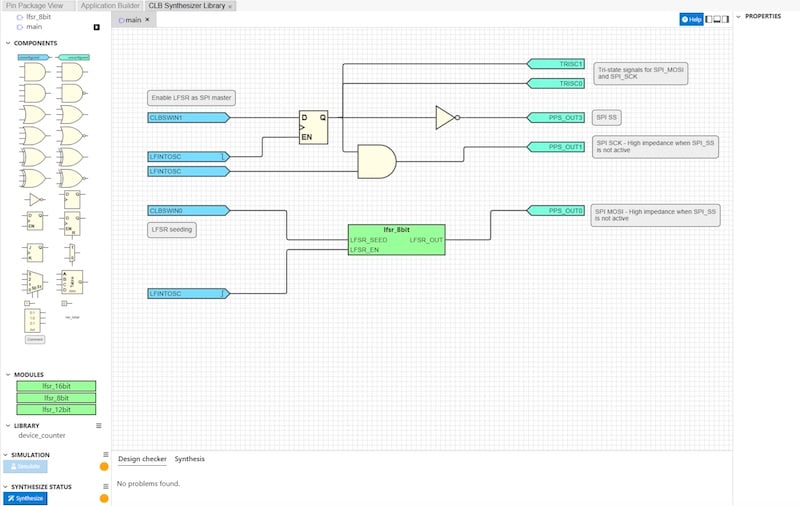
Pseudo-random number generator using CLB in a PIC16F13276.
The toolchain includes drag-and-drop development, timing analysis, simulation, and hardware debugging. It eliminates the need to manually configure registers or write HDL code.
MCU Features
The PIC16F13276 (datasheet linked) features 28 KB of program flash, 2 KB of SRAM, and 256 B of EEPROM. The MCU operates up to 32 MHz, has a 16-level deep stack, and 36 GPIOs (25 in 28-pin packages). The PIC18-Q35 (datasheet linked) has up to 64 KB of program flash, 4 KB of SRAM, and 256 B of EEPROM. GPIO on the PIC18-Q35 parts come in at 24, 35, or 43, with the MCU running at up to 64 MHz.
The chips are equipped with a broad set of peripherals and include a programming and debugging interface disable (PDID) to protect firmware and user data from unauthorized access. To increase the MCU’s flexibility in industrial, automotive, and IoT applications, the new microcontrollers offer a number of multi-voltage I/O (MVIO) port pins. MVIO pins include built-in level shifters to enable MCUs to interface with peripherals at voltages from 1.8 V to 5.5 V.
One of the increasingly unique features of the PIC family, including these new PIC varieties, is their availability in through-hole DIP packaging. The MCU package options range from a 40-pin .6” width DIP down to a 5 mm x 5 mm QFN. The 28-pin variant comes in a .3” 28-pin DIP, down to a 4 mm x 4 mm QFN. The 16F13276 is pin-compatible with most existing PIC16F chips, and the PIC18-Q35 variant is pin-compatible with other PIC18F chips of the same pin count.
Product Availability and Support
Both the PIC16F13276 and PIC18‑Q35 MCUs are currently shipping in volume.
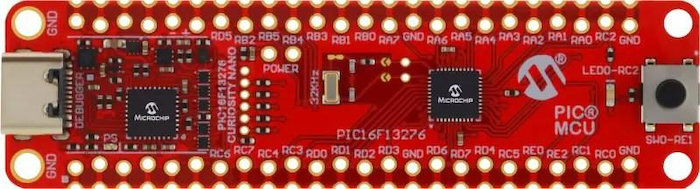
PIC16F13276 Curiosity Evaluation Kit.
Both families offer evaluation boards—the PIC16F13276 Curiosity Nano Evaluation Kit and the PIC18F56Q35 Curiosity Nano Evaluation Kit—to support MCU familiarization and code development.
All images used courtesy of Microchip.
Related Content











The I8051 had a logic processor instruction set. I’ve never used it but Motorola had some super logic processor and communications processors in the 1990s, they could be programmed like software but the programming was quite a lot of work.