Facebook
 Google
 GitHub
 Linkedin
Intersil ICL7106/07: The 40-Pin DIP That Built a Million Multimeters
Nearly five decades after Intersil released the ICL7106 and ICL7107 in 1978, the chips at the heart of the world's cheapest digital meters are still in production.
Crack open a budget multimeter sold in bulk from a hardware store or market stall, and you'll likely find a blob of black epoxy on the PCB. Under it is a die whose architecture hasn't fundamentally changed since the Carter administration.
Whether it's sitting in a professional's Fluke or a no-name DT-830 bought for a few dollars, the same dual-slope integrating ADC concept powers the 3½-digit display. That the world arrived at this standardized solution is largely down to Intersil's ICL7106 and ICL7107, and to a lawsuit that inadvertently seeded an industry.

Intersil's 40-pin DIP ICL7106. Image used courtesy of joe_wv55 and eBay
From Fluke's Bench to the Open Market
The story begins in 1977 with the Fluke 8020A, the company's first handheld digital multimeter. The A/D converter and display driver inside, part number 429100, was co-developed by Fluke and the original Intersil, Inc., founded a decade earlier by Jean Hoerni, the physicist credited with the planar transistor process. A year after the 8020A launched, Intersil commercialized its own version as the ICL7106.
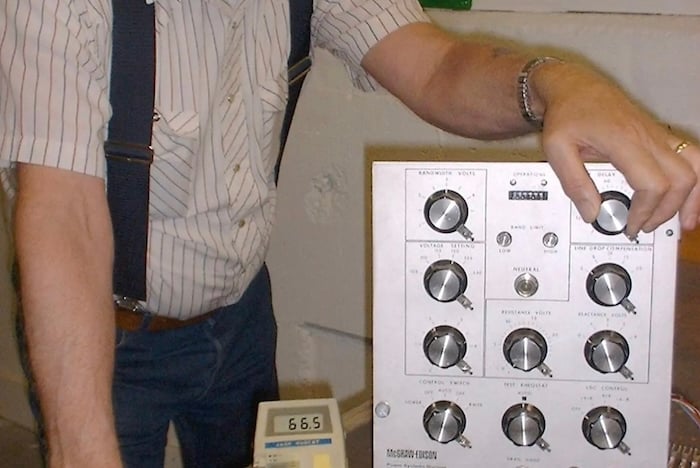
President of Specialty Engineering, Jack Nugent, using his 8020A in 2004. Image used courtesy of Fluke
To sidestep a Fluke patent on the auto-range function, they masked it off in silicon. The problem: the die still bore the Fluke logo, and a lawsuit followed. It was settled out of court because Fluke needed Intersil's fabrication capacity too much to push for a knockout. The settlement left the 7106 free to enter the open commercial market. Within a few years, it was everywhere.
Accuracy Without Tight Tolerances
What made the ICL7106 and ICL7107 so capable was the conversion method at their core. Dual-slope (integrating) ADC conversion avoids the component-matching problems that affect successive-approximation architectures by ratioing an unknown input against a known reference over time rather than voltage. The conversion cycle takes exactly 4,000 clock cycles, divided across three phases: auto-zero, signal integrate, and de-integrate.
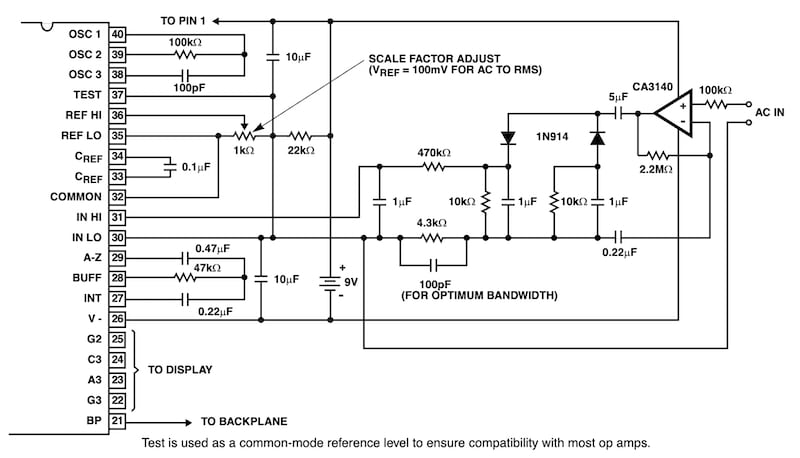
An AC-DC converter with the ICL7106. Image used courtesy of Alldatasheets.com
The auto-zero phase is particularly elegant. Each cycle, the chip nulls its internal offsets and reference errors before a measurement begins, yielding a sub-10 microvolt offset and less than 1 microvolt/°C drift from a CMOS process. Input bias current tops out at 10 pA. Those are serious specifications for a chip that, in chip-on-board form, costs less than a resistor. Making the signal-integrate phase a fixed multiple of the mains frequency adds immunity to line interference without any external filtering: a 40-kHz clock produces an integrate window that rejects both 50-Hz and 60-Hz noise simultaneously.
The ICL7106 drove LCDs via a multiplexed backplane signal; the ICL7107 drove LED seven-segment displays directly. LED versions ran significantly hotter, and that heat degraded the internal reference voltage—a known issue Intersil addressed with the ICL7107S. The "3½ digit" label refers to the leading digit, which can only display 0 or 1, giving a full-scale count of 1,999. At 200-mV full scale, that translates to 100 µV resolution; a simple input divider extends the range to 2 V, 20 V, 200 V, or beyond.
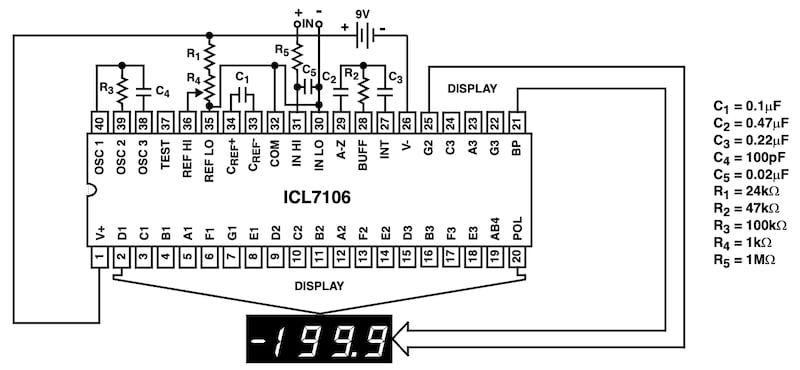
An ICL7106 test circuit. The application shown here is an LCD display component selected for a 200-mV full scale. Image used courtesy of Alldatasheets.com
True differential inputs and an adjustable reference voltage made the chip equally suited to bridge sensors—strain gauges, load cells, and thermocouple amplifiers—which is why it appeared as often in industrial panel meters and weighing equipment as in handheld DMMs. The entire design needed only a handful of passives and a display without the need for firmware or calibration software.
A Chip That Would Not Stop
The ICL71xx family grew into a full lineage, with the 7116 and 7117 adding a display hold function, the 7126 and 7136 improving noise performance, and the 7135 extending resolution to 4½ digits. The 7109 swapped display drivers for a parallel output bus for direct microprocessor interfacing.
Harris, Maxim, and Cyrustek all produced clones; behind the Iron Curtain, Tesla manufactured the MHB7106. Intersil published application notes—AN023, AN046, AN052—that cut design-in to a few pages of component selection, fueling a generation of Elektor magazine projects and DIY panel meters that taught bench skills to engineers worldwide.
The DT-830, the ubiquitous sub-$5 yellow multimeter that has sold in the hundreds of millions since the 1980s, uses a COB version of the 7106 die. Renesas, which absorbed Intersil, still lists the part today, and distributors still stock it. For low-speed, high-accuracy measurement in a product with no software stack to maintain, the architecture remains difficult to displace at the price.
Ultimately, the 3½-digit display became so universal that it effectively defined what a digital meter looked like to two generations of engineers.
Related Content