Facebook
 Google
 GitHub
 Linkedin
A Peek Inside the Electronics on the Nancy Grace Roman Space Telescope
The Nancy Grace Roman Space Telescope’s mirror may get the headlines, but its detector chips, photon-counting cameras, and downlink amplifier tell the electronics story.
On Sunday, Falcon Heavy shot the latest NASA mirrored observatory towards its stellar home for the next half-decade. The Nancy Grace Roman Space Telescope is a 2.4-meter-diameter mirror infrared observatory built to accomplish two very different jobs at once.
The first is cosmology: Roman will survey enormous swaths of the sky, observing and tracking how galaxies cluster. As it watches light bend around massive objects, Roman will help us better understand what dark energy really is. The second is exoplanetary discovery: a dedicated instrument will try to directly image planets as they orbit distant stars—something very few telescopes have been able to do at all.
But if you’re the kind of engineer that’s more interested in schematics than pictures of stars, the more intriguing story is what actually happens when the photons of the universe land on that mirror. The chain of chips, boards, and amplifiers that turns starlight into a bit stream downlinked to a laboratory was built by a chain of companies you might not expect from a flagship NASA mission.
Big Detector Brain, Small Business Design
The Wide Field Instrument (WFI) is the main camera on Roman, featuring 18 H4RG-10 sensor chip assemblies manufactured by Teledyne. These hybrid HgCdTe-on-CMOS arrays are cooled to -178 °C to prevent dark current from interfering with the faint infrared signals that Roman is meant to detect. But the chip used to bias it, clock it, and digitize what comes back wasn’t designed by Teledyne or a prime contractor.
Markury Scientific is the consulting shop in Thousand Oaks, California that designed the mixed-signal chip, called ACADIA (ASIC for Control and Digitization of Images for Astronomy). The chip consists of forty parallel analog channels that feed low-noise, programmable-gain preamps into 16-bit successive-approximation ADCs.
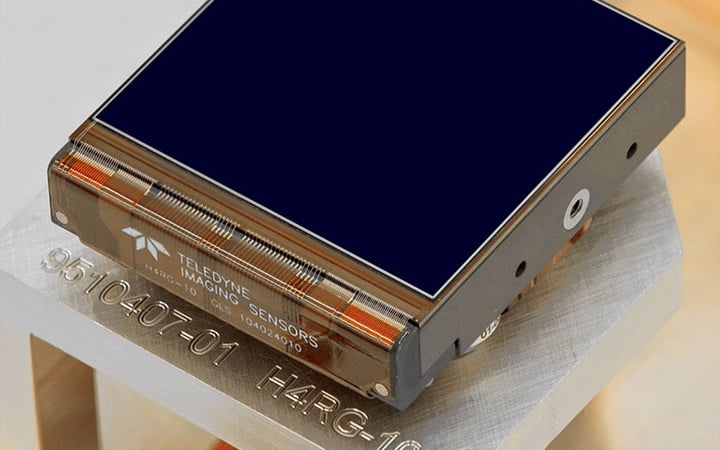
Every one of the H4RG-10’s 16.7 million pixel signals must pass through ACADIA’s channels. Image used courtesy of Teledyne
It also features 24 additional channels that can be configured as current sources or programmable voltage sources. Combine that with an SPI interface, a DMA engine, and single-event-effect hardening, and you have a chip designed to withstand the challenging radiation and temperature environments present at the L2 point.
It’s a remarkable feat of engineering and was conceived by Dr. Markus Loose, who also worked on the SIDECAR ASIC used on both the Hubble and James Webb Space Telescopes.
An Eye That Blocks Stars
Roman’s second instrument is a coronagraph, and it works by physically blocking or masking the light from a star on a specific optical path. The much fainter light from any planets in orbit can then be detected by Roman’s camera, allowing direct visual imaging of exoplanets. But even the best coronagraph still receives enough sunlight to overwhelm a conventional detector. These faint planetary light signals require photon-counting-levels of sensitivity that the H4RG-10 can’t achieve.
This is where the CCD201-20, an electron-multiplying CCD (EMCCD) specified by the Jet Propulsion Laboratory and produced by Teledyne-e2v, a UK-based subsidiary of Teledyne, is integrated into the build to add a gain register after the normal serial shift register. Each pixel’s charge is pushed through a series of high-field multiplication stages prior to feeding into the output amplifier. This boosts the signal, allowing individual photoelectrons to rise above read noise. The concept is not dissimilar to that of low-light scientific cameras in labs—this one is just radiation-qualified and operates 950,000 miles from Earth.
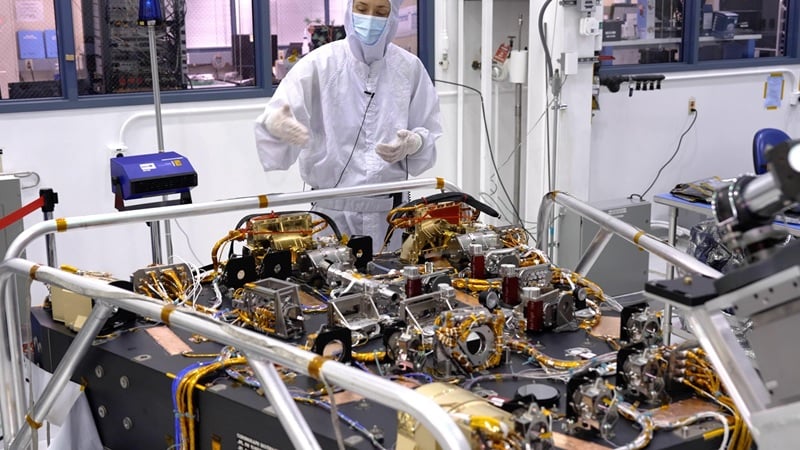
Roman’s coronagraph optical bench at JPL. Inside, two CCD201-20 EMCCDs will count individual photons to see a planet a billion times fainter than its star. Image used courtesy of NASA and JPL
An EMCCD requires its own readout electronics, and these must be tuned for gain-register clocking and to handle immensely variable frame rates (the two cameras run between 0.01 fps and 1000 fps depending on the mode used). To accomplish this, JPL reached out to Nüvü Caméras, a Montreal-based camera electronics company that specializes in EMCCD controller adaptation for scientific applications.
Here, we have an illustration of unique vendor interactions: a single spacecraft capable of operating two entirely unrelated detector architectures, sourced from different divisions of the same company, while relying on two unrelated electronics vendors, an ocean apart. Why? All because the physics of two measurement problems don’t overlap.
An American-Belgian Amplifier That Gets the Bits Home
Without downlink, there is no data. And that data will come back to Earth at nearly 1.4 terabytes per day at peak (for comparison, the James Webb typically downlinks 250 GB daily). Crossing the million miles back to Earth via a Ka-band radio carrier takes significant RF output power, and at those frequencies, traveling-wave tube amplifiers (TWTA) beat solid-state alternatives based on power efficiency—a key factor in space missions.
The decades spent pushing TWTA technology forward were spearheaded by NASA’s own Glenn Research Center. There, NASA engineers hold much of the credit for the R&D of high-efficiency, high-power Ka-band tubes that are present on countless NASA missions today. The hardware itself, though, also crossed an ocean to be included in the build. The 32-GHz band, 76 Watt TWTA was fabricated by the Belgium-based Thales Alenia Space, which also manufactured a similar 26-GHz band, 52-Watt TWTA for the James Webb telescope.
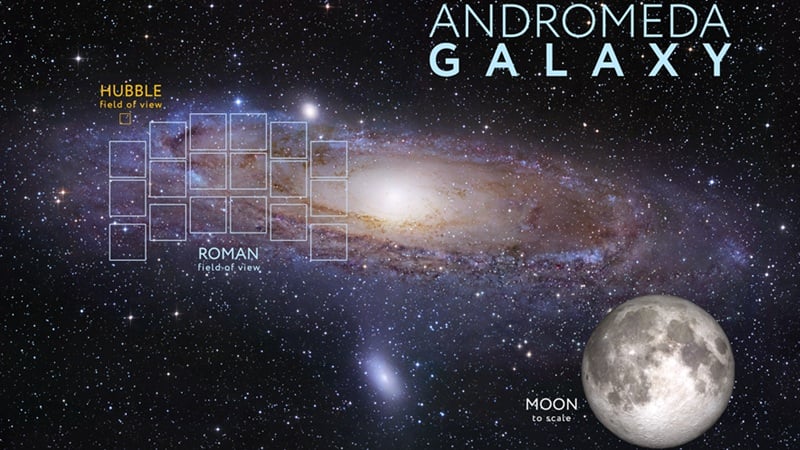
The Andromeda Galaxy, framed by Hubble's field of view (yellow) and Roman's (blue); a hundredfold difference in field of view built on diverse hardware. Image used courtesy of NASA
The utilization of this tube continues a long line of vacuum-tube RF technology development that has yet to be superseded by more modern options. In fact, Roman’s TWTA is a direct descendant of Cassini’s 32 GHz tubes, which in turn were developed based on the traveling-wave tubes built by Hughes for the Voyager missions in the 1970s.
One Photon’s Journey
It’s unlikely that any of these parts will get their own press conference in the coming weeks and months as we use Roman to see more of the universe than we’ve ever seen before. But strung together, these companies map the real shape of space components and supply chains—a small design house handling ASIC design, a Canadian firm helping coronagraph readouts, and NASA itself amplifying the data back home.
Roman’s mirror and its similarities to Hubble will take most of the headlines in the future, but the signal chain behind the lens is what will turn starlight into bits a million miles from the nearest technician. Each link in that chain was forged deliberately and with great care so that we can look to the future as we observe the ancient past.