Facebook
 Google
 GitHub
 Linkedin
Ambarella Debuts Standalone AI Accelerator for Physical AI Designs
The X7 runs on 2-5 W, connects over PCIe Gen 3 or USB 3.2, and uses the same CVflow engine already in over 50 million of the company’s AI SoCs.
Ambarella has launched the X7, its first standalone AI accelerator, designed to add physical AI inference to existing host processors without replacing the main SoC. The X7 operates at 2-5W and connects to host systems via a single-lane PCIe Gen 3 or USB 3.2 interface. The chip is sampling now, and Ambarella is making evaluation kits available to qualified customers through its XCalibur reference design.
The X7 addresses a specific gap in the edge AI market: Many deployed systems in security, industrial, and transportation applications were designed before modern AI workloads existed, and replacing those platforms entirely is expensive and often impractical. The X7 offers a path to add AI inference as a peripheral component, using an accelerator architecture rather than a full SoC.
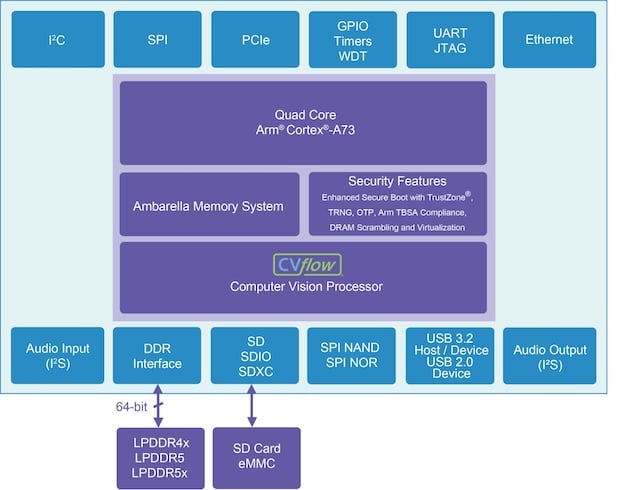
Ambarella X7 processor block diagram
CVflow Engine and Physical AI Capabilities
The X7 is built around Ambarella's third-generation CVflow inference engine, the same architecture that powers the company's CV-series SoCs. Ambarella says CVflow is currently running in more than 50 million shipped AI SoCs, giving the engine a track record in production deployments across security cameras, automotive ADAS systems, and robotics platforms.
Ambarella defines physical AI as the ability for machines to perceive, reason, and act in the physical world. In practice for the X7, that translates to running convolutional neural networks, vision transformers, multimodal transformers, and hybrid models simultaneously on the accelerator while the host processor handles system management and I/O.
The 2-5W power envelope is significant because it keeps the X7 within the thermal budget of existing embedded platforms that were not originally designed with AI acceleration in mind. Adding a 50W or 100W accelerator to a deployed security camera or kiosk is not feasible; a 2-5W device can often slot in without mechanical or thermal redesign.
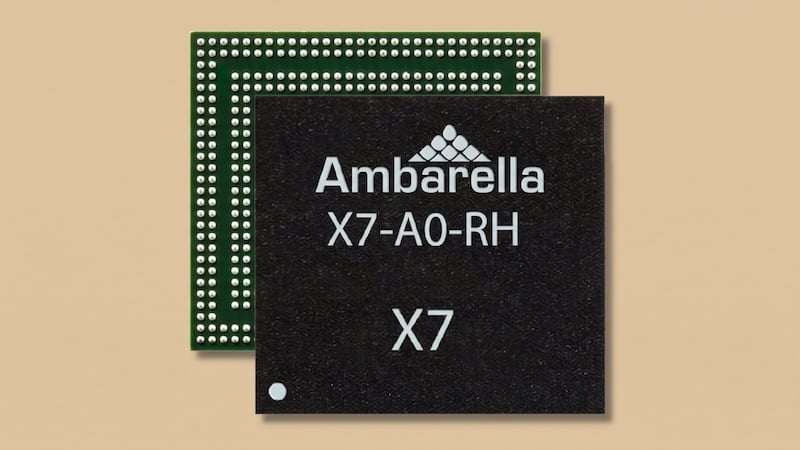
The Ambarella X7 processor is provided in a 16 mm x 16 mm FC TFBGA package with 0.5 mm ball pitch.
The X7 connects to host processors via a single-lane PCIe Gen 3 link or USB 3.2, with the PCIe interface delivering throughput above 840 MB/s on the XCalibur reference design. That bandwidth is sufficient to stream multiple video feeds and return inference results to the host in real time. The X7 Product Brief is available behind a registration wall.
XCalibur Reference Design and Software Tools
Ambarella is packaging the X7 into the XCalibur, a standard M.2 2280 form-factor card with integrated LPDDR5 memory. The M.2 form factor is widely supported in embedded computing platforms, which lowers the mechanical integration barrier for OEMs retrofitting existing products. Ambarella plans to make complete XCalibur design files available to customers for custom implementations.
On the software side, the X7 uses Ambarella's Cooper Developer Platform, which provides compiler, quantization, and profiling tools, along with C++ and Python runtime APIs. Because the X7 shares the CVflow architecture with Ambarella's SoC products, models developed for CV-series chips can run on the X7 with minimal porting effort.
Ambarella has announced distribution and integration partnerships alongside the X7 launch. Capgemini will support enterprise-scale deployments, while Macnica will handle distribution to small and medium businesses, OEMs, and system integrators across the Americas and EMEA regions. Ambarella has also announced collaborations with ZEDEDA for edge orchestration and Ultralytics for the YOLO model ecosystem.
Target applications for the X7 include physical security and retail analytics, industrial inspection and quality control, mobile robots and drones, intelligent transportation systems, and critical infrastructure monitoring. Enterprise edge devices such as kiosks, point-of-sale terminals, and gateways are also on the target list.
All images used courtesy of Ambarella.
Related Content