Facebook
 Google
 GitHub
 Linkedin
Arm Releases First-Ever Silicon Product to Solve Agentic AI Challenges
In a landmark moment in its 35-year history, Arm has debuted its own silicon product, the AGI CPU, built on the Arm Neoverse platform.
Arm has launched the Arm AGI CPU, the company’s first-ever production silicon offering. Previously just an intellectual property licensing firm, Arm’s move into chip production comes at a time when autonomous AI is driving compute demand, and data centers are scrambling.

At the company's announcement event, Arm CEO holds the new Arm AGI CPU.
At the company's announcement event, All About Circuits heard details of the new Arm AGI CPU from Arm's CEO, Rene Haas, and its EVP of cloud AI, Mohamed Awad.
Arm AGI CPU Architecture and Performance
The Arm AGI CPU is built on the Neoverse V3 architecture, with a dual-chiplet design, and manufactured on a 3-nm process node. The chip has up to 136 Neoverse V3 cores, each running at up to 3.7 GHz.
“We are now in a new business for Arm, supplying CPUs as chips,” Haas said. “The biggest reason we're doing this is that our partners have asked for it. But we're also really doing this to solve the problem that, as agentic AI becomes mainstream, all of the work required to make that happen is CPU-bound.”

Some of the highlights of the Arm AGI CPU.
In addition to raw compute, each AGI CPU core has a dedicated 2 MB of L2 cache and 6 GB/s of memory bandwidth. All of this, plus an integrated compute-and-memory design, helps Arm reduce the memory latency of its chips to sub-100-ns levels to handle dynamic AI workloads.
Features for the Modern Data Center
The AGI CPU’s I/O capabilities are just as notable, featuring 96 lanes of PCIe Gen 6 and support for CXL 3.0. These I/O features enable advanced memory pooling and composable infrastructure, allowing customers to take a modular approach to data center design and dynamically allocate resources to the specific needs of an AI agent's task.
“Ultimately, this is about architectural philosophy. We're not strapped to the past. We don't support Lotus Notes. We just don't do it,” Awad said. “We're focused on only what the AGI data center needs: performance, scale, and efficiency.”
For this reason, Arm has seemingly dedicated all of this chip’s resources to the specific demands of high-throughput AI orchestration rather than legacy computing requirements.
With its architecture, Arm claims that its AGI CPU delivers more than double the performance per rack compared to traditional x86 platforms. The company claims this advantage comes from its rack-first approach, which puts density and thermal management over simple peak-clock performance. In a standard 36-kW, air-cooled configuration, the AGI CPU's efficiency and 300-W thermal design power enable the deployment of 8,160 cores and over 180 TB of low-latency memory. In 200-kW, liquid-cooled environments, the system can support up to 45,696 cores and over 1 PB of memory in a single rack.
Optimizing for Agentic AI
Beyond rack density, Arm engineered its AGI CPU to handle the unique orchestration demands of agentic AI. In these AI workflows, the CPU serves as the primary coordinator, managing data movement and request queuing, while accelerators such as GPUs handle the actual token generation.
“The accelerator generates the tokens, but it's almost like pushing a dump truck up and someone's got to move all that dirt,” Haas said. “The CPUs are the pieces of equipment that move that dirt.”
Arm’s high core count and massive memory bandwidth ensure the processor can keep pace with these AI agents, preventing system-level choking when accelerators are forced to wait for data.
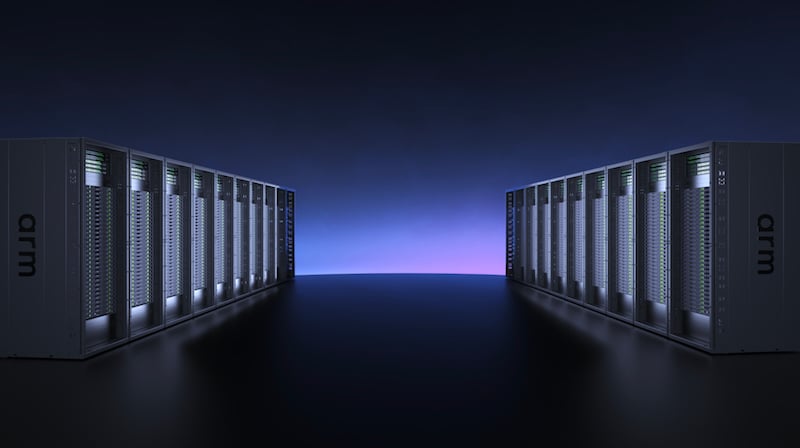
The Arm AGI CPU 1OU Dual Node Reference Server.
To help customers deploy these new chips, Arm also launched a modular 10U Dual Node Reference Server that adheres to Open Compute Project standards. By providing this pre-validated, standards-based blueprint, Arm enables customers to immediately integrate the new chips into existing data centers without the delays of custom hardware engineering.
Market Availability and Outlook
The Arm AGI CPU is now available, supported by a global ecosystem of lead partners and original design manufacturers, including ASRock Rack, Lenovo, Quanta Computer, and Tyan. This immediate availability, combined with the standardization provided by the 10U Dual Node Reference Server, allows cloud service providers to begin scaling agentic AI workloads without the delays typically associated with proprietary hardware development.
By delivering a product that balances high-performance orchestration with power efficiency, Arm has transitioned from providing blueprints to architecting the physical foundation of the AI cloud.
“If anyone thinks that this is something that is going to go away, it's a little bit of an ostrich syndrome,” Haas said. “This is here with us, and it's really changed how people think about computing.”
All images used courtesy of Arm.
Related Content