Facebook
 Google
 GitHub
 Linkedin
At CES, Ambarella Unwraps Edge AI 8K Vision SoC and New Developer Zone
Today at CES, Ambarella unveiled an SoC with multi-sensor perception, multi-stream video, and very low power consumption.
Ambarella came to CES today with a big announcement: it has released its newest edge AI vision processor, the CV7 edge AI vision system-on-chip (SoC). The CV7 features high dynamic range (HDR) multi-stream 8K video capability for use in a wide variety of consumer and commercial video products. The CV7 targets sports and drones, security cameras, and automotive vision systems.

The chip may benefit AI-based 8K cameras, multi-imager enterprise security cameras, aerial drones, industrial automation, multi-stream automotive designs, and high-performance video conferencing devices.
The CV7 uses 20% less power than the company’s prior flagship vision processors. To achieve such power reduction, the company manufactured the chip on Samsung’s 4-nm fabrication technology. The SoC's parallel processing algorithms promote further power reductions.
All About Circuits spoke with Ambarella's team to learn more about the chip ahead of its release.
A Leap Beyond Ambarella's Past Flagship SoCs
Ambarella designed the CV7 to expand the company’s existing portfolio of AI vision products, offering greater capabilities and lower power consumption. In particular, the CV7 comes with significant performance improvements over Ambarella’s previous flagship SoCs, the CV5 and CV72. It comes with double the CPU performance, a 2.5x improvement in AI performance over the CV5 and 33% over the CV72, and 20% lower power consumption than either.
The SoC AI utilizes both convolutional neural network (CNN) and vision transformer (ViT) algorithms, taking advantage of the different strengths of each. While CNN algorithms excel at close-in objects, ViT algorithms excel at the whole picture. The combination results in an edge AI SoC that is faster and more effective, with lower power requirements than many, if not most, alternatives. The CV7 transformer support includes large language models (LLMs), vision-language models (VLMs), and vision-language action models (VLAs).
Key Features of the CV7
The CV7 is built around Ambarella’s third-generation CVflow AI accelerator and includes an advanced image signal processor (ISP). It features a quad-core Arm Cortex-A73 CPU running at 2.0 GHz and supports a 64-bit LPDDR5 DRAM interface. The platform can handle flexible video configurations, including dual 8Kp30, single 8Kp60, single 4Kp240, or quad 4Kp30 streams, with support for up to 12 total input streams. Hardware-accelerated video encoding and decoding are supported for H.264, H.265, and MJPEG.
The ISP supports night vision and AI-enhanced imaging, enabling image capture at extremely low light levels down to 0.01 lux. Additional features include an integrated LCD driver and high-speed connectivity options, including USB 3.2, Wi-Fi, and Bluetooth Low Energy. The SoC also offers a wide range of industry-standard I/O interfaces, including I2C, SPI, PCIe, UART, JTAG, Ethernet, and SD/SDIO/SDXC.
The CV7 does not appear to have a product page on Ambarella's website, but you can register to download the CV7 Product Brief.
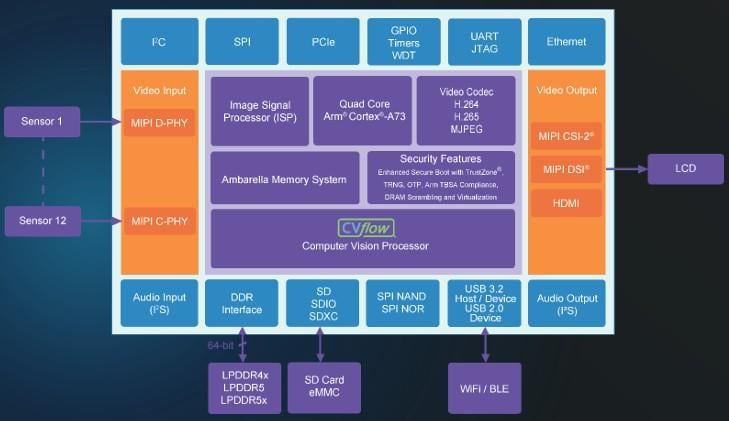
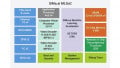
Ambarella CV7 block diagram.
For security, it incorporates TrustZone support, secure boot, a true random number generator (TRNG), one-time programmable (OTP) memory, DRAM scrambling, and virtualization capabilities.
“What we see that's new on the security side is being able to run VLMs, those type of LLM-type models on the camera itself,” said Jerome Gigot, Ambarella's VP of marketing for edge AI products. “Now, instead of just doing object detection or license plate recognition, you can really use natural language to program your camera.”
For video processing, the SoC provides high dynamic range (HDR) capture, fisheye camera dewarping, and dual-fisheye merging. It also includes 3D motion-compensated temporal filtering (MCTF). Multi-stream capability can bring drones and sports cameras additional viewpoints. Combining two 8K streams provides complete 360 x 360 coverage for action capture, security, or automotive situational awareness.
Developer Zone Evaluation and Deployment Platform
Ambarella made another major announcement today: its new Ambarella Developer Zone (DevZone), a platform for development, evaluation, and deployment. DevZone was created to accelerate development with Amarella products by offering optimized models and low-code/no-code agentic blueprints. It consists of three modules:
- Cooper model garden: A collection of validated, optimized models
- Learning and onboarding library: Application notes, training, and tutorial material
- Agentic blueprints: Templates allowing low- or no-code agent and workflow development
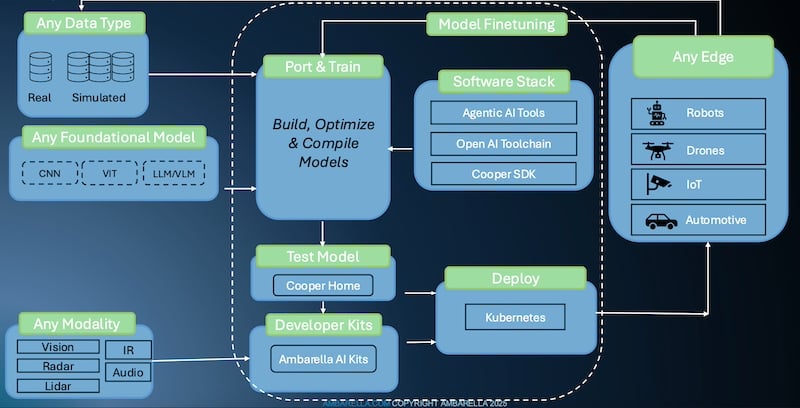
Ambarella's developer workflow.
“The goal is to enable a workflow where partners can port and train foundational models, build and compile them, test them on developer kits, and deploy using Kubernetes,” said Muneyb Minhazuddin, Ambarella's customer growth officer. “Customers get an open and developer-enabled ecosystem, proven AI stacks, and faster scalability.”
Prior to this introduction, Ambarella offered a broad set of SoCs, evaluation kits, operating systems, and core SDKs. The DevZone provides tools and knowledge to help developers quickly gain AI expertise and deliver AI value. DevZone covers the new CV7 and previous Ambarella edge AI SoCs. CV7 SoC samples are available now.
“The edge AI markets we serve are evolving rapidly, and our partner ecosystem needs a way to stay ahead of the curve,” said Minhazuddin. “The Ambarella Developer Zone reduces friction, while giving partners deeper access. It is a foundational part of opening our ecosystem and supporting broader go-to-market collaboration.”
All images used courtesy of Ambarella.