
 Facebook
 Google
 GitHub
 Linkedin
Black History Month Spotlight: Jerry Lawson, Father of the Game Cartridge
You can thank Jerry Lawson for blazing a trail for beloved gaming consoles, including Atari, Nintendo, X-box, and PlayStation.
Jerry Lawson’s work changed video gaming forever. As the lead engineer behind the Fairchild Channel F, the first home console with interchangeable game cartridges, he laid the foundation for modern gaming. His contributions, once overlooked, are now recognized as essential to the industry’s development.
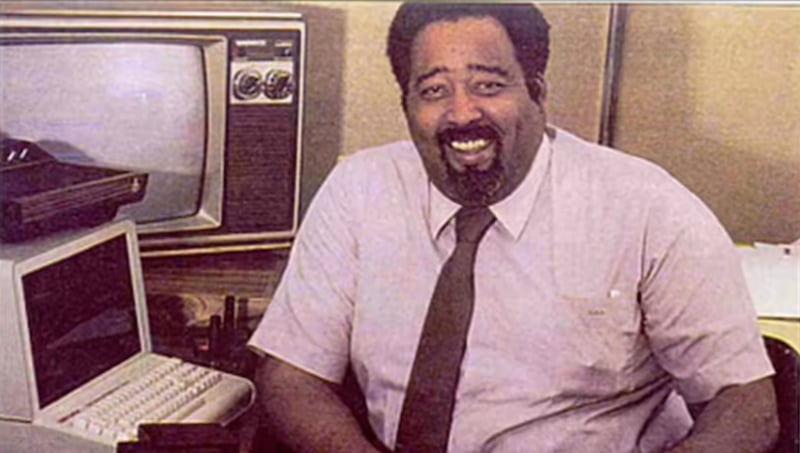
Jerry Lawson’s work is widely recognized for paving the way for modern video games. Here, he is pictured c. 1980. Image used courtesy of Museum of Play/Estate of Jerry Lawson via Wikimedia Commons
From Brooklyn to Silicon Valley
Born in Brooklyn, New York, on December 1, 1940, Gerald Anderson Lawson showed an early interest in electronics. Encouraged by his mother and inspired by inventor George Washington Carver, Lawson spent his youth experimenting with technology. He built his own ham radio station, repaired neighborhood televisions, and by age 13, earned an amateur radio license.
Lawson briefly attended Queens College and City College of New York, but his preference for hands-on engineering led him to leave without completing a degree. Instead, he worked in the electronics industry, taking on roles at ITT and Federal Electric, where he gained experience in radar systems and military-grade electronics.
By the late 1960s, Silicon Valley was on the rise, attracting top talent in the semiconductor industry. Lawson and his wife, Catherine, relocated to Palo Alto, California, where he joined Fairchild Semiconductor as a field applications engineer. There, he worked with integrated circuits amid what would eventually be recognized as a tech revolution that enabled the world as we now know it.
Lawson’s Work at Fairchild
Fairchild Semiconductor was a leader in transistor and microprocessor technology, with its co-founder, Robert Noyce, realizing the world’s first silicon microchip and later co-founding Intel. During his time at Fairchild, Lawson brushed shoulders with some of the biggest Silicon Valley pioneers, including Apple founders Steve Wozniak and Steve Jobs, as a member of the Homebrew Computer Club. While Lawson’s technical expertise earned him positive recognition early on in his career, he would face systemic racism in what was a predominately white industry.
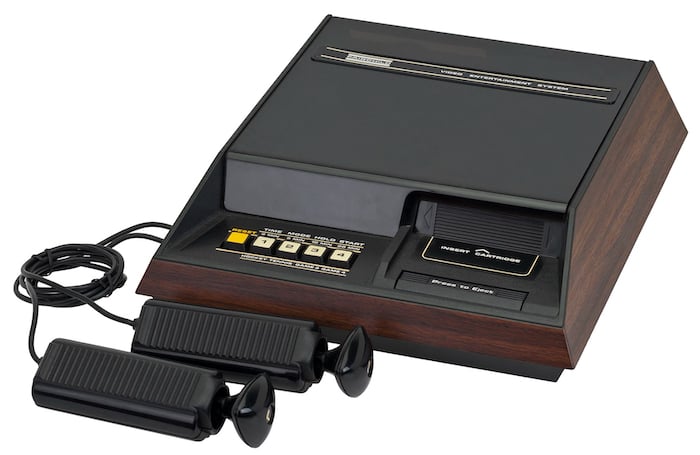
The Fairchild Channel F, with the cartridge slot on the right of the unit. Image used courtesy of Evan-Amos via Wikimedia Commons (CC BY-SA 3.0)
Despite opposition, Lawson would go on to develop Demolition Derby while at Fairchild, one of the earliest arcade games powered by a microprocessor. Built independently in his garage, the game demonstrated the potential of microprocessors in gaming. Fairchild executives took notice and tasked him with leading a team to develop a home gaming console utilizing their F8 microprocessor. By 1976, Lawson had become the director of engineering and marketing for the Fairchild Channel F system—bringing about major changes in the way we play.
Inventing the Video Game Cartridge
Before the Channel F, home consoles like the Magnavox Odyssey had fixed games hardwired into the system. Lawson’s team introduced a new approach: games stored on separate cartridges that could be swapped in and out for a customizable gaming experience.
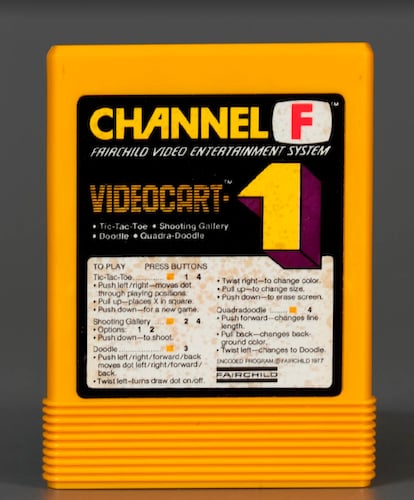
A Channel F game cartridge. Image used courtesy of Google Arts & Culture
The challenge was making cartridges durable and consumer-friendly. Wallace Kirschner and Lawrence Haskel of Alpex Computer Corporation created a prototype, and Lawson’s team refined it for mass production. In short, they designed:
- An eight-way joystick, improving input precision beyond the typical four-way controls
- Error-checking protocols to ensure smooth data transmission
- A pause button, a feature unheard of at the time
- Durable cartridge connectors that could withstand repeated insertions without causing electrical shorts
Crucially, Channel F demonstrated that game software could be sold separately from hardware, paving the way for a whole new gaming business model. However, the console struggled commercially. In 1977, Atari released the 2600 with superior marketing and third-party developer support, quickly surpassing Channel F’s sales. Despite selling only 250,000 units, however, Channel F’s innovations became the standard for gaming hardware.
A Beacon of Game Design Brilliance
Lawson left Fairchild in 1980 to start VideoSoft, one of the first Black-owned video game development companies. The firm specialized in creating software for the Atari 2600, including experimental 3D graphics technology. While VideoSoft never released a blockbuster title, its unfinished projects remain of interest to gaming historians.
Funding challenges eventually forced VideoSoft to close in 1985. Lawson then shifted to consulting, lending his expertise to various tech firms and mentoring young engineers. He collaborated with Stevie Wonder on a voice-controlled device and participated in Stanford University’s mentorship programs, promoting diversity in STEM fields.
Though underappreciated in his time, Lawson’s contributions gained recognition in later years. In 2011, the International Game Developers Association honored him for his work. He passed away the same year from complications related to diabetes. Posthumously, he has been inducted into the World Video Game Hall of Fame. The Gerald A. Lawson fund, established by USC and Take-Two Interactive, launched in Lawson's honor in 2021 to support Black and Indigenous students pursuing game design.












This comment relates only to the need for completeness in the journalistic 5 Ws (Who What Where When, and Why). You say Lawson, “...would face systemic racism in what was a predominately white industry.” Yet in the next paragraph you write, “Fairchild executives took notice and tasked him with leading a team to develop a home gaming console utilizing their F8 microprocessor. By 1976, Lawson had become the director of engineering and marketing for the Fairchild Channel F system…” I suppose the racism statement addresses, Who, barely scratches the surface of What (systemic racism), and asserts the Why (predominantly white industry), no supporting information is provided for more detail as to What and nothing related to Where and When. I have to doubt that someone recognized by Fairchild executives and deservedly put in such leadership positions was really a victim of systemic racism without supporting evidence.